

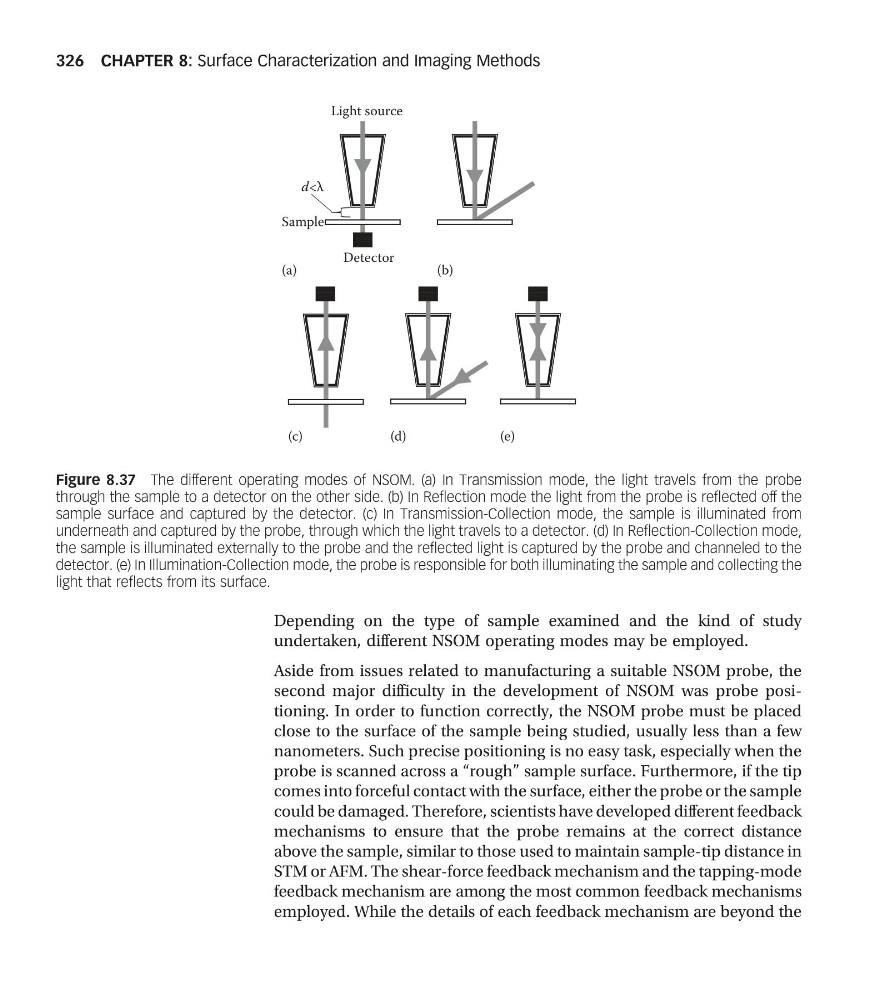
Depending on the type of sample examined and the kind of study
undertaken, different NSOM operating modes may be employed.
Aside from issues related to manufacturing a suitable NSOM probe, the
second major difficulty in the development of NSOM was probe positioning. In order to function correctly, the NSOM probe must be placed
close to the surface of the sample being studied, usually less than a few
nanometers. Such precise positioning is no easy task, especially when the
probe is scanned across a “rough” sample surface. Furthermore, if the tip
comes into forceful contact with the surface, either the probe or the sample
could be damaged. Therefore, scientists have developed different feedback
mechanisms to ensure that the probe remains at the correct distance
above the sample, similar to those used to maintain sample-tip distance in
STM or AFM. The shear-force feedback mechanism and the tapping-mode
feedback mechanism are among the most common feedback mechanisms
employed. While the details of each feedback mechanism are beyond the
Light source
Sample
d<λ
Detector
(a)
(c)
(d)
(e)
(b)
Figure 8.37 The different operating modes of NSOM. (a) In Transmission mode, the light travels from the probe
through the sample to a detector on the other side. (b) In Reflection mode the light from the probe is reflected off the
sample surface and captured by the detector. (c) In Transmission-Collection mode, the sample is illuminated from
underneath and captured by the probe, through which the light travels to a detector. (d) In Reflection-Collection mode,
the sample is illuminated externally to the probe and the reflected light is captured by the probe and channeled to the
detector. (e) In Illumination-Collection mode, the probe is responsible for both illuminating the sample and collecting the
light that reflects from its surface.
CHAPTER 8: Surface Characterization and Imaging Methods
326
undertaken, different NSOM operating modes may be employed.
Aside from issues related to manufacturing a suitable NSOM probe, the
second major difficulty in the development of NSOM was probe positioning. In order to function correctly, the NSOM probe must be placed
close to the surface of the sample being studied, usually less than a few
nanometers. Such precise positioning is no easy task, especially when the
probe is scanned across a “rough” sample surface. Furthermore, if the tip
comes into forceful contact with the surface, either the probe or the sample
could be damaged. Therefore, scientists have developed different feedback
mechanisms to ensure that the probe remains at the correct distance
above the sample, similar to those used to maintain sample-tip distance in
STM or AFM. The shear-force feedback mechanism and the tapping-mode
feedback mechanism are among the most common feedback mechanisms
employed. While the details of each feedback mechanism are beyond the
Light source
Sample
d<λ
Detector
(a)
(c)
(d)
(e)
(b)
Figure 8.37 The different operating modes of NSOM. (a) In Transmission mode, the light travels from the probe
through the sample to a detector on the other side. (b) In Reflection mode the light from the probe is reflected off the
sample surface and captured by the detector. (c) In Transmission-Collection mode, the sample is illuminated from
underneath and captured by the probe, through which the light travels to a detector. (d) In Reflection-Collection mode,
the sample is illuminated externally to the probe and the reflected light is captured by the probe and channeled to the
detector. (e) In Illumination-Collection mode, the probe is responsible for both illuminating the sample and collecting the
light that reflects from its surface.
CHAPTER 8: Surface Characterization and Imaging Methods
326