

scope of this text, the essential idea behind each mechanism is that the
probe is oscillated at a certain frequency and the force that is placed on
the probe as it approaches the surface is monitored. By using a continuous feedback loop, the probe can be oscillated at the correct height
above the sample. Furthermore, if the tip position is monitored as the
sample is scanned in the xy plane, then topographical information about
the sample can be obtained (much like with AFM or STM) in addition to
any optical information. Finally, to ensure accurate probe positioning, the
entire NSOM instrument is usually operated on a vibration isolation table.
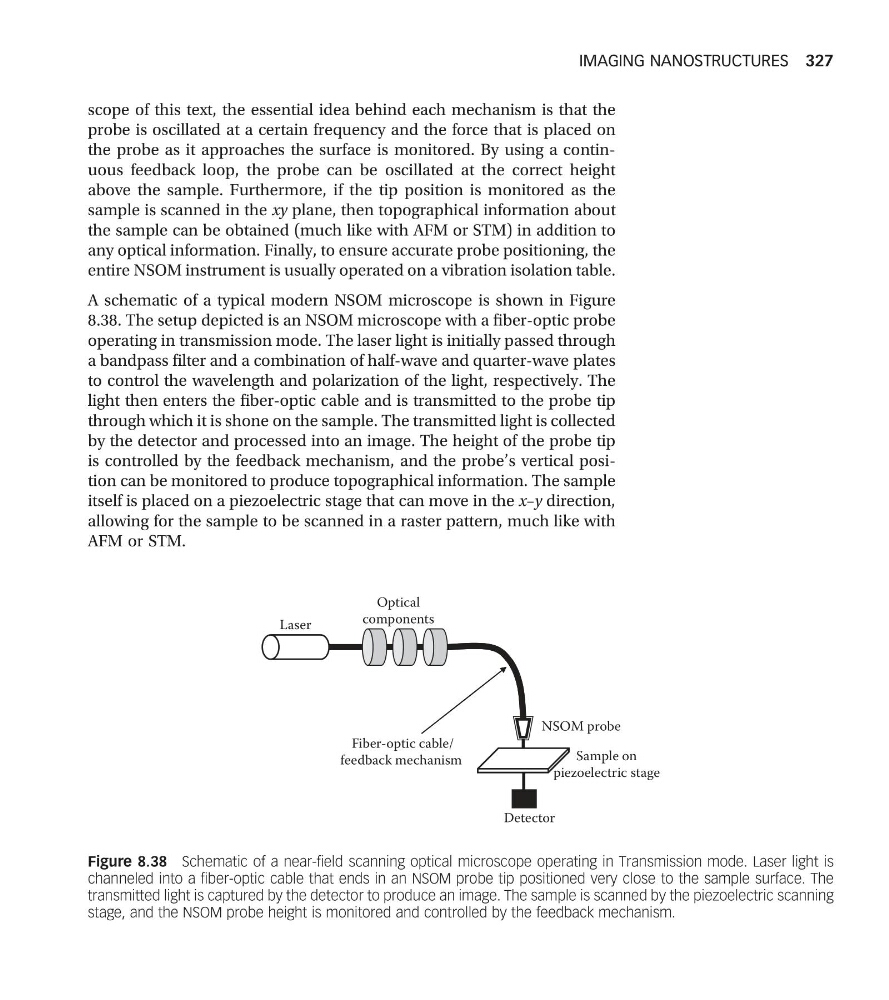
A schematic of a typical modern NSOM microscope is shown in Figure
8.38. The setup depicted is an NSOM microscope with a fiber-optic probe
operating in transmission mode. The laser light is initially passed through
a bandpass filter and a combination of half-wave and quarter-wave plates
to control the wavelength and polarization of the light, respectively. The
light then enters the fiber-optic cable and is transmitted to the probe tip
through which it is shone on the sample. The transmitted light is collected
by the detector and processed into an image. The height of the probe tip
is controlled by the feedback mechanism, and the probe’s vertical position can be monitored to produce topographical information. The sample
itself is placed on a piezoelectric stage that can move in the x–y direction,
allowing for the sample to be scanned in a raster pattern, much like with
AFM or STM.
Optical
components
Laser
Fiber-optic cable/
feedback mechanism
NSOM probe
Sample on
piezoelectric stage
Detector
Figure 8.38 Schematic of a near-field scanning optical microscope operating in Transmission mode. Laser light is
channeled into a fiber-optic cable that ends in an NSOM probe tip positioned very close to the sample surface. The
transmitted light is captured by the detector to produce an image. The sample is scanned by the piezoelectric scanning
stage, and the NSOM probe height is monitored and controlled by the feedback mechanism.
IMAGING NANOSTRUCTURES 327
probe is oscillated at a certain frequency and the force that is placed on
the probe as it approaches the surface is monitored. By using a continuous feedback loop, the probe can be oscillated at the correct height
above the sample. Furthermore, if the tip position is monitored as the
sample is scanned in the xy plane, then topographical information about
the sample can be obtained (much like with AFM or STM) in addition to
any optical information. Finally, to ensure accurate probe positioning, the
entire NSOM instrument is usually operated on a vibration isolation table.
A schematic of a typical modern NSOM microscope is shown in Figure
8.38. The setup depicted is an NSOM microscope with a fiber-optic probe
operating in transmission mode. The laser light is initially passed through
a bandpass filter and a combination of half-wave and quarter-wave plates
to control the wavelength and polarization of the light, respectively. The
light then enters the fiber-optic cable and is transmitted to the probe tip
through which it is shone on the sample. The transmitted light is collected
by the detector and processed into an image. The height of the probe tip
is controlled by the feedback mechanism, and the probe’s vertical position can be monitored to produce topographical information. The sample
itself is placed on a piezoelectric stage that can move in the x–y direction,
allowing for the sample to be scanned in a raster pattern, much like with
AFM or STM.
Optical
components
Laser
Fiber-optic cable/
feedback mechanism
NSOM probe
Sample on
piezoelectric stage
Detector
Figure 8.38 Schematic of a near-field scanning optical microscope operating in Transmission mode. Laser light is
channeled into a fiber-optic cable that ends in an NSOM probe tip positioned very close to the sample surface. The
transmitted light is captured by the detector to produce an image. The sample is scanned by the piezoelectric scanning
stage, and the NSOM probe height is monitored and controlled by the feedback mechanism.
IMAGING NANOSTRUCTURES 327