

changes). There are two obvious methods for imaging the surface. In the
first method, known as “constant-height” STM, the tip is held at a constant vertical position and the tunneling current is plotted as a function of
the x–y region scanned. Because the tunneling current is dependent on
the distance between the tip and the surface (h), the surface can be
imaged. The second method, known as “constant-current” STM, is to
maintain a constant tunneling current as the tip is scanned across the
surface by varying the tip’s vertical position. The piezoelectric transducer
moves the tip up or down as the surface is scanned, ensuring that the
tunneling current is maintained at the predetermined value. Essentially,
h remains constant throughout the scanning process, so the instrumentation has to monitor only the changes in the tip’s vertical position
to provide a topographical image of the surface. In practice, this second
method is generally used to generate a surface image.
As with most of the scanning probe microscopies, STM surface images are
typically generated by scanning the tip across the surface in a raster
pattern, or line by line, to create a rectangular grid. In some STM models,
the scanning process is controlled by moving the substrate and not
the tip, which is moved only vertically to maintain a constant tunneling
current.
Example 8.4 Current Changes in STM
Consider a metal surface with an electronic decay length κ of
10 nm
−1
. By how much does the tunneling current change when
the height h between the surface and the STM tip increases from
1.0 nm to 1.1 nm?
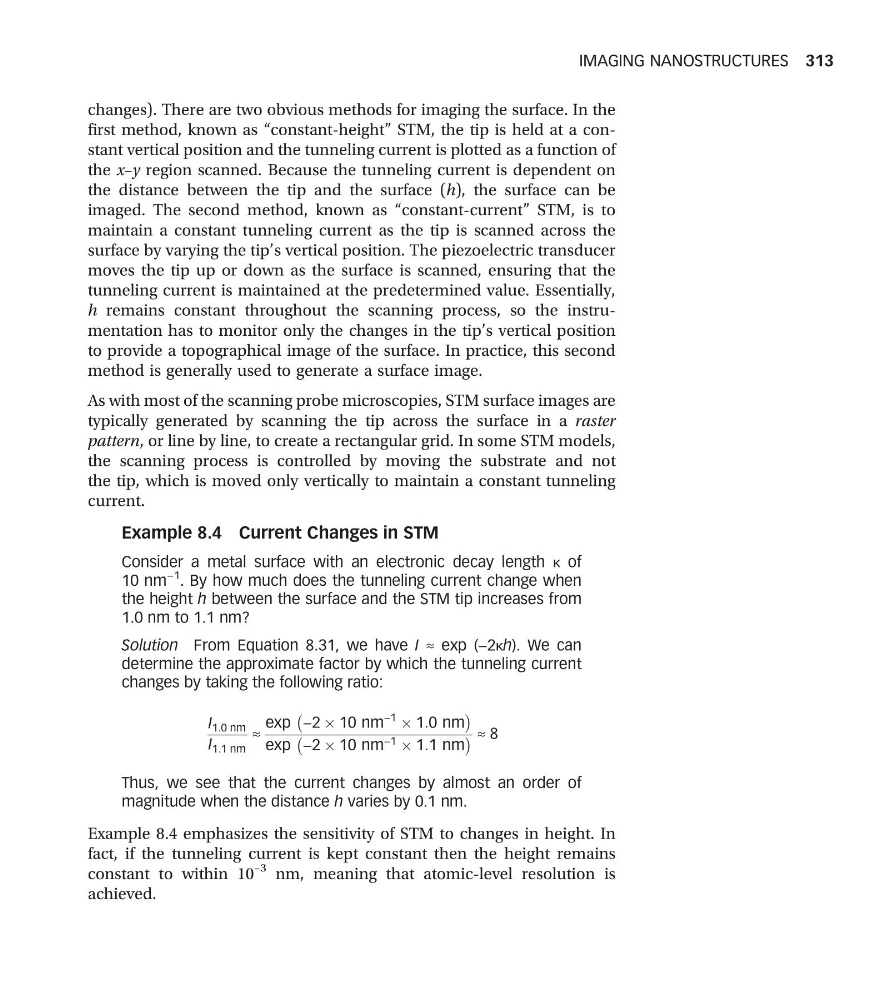
Solution From Equation 8.31, we have I ≈ exp (−2κh). We can
determine the approximate factor by which the tunneling current
changes by taking the following ratio:
I 1:0 nm
I 1:1 nm
≈
exp −2 Â 10 nm
−1
 1:0 nm
À
Á
exp −2 Â 10 nm
−1
 1:1 nm
À
Á ≈ 8
Thus, we see that the current changes by almost an order of
magnitude when the distance h varies by 0.1 nm.
Example 8.4 emphasizes the sensitivity of STM to changes in height. In
fact, if the tunneling current is kept constant then the height remains
constant to within 10
–3 nm, meaning that atomic-level resolution is
achieved.
IMAGING NANOSTRUCTURES 313
first method, known as “constant-height” STM, the tip is held at a constant vertical position and the tunneling current is plotted as a function of
the x–y region scanned. Because the tunneling current is dependent on
the distance between the tip and the surface (h), the surface can be
imaged. The second method, known as “constant-current” STM, is to
maintain a constant tunneling current as the tip is scanned across the
surface by varying the tip’s vertical position. The piezoelectric transducer
moves the tip up or down as the surface is scanned, ensuring that the
tunneling current is maintained at the predetermined value. Essentially,
h remains constant throughout the scanning process, so the instrumentation has to monitor only the changes in the tip’s vertical position
to provide a topographical image of the surface. In practice, this second
method is generally used to generate a surface image.
As with most of the scanning probe microscopies, STM surface images are
typically generated by scanning the tip across the surface in a raster
pattern, or line by line, to create a rectangular grid. In some STM models,
the scanning process is controlled by moving the substrate and not
the tip, which is moved only vertically to maintain a constant tunneling
current.
Example 8.4 Current Changes in STM
Consider a metal surface with an electronic decay length κ of
10 nm
−1
. By how much does the tunneling current change when
the height h between the surface and the STM tip increases from
1.0 nm to 1.1 nm?
Solution From Equation 8.31, we have I ≈ exp (−2κh). We can
determine the approximate factor by which the tunneling current
changes by taking the following ratio:
I 1:0 nm
I 1:1 nm
≈
exp −2 Â 10 nm
−1
 1:0 nm
À
Á
exp −2 Â 10 nm
−1
 1:1 nm
À
Á ≈ 8
Thus, we see that the current changes by almost an order of
magnitude when the distance h varies by 0.1 nm.
Example 8.4 emphasizes the sensitivity of STM to changes in height. In
fact, if the tunneling current is kept constant then the height remains
constant to within 10
–3 nm, meaning that atomic-level resolution is
achieved.
IMAGING NANOSTRUCTURES 313