

SFG spectroscopy has been used extensively to study the conformation
of alkyl chains in monolayers assembled at interfaces. If the alkyl chain is
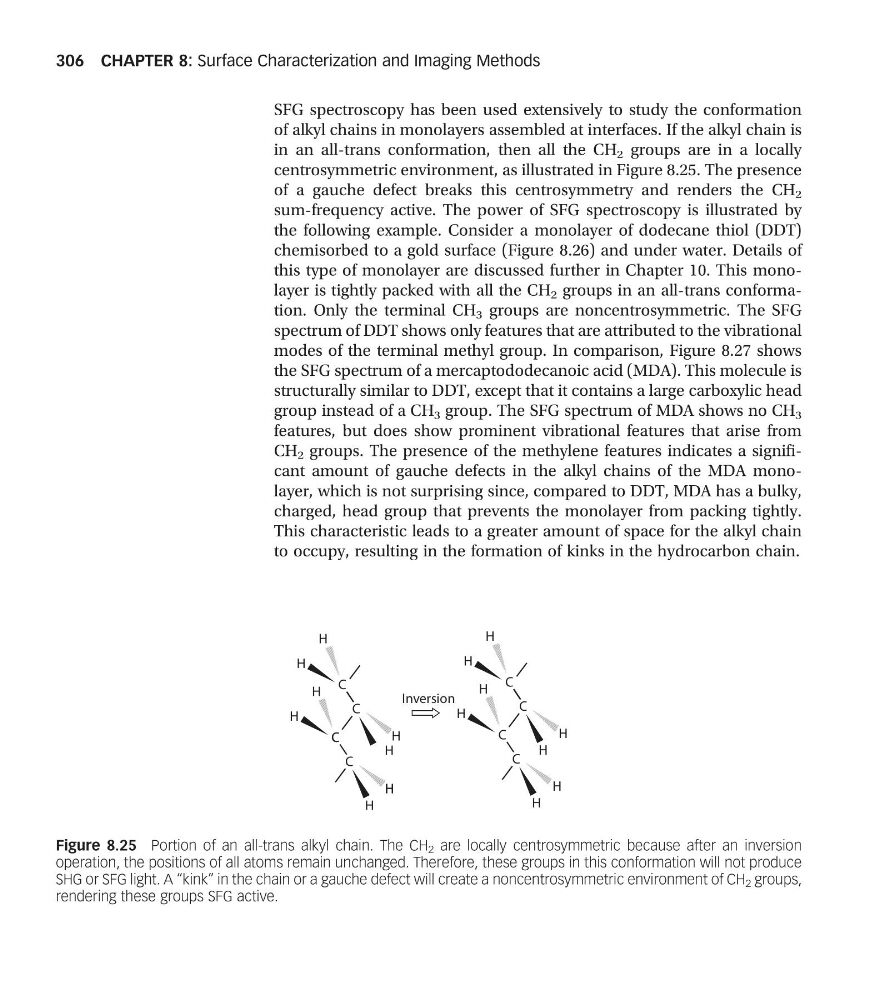
in an all-trans conformation, then all the CH 2 groups are in a locally
centrosymmetric environment, as illustrated in Figure 8.25. The presence
of a gauche defect breaks this centrosymmetry and renders the CH 2
sum-frequency active. The power of SFG spectroscopy is illustrated by
the following example. Consider a monolayer of dodecane thiol (DDT)
chemisorbed to a gold surface (Figure 8.26) and under water. Details of
this type of monolayer are discussed further in Chapter 10. This monolayer is tightly packed with all the CH 2 groups in an all-trans conformation. Only the terminal CH 3 groups are noncentrosymmetric. The SFG
spectrum of DDT shows only features that are attributed to the vibrational
modes of the terminal methyl group. In comparison, Figure 8.27 shows
the SFG spectrum of a mercaptododecanoic acid (MDA). This molecule is
structurally similar to DDT, except that it contains a large carboxylic head
group instead of a CH 3 group. The SFG spectrum of MDA shows no CH 3
features, but does show prominent vibrational features that arise from
CH 2 groups. The presence of the methylene features indicates a significant amount of gauche defects in the alkyl chains of the MDA monolayer, which is not surprising since, compared to DDT, MDA has a bulky,
charged, head group that prevents the monolayer from packing tightly.
This characteristic leads to a greater amount of space for the alkyl chain
to occupy, resulting in the formation of kinks in the hydrocarbon chain.
H
H
H C
H
H C
H
C
H
C
H
C
H
C
H
Inversion
C
C
H
H
C
H
H
H
H
H
Figure 8.25 Portion of an all-trans alkyl chain. The CH 2 are locally centrosymmetric because after an inversion
operation, the positions of all atoms remain unchanged. Therefore, these groups in this conformation will not produce
SHG or SFG light. A “kink” in the chain or a gauche defect will create a noncentrosymmetric environment of CH 2 groups,
rendering these groups SFG active.
CHAPTER 8: Surface Characterization and Imaging Methods
306
of alkyl chains in monolayers assembled at interfaces. If the alkyl chain is
in an all-trans conformation, then all the CH 2 groups are in a locally
centrosymmetric environment, as illustrated in Figure 8.25. The presence
of a gauche defect breaks this centrosymmetry and renders the CH 2
sum-frequency active. The power of SFG spectroscopy is illustrated by
the following example. Consider a monolayer of dodecane thiol (DDT)
chemisorbed to a gold surface (Figure 8.26) and under water. Details of
this type of monolayer are discussed further in Chapter 10. This monolayer is tightly packed with all the CH 2 groups in an all-trans conformation. Only the terminal CH 3 groups are noncentrosymmetric. The SFG
spectrum of DDT shows only features that are attributed to the vibrational
modes of the terminal methyl group. In comparison, Figure 8.27 shows
the SFG spectrum of a mercaptododecanoic acid (MDA). This molecule is
structurally similar to DDT, except that it contains a large carboxylic head
group instead of a CH 3 group. The SFG spectrum of MDA shows no CH 3
features, but does show prominent vibrational features that arise from
CH 2 groups. The presence of the methylene features indicates a significant amount of gauche defects in the alkyl chains of the MDA monolayer, which is not surprising since, compared to DDT, MDA has a bulky,
charged, head group that prevents the monolayer from packing tightly.
This characteristic leads to a greater amount of space for the alkyl chain
to occupy, resulting in the formation of kinks in the hydrocarbon chain.
H
H
H C
H
H C
H
C
H
C
H
C
H
C
H
Inversion
C
C
H
H
C
H
H
H
H
H
Figure 8.25 Portion of an all-trans alkyl chain. The CH 2 are locally centrosymmetric because after an inversion
operation, the positions of all atoms remain unchanged. Therefore, these groups in this conformation will not produce
SHG or SFG light. A “kink” in the chain or a gauche defect will create a noncentrosymmetric environment of CH 2 groups,
rendering these groups SFG active.
CHAPTER 8: Surface Characterization and Imaging Methods
306