

spectroscopy, SFG spectroscopy is surface-specific to within a few
nanometers, whereas ATR methods probe regions within as much as a
few microns from the surface. A theoretical expression for the magnitude
of the SFG signal is given by Equation 8.35:
I SFG = 128π
3 w SFG
hc
3
K SFG K vis K IR
j
j
2 c 2
j j
2 I vis I IR
AT
(8.35)
The signal intensity, I SFG , is the number of SFG photons produced per
laser pulse and depends on the beam intensities (I vis and I IR ), the laser
pulse length (T), the area of overlap of the beams (A), the various geometric Fresnel factors (K), and the second-order susceptibility.
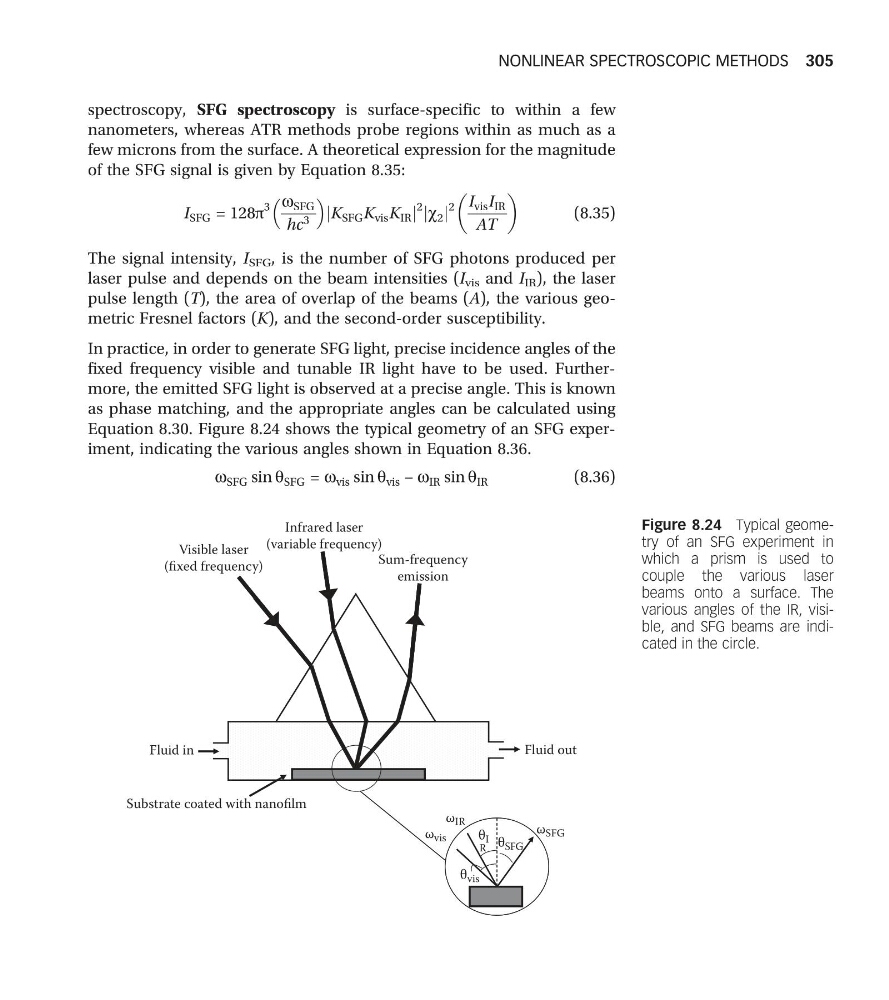
In practice, in order to generate SFG light, precise incidence angles of the
fixed frequency visible and tunable IR light have to be used. Furthermore, the emitted SFG light is observed at a precise angle. This is known
as phase matching, and the appropriate angles can be calculated using
Equation 8.30. Figure 8.24 shows the typical geometry of an SFG experiment, indicating the various angles shown in Equation 8.36.
w SFG sin q SFG = w vis sin q vis − w IR sin q IR
(8.36)
Infrared laser
(variable frequency)
Visible laser
(fixed frequency)
Sum-frequency
emission
Fluid in
Fluid out
Substrate coated with nanofilm
ω IR
ω SFG
ω vis
θ SFG
θ I
R
θ vis
Figure 8.24 Typical geometry of an SFG experiment in
which a prism is used to
couple the various laser
beams onto a surface. The
various angles of the IR, visible, and SFG beams are indicated in the circle.
NONLINEAR SPECTROSCOPIC METHODS 305
nanometers, whereas ATR methods probe regions within as much as a
few microns from the surface. A theoretical expression for the magnitude
of the SFG signal is given by Equation 8.35:
I SFG = 128π
3 w SFG
hc
3
K SFG K vis K IR
j
j
2 c 2
j j
2 I vis I IR
AT
(8.35)
The signal intensity, I SFG , is the number of SFG photons produced per
laser pulse and depends on the beam intensities (I vis and I IR ), the laser
pulse length (T), the area of overlap of the beams (A), the various geometric Fresnel factors (K), and the second-order susceptibility.
In practice, in order to generate SFG light, precise incidence angles of the
fixed frequency visible and tunable IR light have to be used. Furthermore, the emitted SFG light is observed at a precise angle. This is known
as phase matching, and the appropriate angles can be calculated using
Equation 8.30. Figure 8.24 shows the typical geometry of an SFG experiment, indicating the various angles shown in Equation 8.36.
w SFG sin q SFG = w vis sin q vis − w IR sin q IR
(8.36)
Infrared laser
(variable frequency)
Visible laser
(fixed frequency)
Sum-frequency
emission
Fluid in
Fluid out
Substrate coated with nanofilm
ω IR
ω SFG
ω vis
θ SFG
θ I
R
θ vis
Figure 8.24 Typical geometry of an SFG experiment in
which a prism is used to
couple the various laser
beams onto a surface. The
various angles of the IR, visible, and SFG beams are indicated in the circle.
NONLINEAR SPECTROSCOPIC METHODS 305