

arrangement of molecules, but also on the chromophore orientation at
the molecular level.
In addition to measuring the NLO response from a nanomaterial, SHG
can also be used to follow the assembly process in real time, obtain
the density of NLO-active chromophores within the assembly, and even
image ordered domains in nanofilms. By obtaining the relative amount
of SHG generated from s- and p-polarized light, the orientation of the
NLO-active chromophore with respect to the surface normal can also be
calculated.
8.6.3 Sum-frequency generation spectroscopy
Photons of two different frequencies (w 1 and w 2 ) can combine to generate
light at the sum frequency (w SFG = w 1 + w 2 ). Similar to SHG, SFG is
produced from noncentrosymmetric environments. SFG is routinely used
as an IR spectroscopic method to obtain molecular structure information
of nanofilms confined at interfaces. In this technique one of the two
frequencies is fixed at a visible wavelength, typically 532 nm (w vis ). The
other frequency is variable in the IR region (w IR ). The two light beams are
overlapped on a surface and the intensity of the SFG beam is measured.
It turns out that this intensity is greatly enhanced when w IR is in resonance with a vibrational mode of the molecule at the surface. Thus, a plot
of the SHG intensity versus w IR provides a vibrational spectrum of
molecules on the surface. It is worth noting that in contrast to ATR-FTIR
COOH
Acceptor group
N
N
π-conjugated “bridge”
O
Donor group
(CH 2 ) 10 CH 3
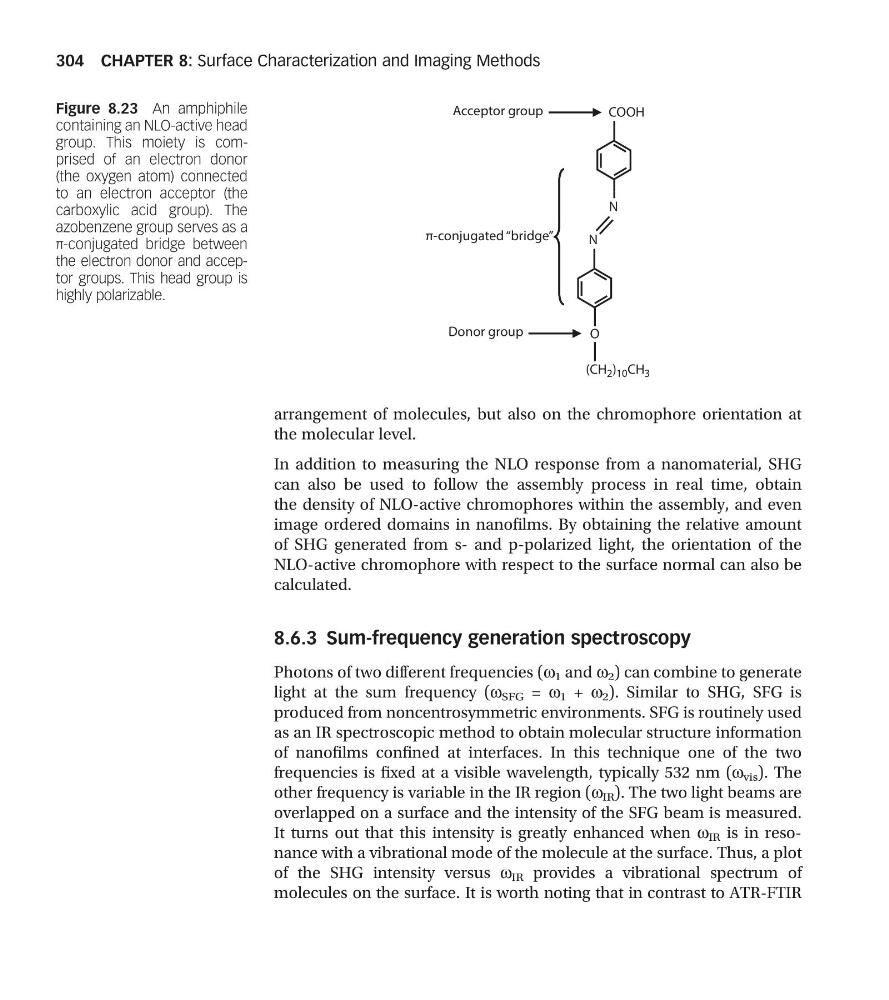
Figure 8.23 An amphiphile
containing an NLO-active head
group. This moiety is comprised of an electron donor
(the oxygen atom) connected
to an electron acceptor (the
carboxylic acid group). The
azobenzene group serves as a
π-conjugated bridge between
the electron donor and acceptor groups. This head group is
highly polarizable.
CHAPTER 8: Surface Characterization and Imaging Methods
304
the molecular level.
In addition to measuring the NLO response from a nanomaterial, SHG
can also be used to follow the assembly process in real time, obtain
the density of NLO-active chromophores within the assembly, and even
image ordered domains in nanofilms. By obtaining the relative amount
of SHG generated from s- and p-polarized light, the orientation of the
NLO-active chromophore with respect to the surface normal can also be
calculated.
8.6.3 Sum-frequency generation spectroscopy
Photons of two different frequencies (w 1 and w 2 ) can combine to generate
light at the sum frequency (w SFG = w 1 + w 2 ). Similar to SHG, SFG is
produced from noncentrosymmetric environments. SFG is routinely used
as an IR spectroscopic method to obtain molecular structure information
of nanofilms confined at interfaces. In this technique one of the two
frequencies is fixed at a visible wavelength, typically 532 nm (w vis ). The
other frequency is variable in the IR region (w IR ). The two light beams are
overlapped on a surface and the intensity of the SFG beam is measured.
It turns out that this intensity is greatly enhanced when w IR is in resonance with a vibrational mode of the molecule at the surface. Thus, a plot
of the SHG intensity versus w IR provides a vibrational spectrum of
molecules on the surface. It is worth noting that in contrast to ATR-FTIR
COOH
Acceptor group
N
N
π-conjugated “bridge”
O
Donor group
(CH 2 ) 10 CH 3
Figure 8.23 An amphiphile
containing an NLO-active head
group. This moiety is comprised of an electron donor
(the oxygen atom) connected
to an electron acceptor (the
carboxylic acid group). The
azobenzene group serves as a
π-conjugated bridge between
the electron donor and acceptor groups. This head group is
highly polarizable.
CHAPTER 8: Surface Characterization and Imaging Methods
304