

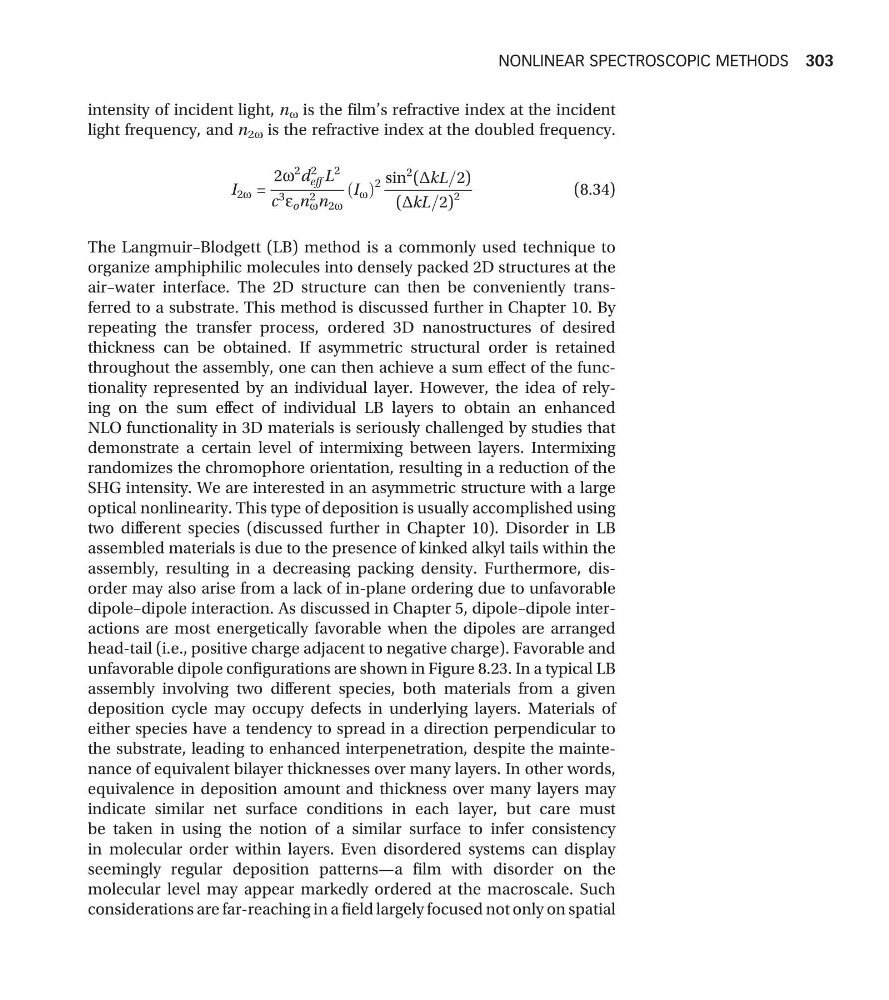
intensity of incident light, n w is the film’s refractive index at the incident
light frequency, and n 2w is the refractive index at the doubled frequency.
I 2w =
2w
2 d
2
eff L
2
c
3 e o n
2
w n 2w
I w
ð Þ
2 sin
2 (ΔkL=2)
(ΔkL=2)
2
(8.34)
The Langmuir–Blodgett (LB) method is a commonly used technique to
organize amphiphilic molecules into densely packed 2D structures at the
air–water interface. The 2D structure can then be conveniently transferred to a substrate. This method is discussed further in Chapter 10. By
repeating the transfer process, ordered 3D nanostructures of desired
thickness can be obtained. If asymmetric structural order is retained
throughout the assembly, one can then achieve a sum effect of the functionality represented by an individual layer. However, the idea of relying on the sum effect of individual LB layers to obtain an enhanced
NLO functionality in 3D materials is seriously challenged by studies that
demonstrate a certain level of intermixing between layers. Intermixing
randomizes the chromophore orientation, resulting in a reduction of the
SHG intensity. We are interested in an asymmetric structure with a large
optical nonlinearity. This type of deposition is usually accomplished using
two different species (discussed further in Chapter 10). Disorder in LB
assembled materials is due to the presence of kinked alkyl tails within the
assembly, resulting in a decreasing packing density. Furthermore, disorder may also arise from a lack of in-plane ordering due to unfavorable
dipole–dipole interaction. As discussed in Chapter 5, dipole–dipole interactions are most energetically favorable when the dipoles are arranged
head-tail (i.e., positive charge adjacent to negative charge). Favorable and
unfavorable dipole configurations are shown in Figure 8.23. In a typical LB
assembly involving two different species, both materials from a given
deposition cycle may occupy defects in underlying layers. Materials of
either species have a tendency to spread in a direction perpendicular to
the substrate, leading to enhanced interpenetration, despite the maintenance of equivalent bilayer thicknesses over many layers. In other words,
equivalence in deposition amount and thickness over many layers may
indicate similar net surface conditions in each layer, but care must
be taken in using the notion of a similar surface to infer consistency
in molecular order within layers. Even disordered systems can display
seemingly regular deposition patterns—a film with disorder on the
molecular level may appear markedly ordered at the macroscale. Such
considerations are far-reaching in a field largely focused not only on spatial
NONLINEAR SPECTROSCOPIC METHODS 303
light frequency, and n 2w is the refractive index at the doubled frequency.
I 2w =
2w
2 d
2
eff L
2
c
3 e o n
2
w n 2w
I w
ð Þ
2 sin
2 (ΔkL=2)
(ΔkL=2)
2
(8.34)
The Langmuir–Blodgett (LB) method is a commonly used technique to
organize amphiphilic molecules into densely packed 2D structures at the
air–water interface. The 2D structure can then be conveniently transferred to a substrate. This method is discussed further in Chapter 10. By
repeating the transfer process, ordered 3D nanostructures of desired
thickness can be obtained. If asymmetric structural order is retained
throughout the assembly, one can then achieve a sum effect of the functionality represented by an individual layer. However, the idea of relying on the sum effect of individual LB layers to obtain an enhanced
NLO functionality in 3D materials is seriously challenged by studies that
demonstrate a certain level of intermixing between layers. Intermixing
randomizes the chromophore orientation, resulting in a reduction of the
SHG intensity. We are interested in an asymmetric structure with a large
optical nonlinearity. This type of deposition is usually accomplished using
two different species (discussed further in Chapter 10). Disorder in LB
assembled materials is due to the presence of kinked alkyl tails within the
assembly, resulting in a decreasing packing density. Furthermore, disorder may also arise from a lack of in-plane ordering due to unfavorable
dipole–dipole interaction. As discussed in Chapter 5, dipole–dipole interactions are most energetically favorable when the dipoles are arranged
head-tail (i.e., positive charge adjacent to negative charge). Favorable and
unfavorable dipole configurations are shown in Figure 8.23. In a typical LB
assembly involving two different species, both materials from a given
deposition cycle may occupy defects in underlying layers. Materials of
either species have a tendency to spread in a direction perpendicular to
the substrate, leading to enhanced interpenetration, despite the maintenance of equivalent bilayer thicknesses over many layers. In other words,
equivalence in deposition amount and thickness over many layers may
indicate similar net surface conditions in each layer, but care must
be taken in using the notion of a similar surface to infer consistency
in molecular order within layers. Even disordered systems can display
seemingly regular deposition patterns—a film with disorder on the
molecular level may appear markedly ordered at the macroscale. Such
considerations are far-reaching in a field largely focused not only on spatial
NONLINEAR SPECTROSCOPIC METHODS 303