

are also used in lasers to generate light of different wavelengths. Selfassembly methods can be used to guide molecular building blocks into
preferred orientations that yield new materials with NLO-active properties. Even though this field is leading the development of next-generation
electronic and computational breakthroughs, fundamental limitations
exist in fabricating functional nanoassemblies for NLO applications.
These limitations arise from the inherent difficulty in obtaining asymmetrically oriented NLO chromophores in layered thin-film assemblies.
As a result, the NLO response does not increase quadratically with the
film thickness, rendering the assembly useless. Layer-by-layer methods,
covered in Chapter 10, seem to be a promising approach to creating
multilayered films containing NLO blocks throughout the 3D assembly.
An ideal NLO-active film would contain hundreds of discrete layers of
highly oriented molecules self-organized on a solid support. In the case of
NLO materials, if electron donor–acceptor chromophores were organized
in such a way that the dipole moments were oriented in the same
direction, then a quadratic increase of the optical second-harmonic signal
would be observed with increasing film thickness (number of bilayers)
as predicted by Equation 8.34, where L is the film thickness, I w is the
Polar molecule
Favorable
(head/tail)
dipole pairing
Unfavorable
dipole pairing
Defect in ordered
layer of molecules
on surface
OH
N
N
C
N
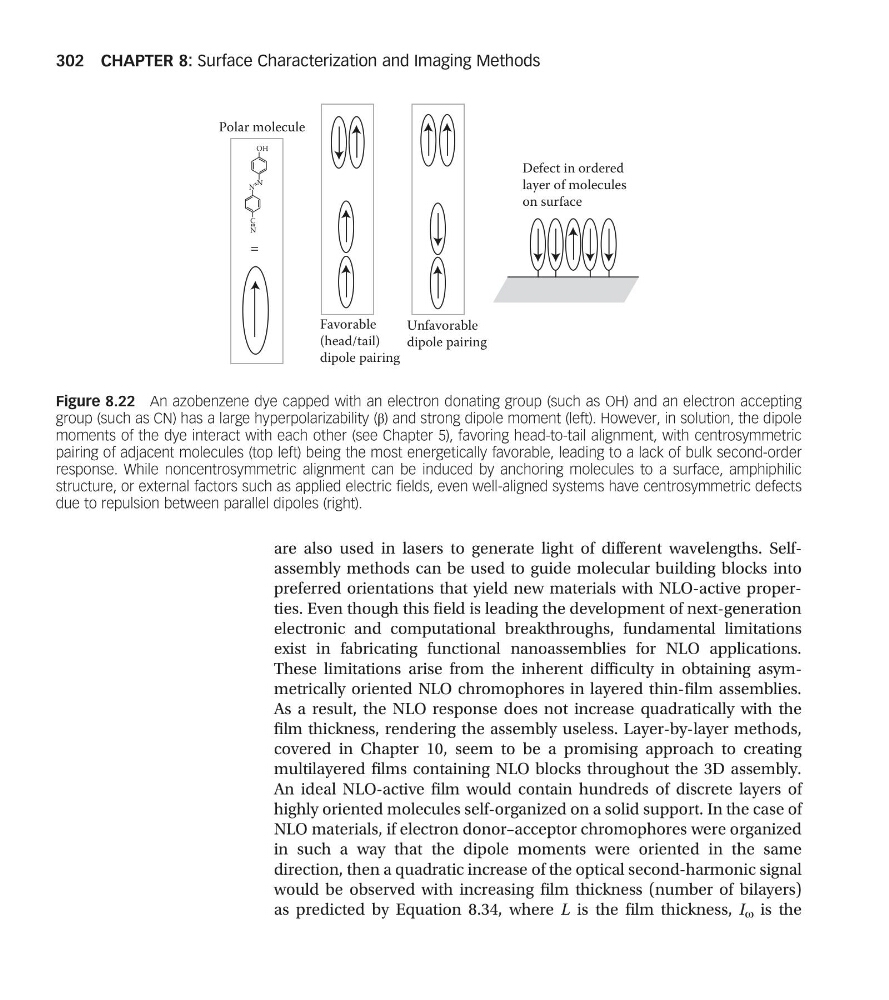
Figure 8.22 An azobenzene dye capped with an electron donating group (such as OH) and an electron accepting
group (such as CN) has a large hyperpolarizability (β) and strong dipole moment (left). However, in solution, the dipole
moments of the dye interact with each other (see Chapter 5), favoring head-to-tail alignment, with centrosymmetric
pairing of adjacent molecules (top left) being the most energetically favorable, leading to a lack of bulk second-order
response. While noncentrosymmetric alignment can be induced by anchoring molecules to a surface, amphiphilic
structure, or external factors such as applied electric fields, even well-aligned systems have centrosymmetric defects
due to repulsion between parallel dipoles (right).
CHAPTER 8: Surface Characterization and Imaging Methods
302
preferred orientations that yield new materials with NLO-active properties. Even though this field is leading the development of next-generation
electronic and computational breakthroughs, fundamental limitations
exist in fabricating functional nanoassemblies for NLO applications.
These limitations arise from the inherent difficulty in obtaining asymmetrically oriented NLO chromophores in layered thin-film assemblies.
As a result, the NLO response does not increase quadratically with the
film thickness, rendering the assembly useless. Layer-by-layer methods,
covered in Chapter 10, seem to be a promising approach to creating
multilayered films containing NLO blocks throughout the 3D assembly.
An ideal NLO-active film would contain hundreds of discrete layers of
highly oriented molecules self-organized on a solid support. In the case of
NLO materials, if electron donor–acceptor chromophores were organized
in such a way that the dipole moments were oriented in the same
direction, then a quadratic increase of the optical second-harmonic signal
would be observed with increasing film thickness (number of bilayers)
as predicted by Equation 8.34, where L is the film thickness, I w is the
Polar molecule
Favorable
(head/tail)
dipole pairing
Unfavorable
dipole pairing
Defect in ordered
layer of molecules
on surface
OH
N
N
C
N
Figure 8.22 An azobenzene dye capped with an electron donating group (such as OH) and an electron accepting
group (such as CN) has a large hyperpolarizability (β) and strong dipole moment (left). However, in solution, the dipole
moments of the dye interact with each other (see Chapter 5), favoring head-to-tail alignment, with centrosymmetric
pairing of adjacent molecules (top left) being the most energetically favorable, leading to a lack of bulk second-order
response. While noncentrosymmetric alignment can be induced by anchoring molecules to a surface, amphiphilic
structure, or external factors such as applied electric fields, even well-aligned systems have centrosymmetric defects
due to repulsion between parallel dipoles (right).
CHAPTER 8: Surface Characterization and Imaging Methods
302