

acentrically (noncentrosymmetrically) ordered and for molecules that
exhibit a large first hyperpolarizability (b). To first order, hyperpolarizability is proportional to dipole moment and to polarizability. Consider an
amphiphile containing a high-b head group (Figure 8.22). The polarizable
head group can be considered as an NLO chromophore, in which lone
pairs on the alkoxy group function as an electron donor and the carboxylic acid group functions as an electron acceptor, with a conjugated
azobenzene structure acting as the polarizable bridge between donor and
acceptor. A monolayer comprised of this molecule produces a highly
oriented assembly with a large net dipole. These conditions meet the
requirement of a strong SHG signal. An additional layer can be added to
the assembly either with the same orientation (asymmetric assembly) or
with the opposite orientation (symmetric assembly). The latter reduces
the SHG signal because of the centrosymmetric nature of the symmetric
bilayer.
Constructing nanoassemblies that have a large NLO response is important to a number of technologies, including optoelectronics (using photons instead of electrons in electronic devices), communications, and
data storage. Materials with efficient frequency-doubling properties
H
H
H
H
H
H
C
H
H
C
H
H
Inversion
C
H
C
H
C Inversion C
C
C
(a)
(b)
C
H
H
H
H
H
H
C
C
C
H
H
C
C
Inversion
C
C
(c)
H
C
H
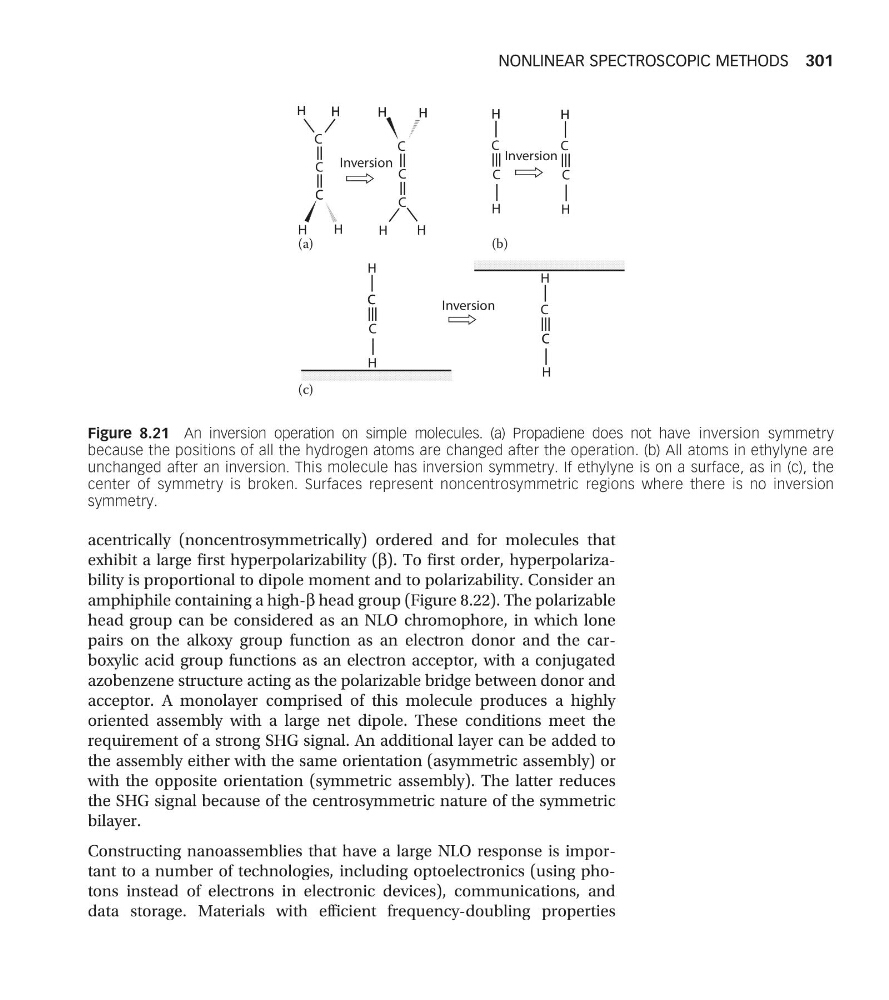
Figure 8.21 An inversion operation on simple molecules. (a) Propadiene does not have inversion symmetry
because the positions of all the hydrogen atoms are changed after the operation. (b) All atoms in ethylyne are
unchanged after an inversion. This molecule has inversion symmetry. If ethylyne is on a surface, as in (c), the
center of symmetry is broken. Surfaces represent noncentrosymmetric regions where there is no inversion
symmetry.
NONLINEAR SPECTROSCOPIC METHODS 301
exhibit a large first hyperpolarizability (b). To first order, hyperpolarizability is proportional to dipole moment and to polarizability. Consider an
amphiphile containing a high-b head group (Figure 8.22). The polarizable
head group can be considered as an NLO chromophore, in which lone
pairs on the alkoxy group function as an electron donor and the carboxylic acid group functions as an electron acceptor, with a conjugated
azobenzene structure acting as the polarizable bridge between donor and
acceptor. A monolayer comprised of this molecule produces a highly
oriented assembly with a large net dipole. These conditions meet the
requirement of a strong SHG signal. An additional layer can be added to
the assembly either with the same orientation (asymmetric assembly) or
with the opposite orientation (symmetric assembly). The latter reduces
the SHG signal because of the centrosymmetric nature of the symmetric
bilayer.
Constructing nanoassemblies that have a large NLO response is important to a number of technologies, including optoelectronics (using photons instead of electrons in electronic devices), communications, and
data storage. Materials with efficient frequency-doubling properties
H
H
H
H
H
H
C
H
H
C
H
H
Inversion
C
H
C
H
C Inversion C
C
C
(a)
(b)
C
H
H
H
H
H
H
C
C
C
H
H
C
C
Inversion
C
C
(c)
H
C
H
Figure 8.21 An inversion operation on simple molecules. (a) Propadiene does not have inversion symmetry
because the positions of all the hydrogen atoms are changed after the operation. (b) All atoms in ethylyne are
unchanged after an inversion. This molecule has inversion symmetry. If ethylyne is on a surface, as in (c), the
center of symmetry is broken. Surfaces represent noncentrosymmetric regions where there is no inversion
symmetry.
NONLINEAR SPECTROSCOPIC METHODS 301