

even ethylyne (Figure 8.21). The symmetry breaking for otherwise centrosymmetric molecules at a surface is due to differences in the interactions of the molecule with the interface versus the bulk. Therefore,
surfaces and interfaces are inherently noncentrosymmetric regions, and
molecules confined to such regions produce SHG and SFG light. This fact
allows SFG and SHG to be used as surface-specific probes to investigate
molecular structure at interfaces. Many nanomaterials are supported on
surfaces and can be probed using such nonlinear optical techniques.
8.6.2 Second-harmonic generation
SHG involves the conversion of frequency w to 2w. Like any second-order
nonlinear optical effect, it requires that the material exhibiting SHG is
noncentrosymmetric and is strongest for regions that are strongly
1,3,5-hexatriene
1-amino-4-nitro butadiene
Donor
μ
μ
μ
H 2 N
NO 2
Acceptor
E
E
No initial dipole
linear response
to applied field
Electron donor
and acceptor
induce nonlinear
response
Polarization response
Centrosymmetric
order, cos 3 θ =0
Non-centrosymmetric
order, cos 3 θ =1
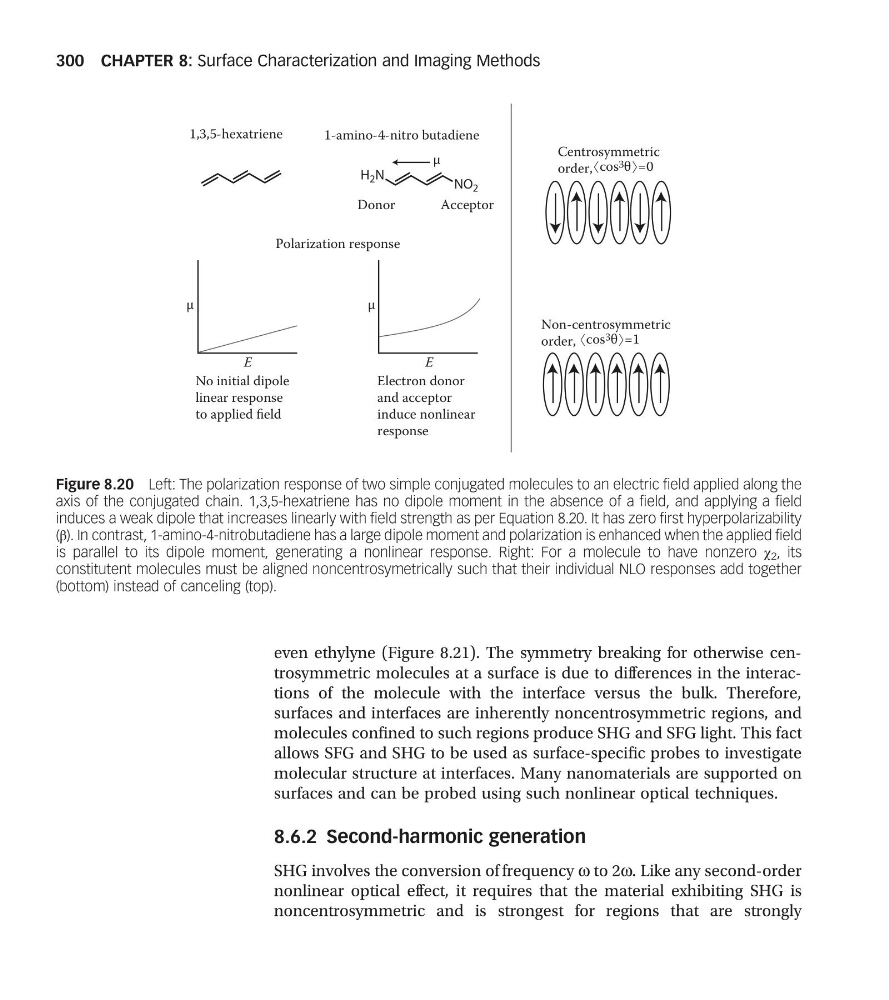
Figure 8.20 Left: The polarization response of two simple conjugated molecules to an electric field applied along the
axis of the conjugated chain. 1,3,5-hexatriene has no dipole moment in the absence of a field, and applying a field
induces a weak dipole that increases linearly with field strength as per Equation 8.20. It has zero first hyperpolarizability
(β). In contrast, 1-amino-4-nitrobutadiene has a large dipole moment and polarization is enhanced when the applied field
is parallel to its dipole moment, generating a nonlinear response. Right: For a molecule to have nonzero χ 2 , its
constitutent molecules must be aligned noncentrosymetrically such that their individual NLO responses add together
(bottom) instead of canceling (top).
CHAPTER 8: Surface Characterization and Imaging Methods
300
surfaces and interfaces are inherently noncentrosymmetric regions, and
molecules confined to such regions produce SHG and SFG light. This fact
allows SFG and SHG to be used as surface-specific probes to investigate
molecular structure at interfaces. Many nanomaterials are supported on
surfaces and can be probed using such nonlinear optical techniques.
8.6.2 Second-harmonic generation
SHG involves the conversion of frequency w to 2w. Like any second-order
nonlinear optical effect, it requires that the material exhibiting SHG is
noncentrosymmetric and is strongest for regions that are strongly
1,3,5-hexatriene
1-amino-4-nitro butadiene
Donor
μ
μ
μ
H 2 N
NO 2
Acceptor
E
E
No initial dipole
linear response
to applied field
Electron donor
and acceptor
induce nonlinear
response
Polarization response
Centrosymmetric
order, cos 3 θ =0
Non-centrosymmetric
order, cos 3 θ =1
Figure 8.20 Left: The polarization response of two simple conjugated molecules to an electric field applied along the
axis of the conjugated chain. 1,3,5-hexatriene has no dipole moment in the absence of a field, and applying a field
induces a weak dipole that increases linearly with field strength as per Equation 8.20. It has zero first hyperpolarizability
(β). In contrast, 1-amino-4-nitrobutadiene has a large dipole moment and polarization is enhanced when the applied field
is parallel to its dipole moment, generating a nonlinear response. Right: For a molecule to have nonzero χ 2 , its
constitutent molecules must be aligned noncentrosymetrically such that their individual NLO responses add together
(bottom) instead of canceling (top).
CHAPTER 8: Surface Characterization and Imaging Methods
300