

parallel to its dipole moment than to polarize antiparallel to it. The conjugated, polarizable bridge allows electrons to move from donor to
acceptor more easily. NLO response can be increased by increasing the
strength of the donor or acceptor or length of the conjugated structure
(moving the partial charges of the dipole farther away from each other).
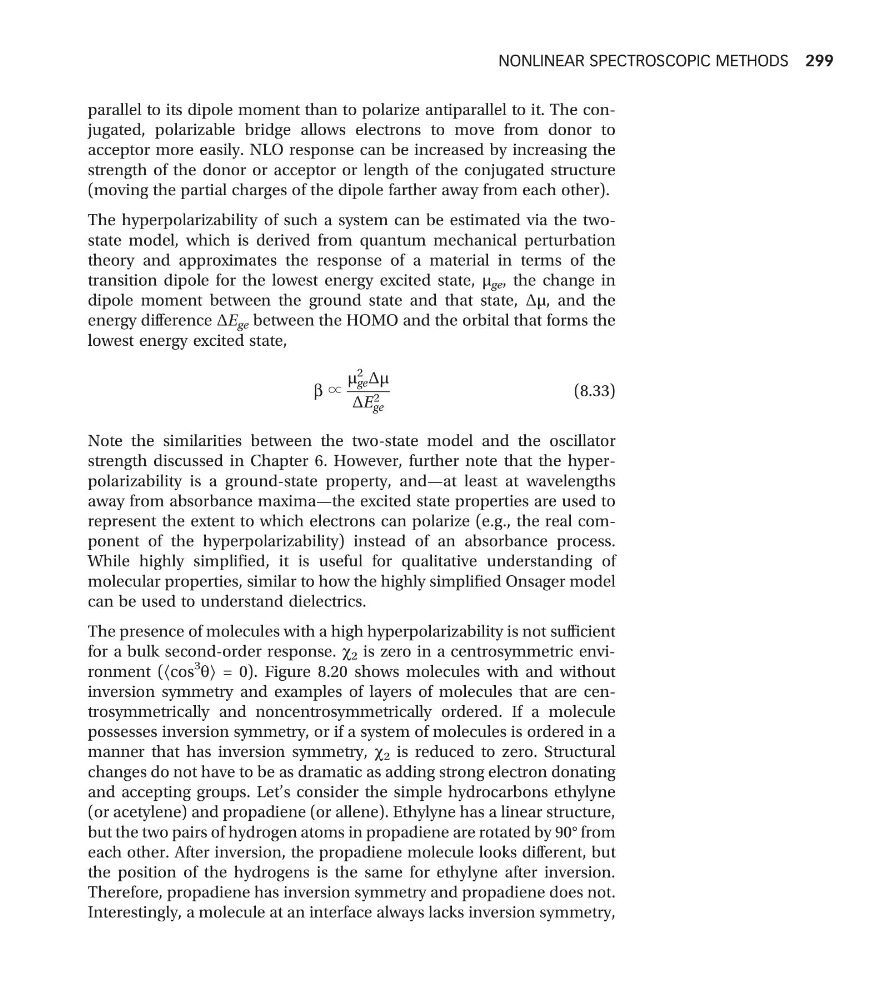
The hyperpolarizability of such a system can be estimated via the twostate model, which is derived from quantum mechanical perturbation
theory and approximates the response of a material in terms of the
transition dipole for the lowest energy excited state, μ ge , the change in
dipole moment between the ground state and that state, Δμ, and the
energy difference ΔE ge between the HOMO and the orbital that forms the
lowest energy excited state,
b ∝
μ
2
ge Δμ
ΔE
2
ge
(8.33)
Note the similarities between the two-state model and the oscillator
strength discussed in Chapter 6. However, further note that the hyperpolarizability is a ground-state property, and—at least at wavelengths
away from absorbance maxima—the excited state properties are used to
represent the extent to which electrons can polarize (e.g., the real component of the hyperpolarizability) instead of an absorbance process.
While highly simplified, it is useful for qualitative understanding of
molecular properties, similar to how the highly simplified Onsager model
can be used to understand dielectrics.
The presence of molecules with a high hyperpolarizability is not sufficient
for a bulk second-order response. c 2 is zero in a centrosymmetric environment (〈cos
3
q〉 = 0). Figure 8.20 shows molecules with and without
inversion symmetry and examples of layers of molecules that are centrosymmetrically and noncentrosymmetrically ordered. If a molecule
possesses inversion symmetry, or if a system of molecules is ordered in a
manner that has inversion symmetry, c 2 is reduced to zero. Structural
changes do not have to be as dramatic as adding strong electron donating
and accepting groups. Let’s consider the simple hydrocarbons ethylyne
(or acetylene) and propadiene (or allene). Ethylyne has a linear structure,
but the two pairs of hydrogen atoms in propadiene are rotated by 90° from
each other. After inversion, the propadiene molecule looks different, but
the position of the hydrogens is the same for ethylyne after inversion.
Therefore, propadiene has inversion symmetry and propadiene does not.
Interestingly, a molecule at an interface always lacks inversion symmetry,
NONLINEAR SPECTROSCOPIC METHODS 299
acceptor more easily. NLO response can be increased by increasing the
strength of the donor or acceptor or length of the conjugated structure
(moving the partial charges of the dipole farther away from each other).
The hyperpolarizability of such a system can be estimated via the twostate model, which is derived from quantum mechanical perturbation
theory and approximates the response of a material in terms of the
transition dipole for the lowest energy excited state, μ ge , the change in
dipole moment between the ground state and that state, Δμ, and the
energy difference ΔE ge between the HOMO and the orbital that forms the
lowest energy excited state,
b ∝
μ
2
ge Δμ
ΔE
2
ge
(8.33)
Note the similarities between the two-state model and the oscillator
strength discussed in Chapter 6. However, further note that the hyperpolarizability is a ground-state property, and—at least at wavelengths
away from absorbance maxima—the excited state properties are used to
represent the extent to which electrons can polarize (e.g., the real component of the hyperpolarizability) instead of an absorbance process.
While highly simplified, it is useful for qualitative understanding of
molecular properties, similar to how the highly simplified Onsager model
can be used to understand dielectrics.
The presence of molecules with a high hyperpolarizability is not sufficient
for a bulk second-order response. c 2 is zero in a centrosymmetric environment (〈cos
3
q〉 = 0). Figure 8.20 shows molecules with and without
inversion symmetry and examples of layers of molecules that are centrosymmetrically and noncentrosymmetrically ordered. If a molecule
possesses inversion symmetry, or if a system of molecules is ordered in a
manner that has inversion symmetry, c 2 is reduced to zero. Structural
changes do not have to be as dramatic as adding strong electron donating
and accepting groups. Let’s consider the simple hydrocarbons ethylyne
(or acetylene) and propadiene (or allene). Ethylyne has a linear structure,
but the two pairs of hydrogen atoms in propadiene are rotated by 90° from
each other. After inversion, the propadiene molecule looks different, but
the position of the hydrogens is the same for ethylyne after inversion.
Therefore, propadiene has inversion symmetry and propadiene does not.
Interestingly, a molecule at an interface always lacks inversion symmetry,
NONLINEAR SPECTROSCOPIC METHODS 299