

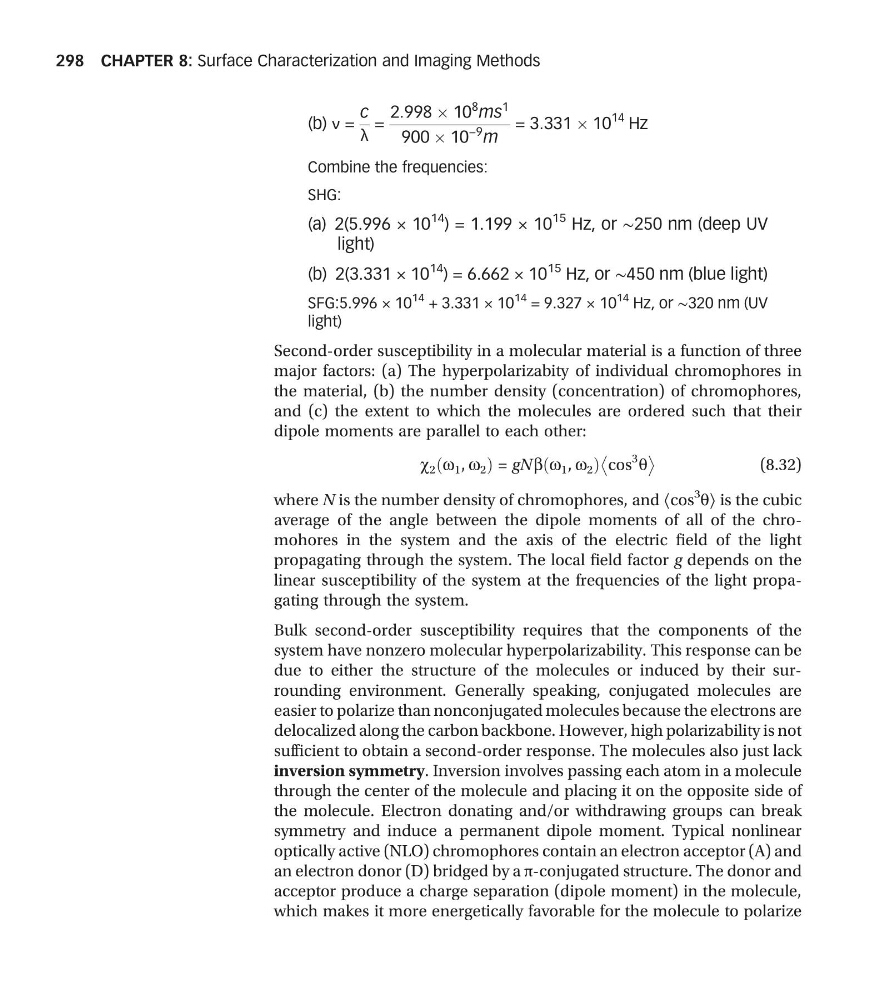
(b) ν =
c
λ
=
2:998 Â 10
8 ms
1
900 Â 10
−9 m
= 3:331 Â 10
14 Hz
Combine the frequencies:
SHG:
(a) 2(5.996 × 10
14
) = 1.199 × 10
15 Hz, or ∼250 nm (deep UV
light)
(b) 2(3.331 × 10
14
) = 6.662 × 10
15 Hz, or ∼450 nm (blue light)
SFG:5.996 × 10
14 + 3.331 × 10
14 = 9.327 × 10
14 Hz, or ∼320 nm (UV
light)
Second-order susceptibility in a molecular material is a function of three
major factors: (a) The hyperpolarizabity of individual chromophores in
the material, (b) the number density (concentration) of chromophores,
and (c) the extent to which the molecules are ordered such that their
dipole moments are parallel to each other:
c 2 w 1 , w 2
ð
Þ= gNb w 1 , w 2
ð
Þ cos
3 q
(8.32)
where N is the number density of chromophores, and 〈cos
3
q〉 is the cubic
average of the angle between the dipole moments of all of the chromohores in the system and the axis of the electric field of the light
propagating through the system. The local field factor g depends on the
linear susceptibility of the system at the frequencies of the light propagating through the system.
Bulk second-order susceptibility requires that the components of the
system have nonzero molecular hyperpolarizability. This response can be
due to either the structure of the molecules or induced by their surrounding environment. Generally speaking, conjugated molecules are
easier to polarize than nonconjugated molecules because the electrons are
delocalized along the carbon backbone. However, high polarizability is not
sufficient to obtain a second-order response. The molecules also just lack
inversion symmetry. Inversion involves passing each atom in a molecule
through the center of the molecule and placing it on the opposite side of
the molecule. Electron donating and/or withdrawing groups can break
symmetry and induce a permanent dipole moment. Typical nonlinear
optically active (NLO) chromophores contain an electron acceptor (A) and
an electron donor (D) bridged by a π-conjugated structure. The donor and
acceptor produce a charge separation (dipole moment) in the molecule,
which makes it more energetically favorable for the molecule to polarize
CHAPTER 8: Surface Characterization and Imaging Methods
298
c
λ
=
2:998 Â 10
8 ms
1
900 Â 10
−9 m
= 3:331 Â 10
14 Hz
Combine the frequencies:
SHG:
(a) 2(5.996 × 10
14
) = 1.199 × 10
15 Hz, or ∼250 nm (deep UV
light)
(b) 2(3.331 × 10
14
) = 6.662 × 10
15 Hz, or ∼450 nm (blue light)
SFG:5.996 × 10
14 + 3.331 × 10
14 = 9.327 × 10
14 Hz, or ∼320 nm (UV
light)
Second-order susceptibility in a molecular material is a function of three
major factors: (a) The hyperpolarizabity of individual chromophores in
the material, (b) the number density (concentration) of chromophores,
and (c) the extent to which the molecules are ordered such that their
dipole moments are parallel to each other:
c 2 w 1 , w 2
ð
Þ= gNb w 1 , w 2
ð
Þ cos
3 q
(8.32)
where N is the number density of chromophores, and 〈cos
3
q〉 is the cubic
average of the angle between the dipole moments of all of the chromohores in the system and the axis of the electric field of the light
propagating through the system. The local field factor g depends on the
linear susceptibility of the system at the frequencies of the light propagating through the system.
Bulk second-order susceptibility requires that the components of the
system have nonzero molecular hyperpolarizability. This response can be
due to either the structure of the molecules or induced by their surrounding environment. Generally speaking, conjugated molecules are
easier to polarize than nonconjugated molecules because the electrons are
delocalized along the carbon backbone. However, high polarizability is not
sufficient to obtain a second-order response. The molecules also just lack
inversion symmetry. Inversion involves passing each atom in a molecule
through the center of the molecule and placing it on the opposite side of
the molecule. Electron donating and/or withdrawing groups can break
symmetry and induce a permanent dipole moment. Typical nonlinear
optically active (NLO) chromophores contain an electron acceptor (A) and
an electron donor (D) bridged by a π-conjugated structure. The donor and
acceptor produce a charge separation (dipole moment) in the molecule,
which makes it more energetically favorable for the molecule to polarize
CHAPTER 8: Surface Characterization and Imaging Methods
298