

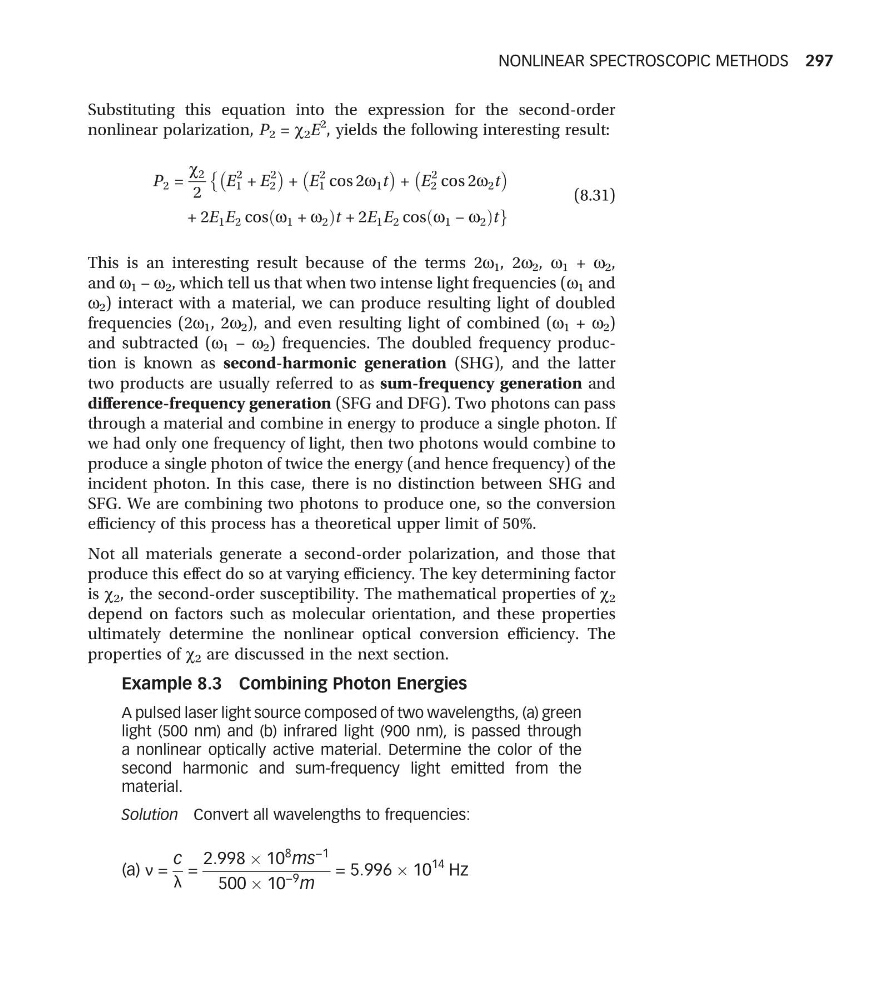
Substituting this equation into the expression for the second-order
nonlinear polarization, P 2 = c 2 E
2 , yields the following interesting result:
P 2 =
c 2
2
E
2
1 + E
2
2
À
Á
+ E
2
1 cos 2w 1 t
À
Á
+ E
2
2 cos 2w 2 t
À
Á
È
+ 2E 1 E 2 cos w 1 + w 2
ð
Þt + 2E 1 E 2 cos w 1 − w 2
ð
Þtg
(8.31)
This is an interesting result because of the terms 2w 1 , 2w 2 , w 1 + w 2 ,
and w 1 − w 2 , which tell us that when two intense light frequencies (w 1 and
w 2 ) interact with a material, we can produce resulting light of doubled
frequencies (2w 1 , 2w 2 ), and even resulting light of combined (w 1 + w 2 )
and subtracted (w 1 − w 2 ) frequencies. The doubled frequency production is known as second-harmonic generation (SHG), and the latter
two products are usually referred to as sum-frequency generation and
difference-frequency generation (SFG and DFG). Two photons can pass
through a material and combine in energy to produce a single photon. If
we had only one frequency of light, then two photons would combine to
produce a single photon of twice the energy (and hence frequency) of the
incident photon. In this case, there is no distinction between SHG and
SFG. We are combining two photons to produce one, so the conversion
efficiency of this process has a theoretical upper limit of 50%.
Not all materials generate a second-order polarization, and those that
produce this effect do so at varying efficiency. The key determining factor
is c 2 , the second-order susceptibility. The mathematical properties of c 2
depend on factors such as molecular orientation, and these properties
ultimately determine the nonlinear optical conversion efficiency. The
properties of c 2 are discussed in the next section.
Example 8.3 Combining Photon Energies
A pulsed laser light source composed of two wavelengths, (a) green
light (500 nm) and (b) infrared light (900 nm), is passed through
a nonlinear optically active material. Determine the color of the
second harmonic and sum-frequency light emitted from the
material.
Solution Convert all wavelengths to frequencies:
(a) ν =
c
λ
=
2:998 Â 10
8 ms
−1
500 Â 10
−9 m
= 5:996 Â 10
14 Hz
NONLINEAR SPECTROSCOPIC METHODS 297
nonlinear polarization, P 2 = c 2 E
2 , yields the following interesting result:
P 2 =
c 2
2
E
2
1 + E
2
2
À
Á
+ E
2
1 cos 2w 1 t
À
Á
+ E
2
2 cos 2w 2 t
À
Á
È
+ 2E 1 E 2 cos w 1 + w 2
ð
Þt + 2E 1 E 2 cos w 1 − w 2
ð
Þtg
(8.31)
This is an interesting result because of the terms 2w 1 , 2w 2 , w 1 + w 2 ,
and w 1 − w 2 , which tell us that when two intense light frequencies (w 1 and
w 2 ) interact with a material, we can produce resulting light of doubled
frequencies (2w 1 , 2w 2 ), and even resulting light of combined (w 1 + w 2 )
and subtracted (w 1 − w 2 ) frequencies. The doubled frequency production is known as second-harmonic generation (SHG), and the latter
two products are usually referred to as sum-frequency generation and
difference-frequency generation (SFG and DFG). Two photons can pass
through a material and combine in energy to produce a single photon. If
we had only one frequency of light, then two photons would combine to
produce a single photon of twice the energy (and hence frequency) of the
incident photon. In this case, there is no distinction between SHG and
SFG. We are combining two photons to produce one, so the conversion
efficiency of this process has a theoretical upper limit of 50%.
Not all materials generate a second-order polarization, and those that
produce this effect do so at varying efficiency. The key determining factor
is c 2 , the second-order susceptibility. The mathematical properties of c 2
depend on factors such as molecular orientation, and these properties
ultimately determine the nonlinear optical conversion efficiency. The
properties of c 2 are discussed in the next section.
Example 8.3 Combining Photon Energies
A pulsed laser light source composed of two wavelengths, (a) green
light (500 nm) and (b) infrared light (900 nm), is passed through
a nonlinear optically active material. Determine the color of the
second harmonic and sum-frequency light emitted from the
material.
Solution Convert all wavelengths to frequencies:
(a) ν =
c
λ
=
2:998 Â 10
8 ms
−1
500 Â 10
−9 m
= 5:996 Â 10
14 Hz
NONLINEAR SPECTROSCOPIC METHODS 297