

SFG spectroscopy has established itself as a powerful nanocharacterization method. The technique can probe any interfacial medium that is
optically accessible, and has been used to probe many interfacial processes such as corrosion, surface phase transitions, detergency, and the
structure of cell membranes.
Carboxyl groups
randomly oriented
Alkyl chain
containing
“defects”
Strong
S–Au bonds
Gold substrate
Water
I
SFG (arbitrary units)
(a)
(b)
0.8
2800
2850
2900
Wavenumber (cm –1 )
Absence of CH 3 peaks
Strong CH 2 peaks
2950
3000
1
1.2
1.4
1.6
1.8
2
2.2
2.4
2.6
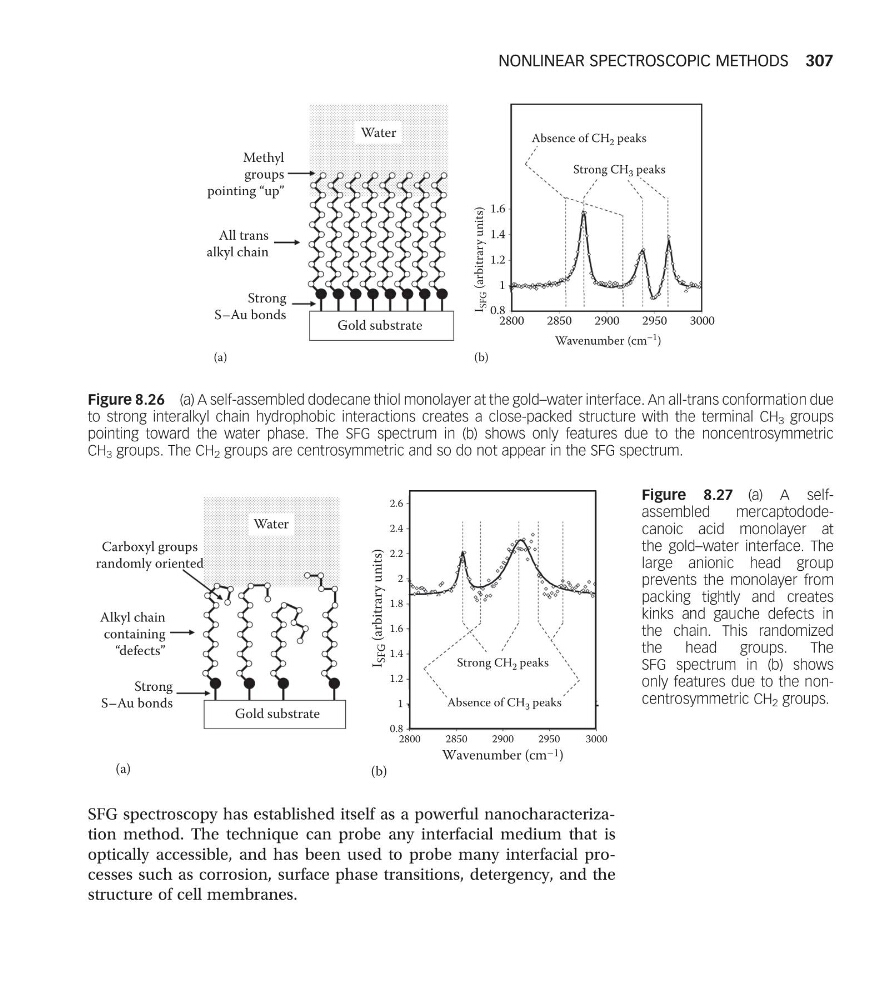
Figure 8.27 (a) A selfassembled
mercaptododecanoic acid monolayer at
the gold–water interface. The
large anionic head group
prevents the monolayer from
packing tightly and creates
kinks and gauche defects in
the chain. This randomized
the
head
groups.
The
SFG spectrum in (b) shows
only features due to the noncentrosymmetric CH 2 groups.
Water
Methyl
groups
pointing “up”
All trans
alkyl chain
Strong
S–Au bonds
Gold substrate
(a)
(b)
2800
0.8
1
1.2
1.4
I
SFG (arbitrary units)
1.6
2850
2900
2950
3000
Wavenumber (cm
–1 )
Absence of CH 2 peaks
Strong CH 3 peaks
Figure 8.26 (a) A self-assembled dodecane thiol monolayer at the gold–water interface. An all-trans conformation due
to strong interalkyl chain hydrophobic interactions creates a close-packed structure with the terminal CH 3 groups
pointing toward the water phase. The SFG spectrum in (b) shows only features due to the noncentrosymmetric
CH 3 groups. The CH 2 groups are centrosymmetric and so do not appear in the SFG spectrum.
NONLINEAR SPECTROSCOPIC METHODS 307
optically accessible, and has been used to probe many interfacial processes such as corrosion, surface phase transitions, detergency, and the
structure of cell membranes.
Carboxyl groups
randomly oriented
Alkyl chain
containing
“defects”
Strong
S–Au bonds
Gold substrate
Water
I
SFG (arbitrary units)
(a)
(b)
0.8
2800
2850
2900
Wavenumber (cm –1 )
Absence of CH 3 peaks
Strong CH 2 peaks
2950
3000
1
1.2
1.4
1.6
1.8
2
2.2
2.4
2.6
Figure 8.27 (a) A selfassembled
mercaptododecanoic acid monolayer at
the gold–water interface. The
large anionic head group
prevents the monolayer from
packing tightly and creates
kinks and gauche defects in
the chain. This randomized
the
head
groups.
The
SFG spectrum in (b) shows
only features due to the noncentrosymmetric CH 2 groups.
Water
Methyl
groups
pointing “up”
All trans
alkyl chain
Strong
S–Au bonds
Gold substrate
(a)
(b)
2800
0.8
1
1.2
1.4
I
SFG (arbitrary units)
1.6
2850
2900
2950
3000
Wavenumber (cm
–1 )
Absence of CH 2 peaks
Strong CH 3 peaks
Figure 8.26 (a) A self-assembled dodecane thiol monolayer at the gold–water interface. An all-trans conformation due
to strong interalkyl chain hydrophobic interactions creates a close-packed structure with the terminal CH 3 groups
pointing toward the water phase. The SFG spectrum in (b) shows only features due to the noncentrosymmetric
CH 3 groups. The CH 2 groups are centrosymmetric and so do not appear in the SFG spectrum.
NONLINEAR SPECTROSCOPIC METHODS 307