

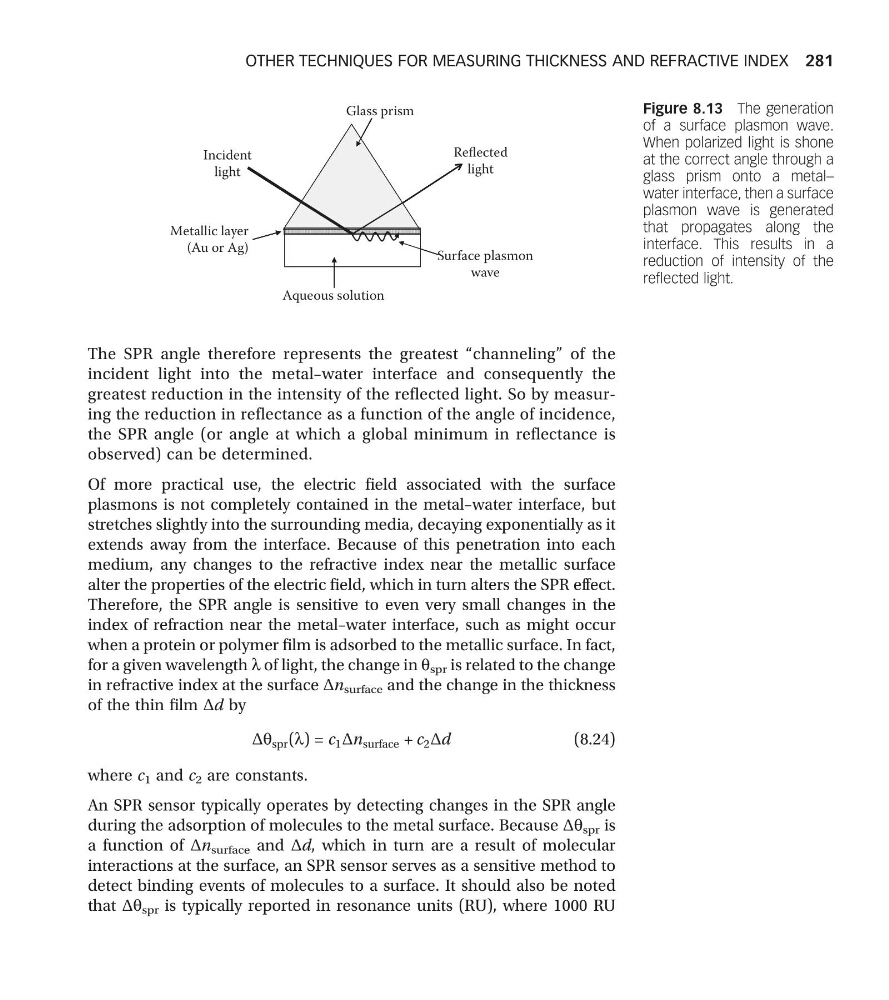
The SPR angle therefore represents the greatest “channeling” of the
incident light into the metal–water interface and consequently the
greatest reduction in the intensity of the reflected light. So by measuring the reduction in reflectance as a function of the angle of incidence,
the SPR angle (or angle at which a global minimum in reflectance is
observed) can be determined.
Of more practical use, the electric field associated with the surface
plasmons is not completely contained in the metal–water interface, but
stretches slightly into the surrounding media, decaying exponentially as it
extends away from the interface. Because of this penetration into each
medium, any changes to the refractive index near the metallic surface
alter the properties of the electric field, which in turn alters the SPR effect.
Therefore, the SPR angle is sensitive to even very small changes in the
index of refraction near the metal–water interface, such as might occur
when a protein or polymer film is adsorbed to the metallic surface. In fact,
for a given wavelength l of light, the change in q spr is related to the change
in refractive index at the surface Δn surface and the change in the thickness
of the thin film Δd by
Δq spr (l) = c 1 Δn surface + c 2 Δd
(8.24)
where c 1 and c 2 are constants.
An SPR sensor typically operates by detecting changes in the SPR angle
during the adsorption of molecules to the metal surface. Because Δq spr is
a function of Δn surface and Δd, which in turn are a result of molecular
interactions at the surface, an SPR sensor serves as a sensitive method to
detect binding events of molecules to a surface. It should also be noted
that Δq spr is typically reported in resonance units (RU), where 1000 RU
Glass prism
Incident
light
Reflected
light
Metallic layer
(Au or Ag)
Surface plasmon
wave
Aqueous solution
Figure 8.13 The generation
of a surface plasmon wave.
When polarized light is shone
at the correct angle through a
glass prism onto a metal–
water interface, then a surface
plasmon wave is generated
that propagates along the
interface. This results in a
reduction of intensity of the
reflected light.
OTHER TECHNIQUES FOR MEASURING THICKNESS AND REFRACTIVE INDEX 281
incident light into the metal–water interface and consequently the
greatest reduction in the intensity of the reflected light. So by measuring the reduction in reflectance as a function of the angle of incidence,
the SPR angle (or angle at which a global minimum in reflectance is
observed) can be determined.
Of more practical use, the electric field associated with the surface
plasmons is not completely contained in the metal–water interface, but
stretches slightly into the surrounding media, decaying exponentially as it
extends away from the interface. Because of this penetration into each
medium, any changes to the refractive index near the metallic surface
alter the properties of the electric field, which in turn alters the SPR effect.
Therefore, the SPR angle is sensitive to even very small changes in the
index of refraction near the metal–water interface, such as might occur
when a protein or polymer film is adsorbed to the metallic surface. In fact,
for a given wavelength l of light, the change in q spr is related to the change
in refractive index at the surface Δn surface and the change in the thickness
of the thin film Δd by
Δq spr (l) = c 1 Δn surface + c 2 Δd
(8.24)
where c 1 and c 2 are constants.
An SPR sensor typically operates by detecting changes in the SPR angle
during the adsorption of molecules to the metal surface. Because Δq spr is
a function of Δn surface and Δd, which in turn are a result of molecular
interactions at the surface, an SPR sensor serves as a sensitive method to
detect binding events of molecules to a surface. It should also be noted
that Δq spr is typically reported in resonance units (RU), where 1000 RU
Glass prism
Incident
light
Reflected
light
Metallic layer
(Au or Ag)
Surface plasmon
wave
Aqueous solution
Figure 8.13 The generation
of a surface plasmon wave.
When polarized light is shone
at the correct angle through a
glass prism onto a metal–
water interface, then a surface
plasmon wave is generated
that propagates along the
interface. This results in a
reduction of intensity of the
reflected light.
OTHER TECHNIQUES FOR MEASURING THICKNESS AND REFRACTIVE INDEX 281