

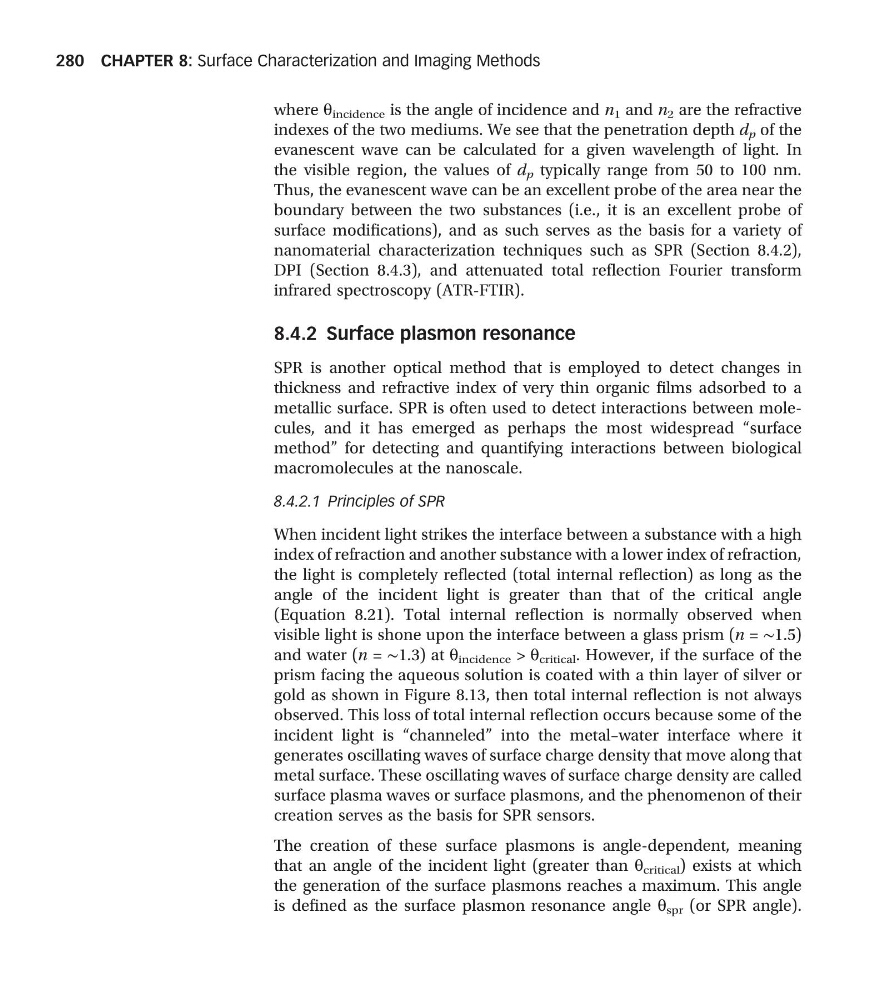
where q incidence is the angle of incidence and n 1 and n 2 are the refractive
indexes of the two mediums. We see that the penetration depth d p of the
evanescent wave can be calculated for a given wavelength of light. In
the visible region, the values of d p typically range from 50 to 100 nm.
Thus, the evanescent wave can be an excellent probe of the area near the
boundary between the two substances (i.e., it is an excellent probe of
surface modifications), and as such serves as the basis for a variety of
nanomaterial characterization techniques such as SPR (Section 8.4.2),
DPI (Section 8.4.3), and attenuated total reflection Fourier transform
infrared spectroscopy (ATR-FTIR).
8.4.2 Surface plasmon resonance
SPR is another optical method that is employed to detect changes in
thickness and refractive index of very thin organic films adsorbed to a
metallic surface. SPR is often used to detect interactions between molecules, and it has emerged as perhaps the most widespread “surface
method” for detecting and quantifying interactions between biological
macromolecules at the nanoscale.
8.4.2.1 Principles of SPR
When incident light strikes the interface between a substance with a high
index of refraction and another substance with a lower index of refraction,
the light is completely reflected (total internal reflection) as long as the
angle of the incident light is greater than that of the critical angle
(Equation 8.21). Total internal reflection is normally observed when
visible light is shone upon the interface between a glass prism (n = ∼1.5)
and water (n = ∼1.3) at q incidence > q critical . However, if the surface of the
prism facing the aqueous solution is coated with a thin layer of silver or
gold as shown in Figure 8.13, then total internal reflection is not always
observed. This loss of total internal reflection occurs because some of the
incident light is “channeled” into the metal–water interface where it
generates oscillating waves of surface charge density that move along that
metal surface. These oscillating waves of surface charge density are called
surface plasma waves or surface plasmons, and the phenomenon of their
creation serves as the basis for SPR sensors.
The creation of these surface plasmons is angle-dependent, meaning
that an angle of the incident light (greater than q critical ) exists at which
the generation of the surface plasmons reaches a maximum. This angle
is defined as the surface plasmon resonance angle q spr (or SPR angle).
CHAPTER 8: Surface Characterization and Imaging Methods
280
indexes of the two mediums. We see that the penetration depth d p of the
evanescent wave can be calculated for a given wavelength of light. In
the visible region, the values of d p typically range from 50 to 100 nm.
Thus, the evanescent wave can be an excellent probe of the area near the
boundary between the two substances (i.e., it is an excellent probe of
surface modifications), and as such serves as the basis for a variety of
nanomaterial characterization techniques such as SPR (Section 8.4.2),
DPI (Section 8.4.3), and attenuated total reflection Fourier transform
infrared spectroscopy (ATR-FTIR).
8.4.2 Surface plasmon resonance
SPR is another optical method that is employed to detect changes in
thickness and refractive index of very thin organic films adsorbed to a
metallic surface. SPR is often used to detect interactions between molecules, and it has emerged as perhaps the most widespread “surface
method” for detecting and quantifying interactions between biological
macromolecules at the nanoscale.
8.4.2.1 Principles of SPR
When incident light strikes the interface between a substance with a high
index of refraction and another substance with a lower index of refraction,
the light is completely reflected (total internal reflection) as long as the
angle of the incident light is greater than that of the critical angle
(Equation 8.21). Total internal reflection is normally observed when
visible light is shone upon the interface between a glass prism (n = ∼1.5)
and water (n = ∼1.3) at q incidence > q critical . However, if the surface of the
prism facing the aqueous solution is coated with a thin layer of silver or
gold as shown in Figure 8.13, then total internal reflection is not always
observed. This loss of total internal reflection occurs because some of the
incident light is “channeled” into the metal–water interface where it
generates oscillating waves of surface charge density that move along that
metal surface. These oscillating waves of surface charge density are called
surface plasma waves or surface plasmons, and the phenomenon of their
creation serves as the basis for SPR sensors.
The creation of these surface plasmons is angle-dependent, meaning
that an angle of the incident light (greater than q critical ) exists at which
the generation of the surface plasmons reaches a maximum. This angle
is defined as the surface plasmon resonance angle q spr (or SPR angle).
CHAPTER 8: Surface Characterization and Imaging Methods
280