

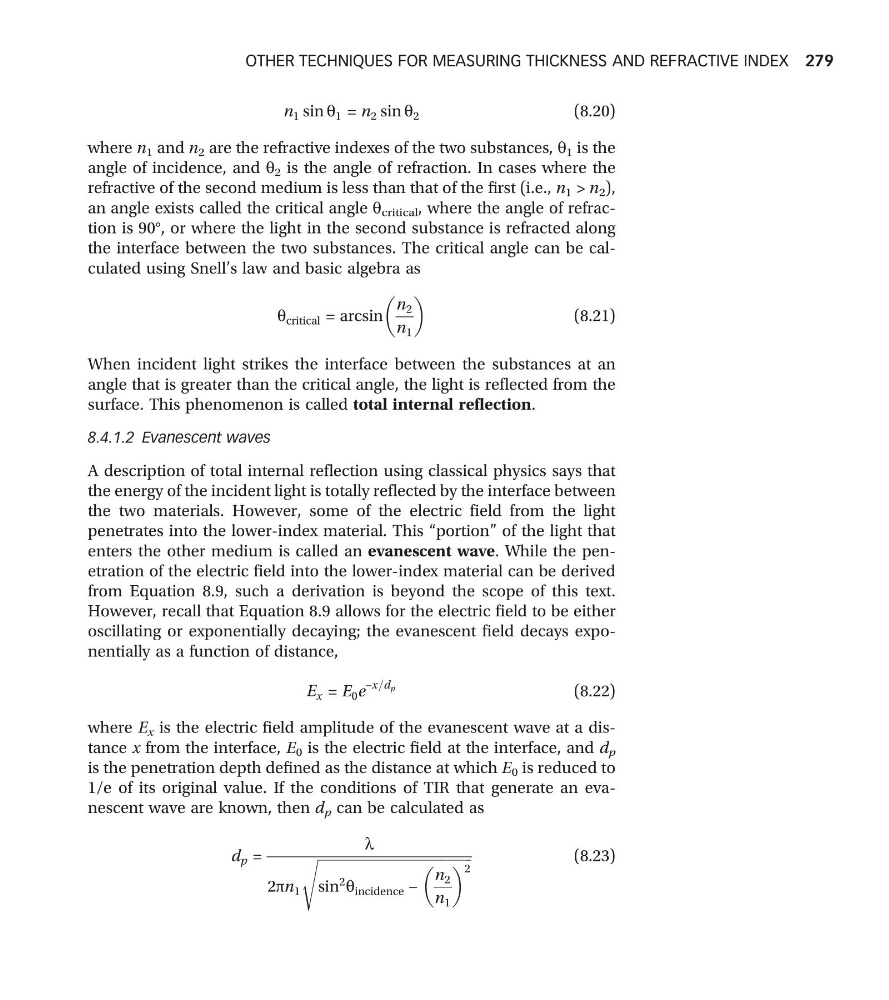
n 1 sin q 1 = n 2 sin q 2
(8.20)
where n 1 and n 2 are the refractive indexes of the two substances, q 1 is the
angle of incidence, and q 2 is the angle of refraction. In cases where the
refractive of the second medium is less than that of the first (i.e., n 1 > n 2 ),
an angle exists called the critical angle q critical , where the angle of refraction is 90°, or where the light in the second substance is refracted along
the interface between the two substances. The critical angle can be calculated using Snell’s law and basic algebra as
q critical = arcsin
n 2
n 1
(8.21)
When incident light strikes the interface between the substances at an
angle that is greater than the critical angle, the light is reflected from the
surface. This phenomenon is called total internal reflection.
8.4.1.2 Evanescent waves
A description of total internal reflection using classical physics says that
the energy of the incident light is totally reflected by the interface between
the two materials. However, some of the electric field from the light
penetrates into the lower-index material. This “portion” of the light that
enters the other medium is called an evanescent wave. While the penetration of the electric field into the lower-index material can be derived
from Equation 8.9, such a derivation is beyond the scope of this text.
However, recall that Equation 8.9 allows for the electric field to be either
oscillating or exponentially decaying; the evanescent field decays exponentially as a function of distance,
E x = E 0 e
−x=d p
(8.22)
where E x is the electric field amplitude of the evanescent wave at a distance x from the interface, E 0 is the electric field at the interface, and d p
is the penetration depth defined as the distance at which E 0 is reduced to
1/e of its original value. If the conditions of TIR that generate an evanescent wave are known, then d p can be calculated as
d p =
l
2πn 1
ffiffiffiffiffiffiffiffiffiffiffiffiffiffiffiffiffiffiffiffiffiffiffiffiffiffiffiffiffiffiffiffiffiffiffiffiffiffiffiffiffiffiffi ffi
sin
2 q incidence −
n 2
n 1
2
s
(8.23)
OTHER TECHNIQUES FOR MEASURING THICKNESS AND REFRACTIVE INDEX 279
(8.20)
where n 1 and n 2 are the refractive indexes of the two substances, q 1 is the
angle of incidence, and q 2 is the angle of refraction. In cases where the
refractive of the second medium is less than that of the first (i.e., n 1 > n 2 ),
an angle exists called the critical angle q critical , where the angle of refraction is 90°, or where the light in the second substance is refracted along
the interface between the two substances. The critical angle can be calculated using Snell’s law and basic algebra as
q critical = arcsin
n 2
n 1
(8.21)
When incident light strikes the interface between the substances at an
angle that is greater than the critical angle, the light is reflected from the
surface. This phenomenon is called total internal reflection.
8.4.1.2 Evanescent waves
A description of total internal reflection using classical physics says that
the energy of the incident light is totally reflected by the interface between
the two materials. However, some of the electric field from the light
penetrates into the lower-index material. This “portion” of the light that
enters the other medium is called an evanescent wave. While the penetration of the electric field into the lower-index material can be derived
from Equation 8.9, such a derivation is beyond the scope of this text.
However, recall that Equation 8.9 allows for the electric field to be either
oscillating or exponentially decaying; the evanescent field decays exponentially as a function of distance,
E x = E 0 e
−x=d p
(8.22)
where E x is the electric field amplitude of the evanescent wave at a distance x from the interface, E 0 is the electric field at the interface, and d p
is the penetration depth defined as the distance at which E 0 is reduced to
1/e of its original value. If the conditions of TIR that generate an evanescent wave are known, then d p can be calculated as
d p =
l
2πn 1
ffiffiffiffiffiffiffiffiffiffiffiffiffiffiffiffiffiffiffiffiffiffiffiffiffiffiffiffiffiffiffiffiffiffiffiffiffiffiffiffiffiffiffi ffi
sin
2 q incidence −
n 2
n 1
2
s
(8.23)
OTHER TECHNIQUES FOR MEASURING THICKNESS AND REFRACTIVE INDEX 279