

8.4 OTHER TECHNIQUES FOR MEASURING
THICKNESS AND REFRACTIVE INDEX
Other techniques aside from ellipsometry exist to determine the refractive
index and thickness of thin nanofilms based on the interaction of polarized light with a surface. We will discuss two such techniques, surface
plasmon resonance (SPR) and dual-polarization interferometry, along
with the optical principles necessary to understand these techniques.
8.4.1 Reflection phenomena at interfaces
The extent to which light is transmitted or reflected at interfaces depends
on the refractive indices of the materials composing the interface as well
as the angle of incidence of the light. We previously discussed reflection at
interfaces in the context of ellipsometry, but two other key phenomena
occur at such interfaces that can be exploited to characterize the properties of those interfaces or use those interfaces to perform a desired
function such as sensing or data transmission. Those phenomena are
total internal reflection (TIR) and evanescent waves.
8.4.1.1 Total internal reflection
When light is shone on the boundary between two materials with different
refractive indexes (n 1 ≠ n 2 ), the light passes through the boundary into the
second medium and is refracted toward the surface normal if n 2 > n 1 and
away from the surface normal if n 1 > n 2 . This refraction obeys Snell’s law:
5
4
2
3
1
0 1 2 3 4 5 6 7 8 9 10
Ellipsometric thickness (nm)
0
Bilayer number
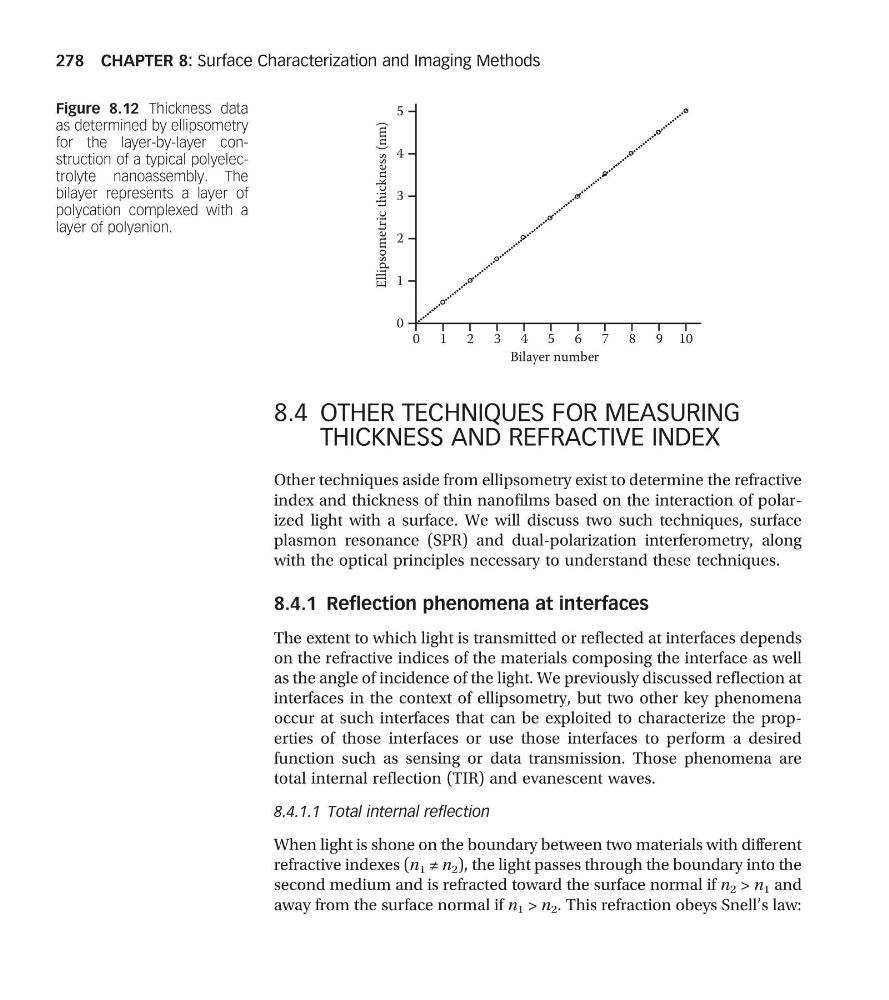
Figure 8.12 Thickness data
as determined by ellipsometry
for the layer-by-layer construction of a typical polyelectrolyte nanoassembly. The
bilayer represents a layer of
polycation complexed with a
layer of polyanion.
CHAPTER 8: Surface Characterization and Imaging Methods
278
THICKNESS AND REFRACTIVE INDEX
Other techniques aside from ellipsometry exist to determine the refractive
index and thickness of thin nanofilms based on the interaction of polarized light with a surface. We will discuss two such techniques, surface
plasmon resonance (SPR) and dual-polarization interferometry, along
with the optical principles necessary to understand these techniques.
8.4.1 Reflection phenomena at interfaces
The extent to which light is transmitted or reflected at interfaces depends
on the refractive indices of the materials composing the interface as well
as the angle of incidence of the light. We previously discussed reflection at
interfaces in the context of ellipsometry, but two other key phenomena
occur at such interfaces that can be exploited to characterize the properties of those interfaces or use those interfaces to perform a desired
function such as sensing or data transmission. Those phenomena are
total internal reflection (TIR) and evanescent waves.
8.4.1.1 Total internal reflection
When light is shone on the boundary between two materials with different
refractive indexes (n 1 ≠ n 2 ), the light passes through the boundary into the
second medium and is refracted toward the surface normal if n 2 > n 1 and
away from the surface normal if n 1 > n 2 . This refraction obeys Snell’s law:
5
4
2
3
1
0 1 2 3 4 5 6 7 8 9 10
Ellipsometric thickness (nm)
0
Bilayer number
Figure 8.12 Thickness data
as determined by ellipsometry
for the layer-by-layer construction of a typical polyelectrolyte nanoassembly. The
bilayer represents a layer of
polycation complexed with a
layer of polyanion.
CHAPTER 8: Surface Characterization and Imaging Methods
278