

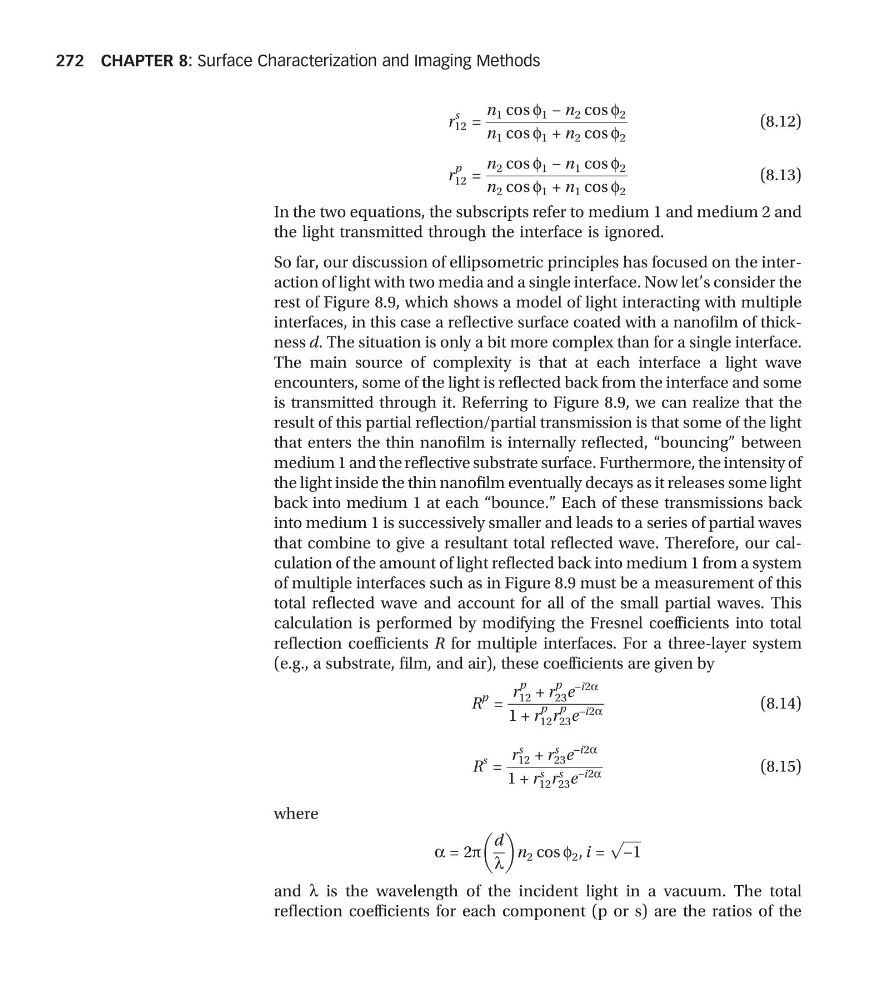
r
s
12 =
n 1 cos f 1 − n 2 cos f 2
n 1 cos f 1 + n 2 cos f 2
(8.12)
r
p
12 =
n 2 cos f 1 − n 1 cos f 2
n 2 cos f 1 + n 1 cos f 2
(8.13)
In the two equations, the subscripts refer to medium 1 and medium 2 and
the light transmitted through the interface is ignored.
So far, our discussion of ellipsometric principles has focused on the interaction of light with two media and a single interface. Now let’s consider the
rest of Figure 8.9, which shows a model of light interacting with multiple
interfaces, in this case a reflective surface coated with a nanofilm of thickness d. The situation is only a bit more complex than for a single interface.
The main source of complexity is that at each interface a light wave
encounters, some of the light is reflected back from the interface and some
is transmitted through it. Referring to Figure 8.9, we can realize that the
result of this partial reflection/partial transmission is that some of the light
that enters the thin nanofilm is internally reflected, “bouncing” between
medium 1 and the reflective substrate surface. Furthermore, the intensity of
the light inside the thin nanofilm eventually decays as it releases some light
back into medium 1 at each “bounce.” Each of these transmissions back
into medium 1 is successively smaller and leads to a series of partial waves
that combine to give a resultant total reflected wave. Therefore, our calculation of the amount of light reflected back into medium 1 from a system
of multiple interfaces such as in Figure 8.9 must be a measurement of this
total reflected wave and account for all of the small partial waves. This
calculation is performed by modifying the Fresnel coefficients into total
reflection coefficients R for multiple interfaces. For a three-layer system
(e.g., a substrate, film, and air), these coefficients are given by
R
p =
r
p
12 + r
p
23 e
−i2a
1 + r
p
12 r
p
23 e
−i2a
(8.14)
R
s =
r
s
12 + r
s
23 e
−i2a
1 + r
s
12 r
s
23 e
−i2a
(8.15)
where
a = 2π
d
l
n 2 cos f 2 , i =
ffiffiffiffiffi
−1
p
and l is the wavelength of the incident light in a vacuum. The total
reflection coefficients for each component (p or s) are the ratios of the
CHAPTER 8: Surface Characterization and Imaging Methods
272
s
12 =
n 1 cos f 1 − n 2 cos f 2
n 1 cos f 1 + n 2 cos f 2
(8.12)
r
p
12 =
n 2 cos f 1 − n 1 cos f 2
n 2 cos f 1 + n 1 cos f 2
(8.13)
In the two equations, the subscripts refer to medium 1 and medium 2 and
the light transmitted through the interface is ignored.
So far, our discussion of ellipsometric principles has focused on the interaction of light with two media and a single interface. Now let’s consider the
rest of Figure 8.9, which shows a model of light interacting with multiple
interfaces, in this case a reflective surface coated with a nanofilm of thickness d. The situation is only a bit more complex than for a single interface.
The main source of complexity is that at each interface a light wave
encounters, some of the light is reflected back from the interface and some
is transmitted through it. Referring to Figure 8.9, we can realize that the
result of this partial reflection/partial transmission is that some of the light
that enters the thin nanofilm is internally reflected, “bouncing” between
medium 1 and the reflective substrate surface. Furthermore, the intensity of
the light inside the thin nanofilm eventually decays as it releases some light
back into medium 1 at each “bounce.” Each of these transmissions back
into medium 1 is successively smaller and leads to a series of partial waves
that combine to give a resultant total reflected wave. Therefore, our calculation of the amount of light reflected back into medium 1 from a system
of multiple interfaces such as in Figure 8.9 must be a measurement of this
total reflected wave and account for all of the small partial waves. This
calculation is performed by modifying the Fresnel coefficients into total
reflection coefficients R for multiple interfaces. For a three-layer system
(e.g., a substrate, film, and air), these coefficients are given by
R
p =
r
p
12 + r
p
23 e
−i2a
1 + r
p
12 r
p
23 e
−i2a
(8.14)
R
s =
r
s
12 + r
s
23 e
−i2a
1 + r
s
12 r
s
23 e
−i2a
(8.15)
where
a = 2π
d
l
n 2 cos f 2 , i =
ffiffiffiffiffi
−1
p
and l is the wavelength of the incident light in a vacuum. The total
reflection coefficients for each component (p or s) are the ratios of the
CHAPTER 8: Surface Characterization and Imaging Methods
272