

reflected wave amplitude to the incident wave amplitude. We see that the
equations for these total reflection coefficients each incorporate an
exponential decay term, e
−i2a , which accounts for the increasingly smaller
partial waves that are produced by the partial reflection/partial transmission at the nanofilm/medium 1 interface. We also notice that if d = 0
(or if there is no nanofilm on the surface) then Equations 8.14 and 8.15
reduce to Equations 8.13 and 8.14, as expected.
8.3.3 Obtaining the thickness of films: Optical parameters
Del (Δ) and Psi (ψ)
Section 8.3.2 covered the necessary background needed to understand how
ellipsometry can be used to yield thickness values for thin nanofilms. At this
point, we need to define two parameters (d 1 and d 2 ) that describe the
change in phase as light is reflected off a surface. Let d 1 be the phase difference between the p-polarized component and the s-polarized component of the incident light. Let d 2 be the phase difference between the ppolarized and the s-polarized component of the reflected light. We can now
define one of the most important optical parameters used in ellipsometry,
the parameter Del (Δ), as the phase difference between the p-polarized and
s-polarized components of the incident light upon reflection. In other
words, Δ is the resulting change in the phase difference between the s and p
waves as the light is reflected from the sample (Equation 8.16).
Δ = d 1 − d 2
(8.16)
The two components (p and s) making up the incident light each have a
given amplitude (length of the electric field vector), and those amplitudes
may also change upon reflection. These amplitude changes are given by
the total reflection coefficients in Equations 8.14 and 8.15. The second
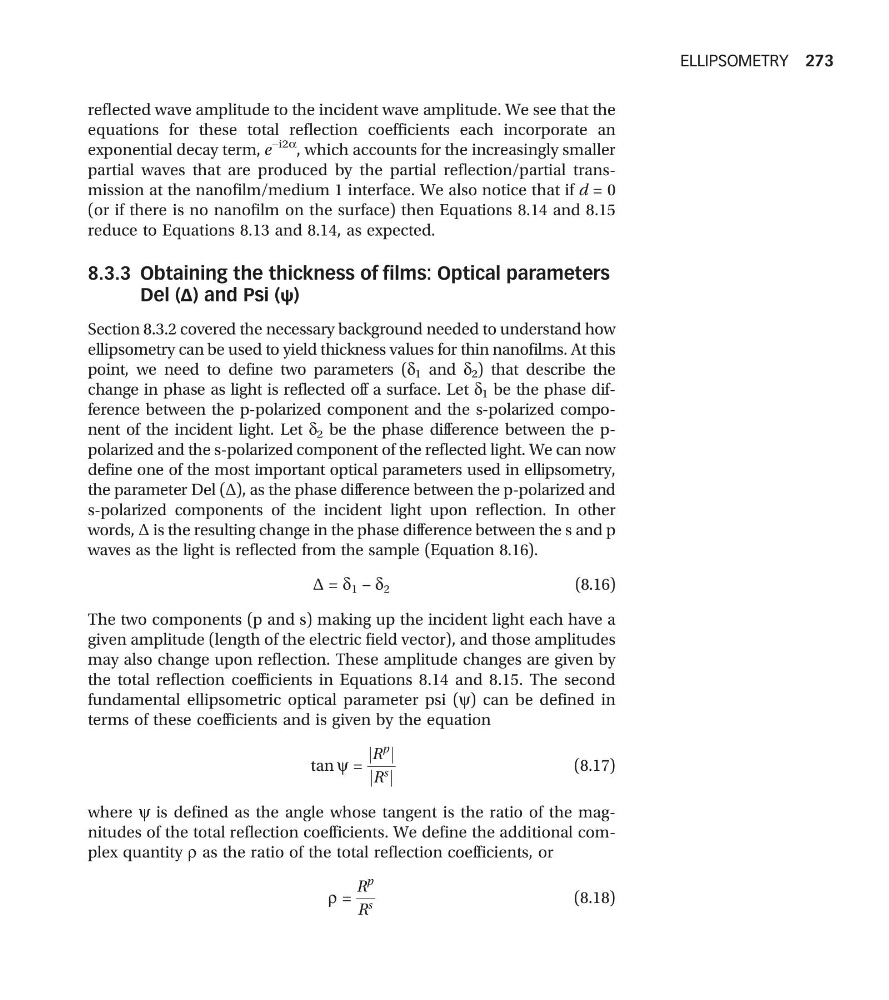
fundamental ellipsometric optical parameter psi (y) can be defined in
terms of these coefficients and is given by the equation
tan y =
R
p
j j
R
s
j j
(8.17)
where y is defined as the angle whose tangent is the ratio of the magnitudes of the total reflection coefficients. We define the additional complex quantity r as the ratio of the total reflection coefficients, or
r =
R
p
R
s
(8.18)
ELLIPSOMETRY 273
equations for these total reflection coefficients each incorporate an
exponential decay term, e
−i2a , which accounts for the increasingly smaller
partial waves that are produced by the partial reflection/partial transmission at the nanofilm/medium 1 interface. We also notice that if d = 0
(or if there is no nanofilm on the surface) then Equations 8.14 and 8.15
reduce to Equations 8.13 and 8.14, as expected.
8.3.3 Obtaining the thickness of films: Optical parameters
Del (Δ) and Psi (ψ)
Section 8.3.2 covered the necessary background needed to understand how
ellipsometry can be used to yield thickness values for thin nanofilms. At this
point, we need to define two parameters (d 1 and d 2 ) that describe the
change in phase as light is reflected off a surface. Let d 1 be the phase difference between the p-polarized component and the s-polarized component of the incident light. Let d 2 be the phase difference between the ppolarized and the s-polarized component of the reflected light. We can now
define one of the most important optical parameters used in ellipsometry,
the parameter Del (Δ), as the phase difference between the p-polarized and
s-polarized components of the incident light upon reflection. In other
words, Δ is the resulting change in the phase difference between the s and p
waves as the light is reflected from the sample (Equation 8.16).
Δ = d 1 − d 2
(8.16)
The two components (p and s) making up the incident light each have a
given amplitude (length of the electric field vector), and those amplitudes
may also change upon reflection. These amplitude changes are given by
the total reflection coefficients in Equations 8.14 and 8.15. The second
fundamental ellipsometric optical parameter psi (y) can be defined in
terms of these coefficients and is given by the equation
tan y =
R
p
j j
R
s
j j
(8.17)
where y is defined as the angle whose tangent is the ratio of the magnitudes of the total reflection coefficients. We define the additional complex quantity r as the ratio of the total reflection coefficients, or
r =
R
p
R
s
(8.18)
ELLIPSOMETRY 273