

the wavelength used for the measurement is insignificant; more complex
models are required for absorbing films.
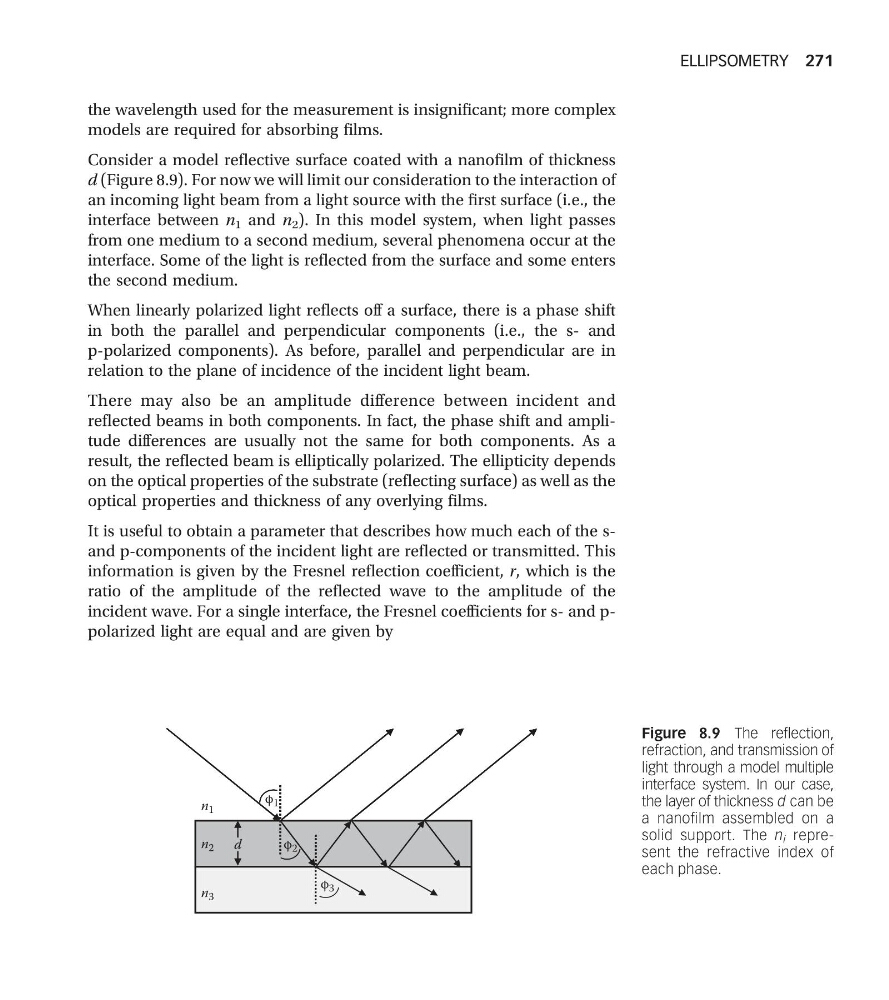
Consider a model reflective surface coated with a nanofilm of thickness
d (Figure 8.9). For now we will limit our consideration to the interaction of
an incoming light beam from a light source with the first surface (i.e., the
interface between n 1 and n 2 ). In this model system, when light passes
from one medium to a second medium, several phenomena occur at the
interface. Some of the light is reflected from the surface and some enters
the second medium.
When linearly polarized light reflects off a surface, there is a phase shift
in both the parallel and perpendicular components (i.e., the s- and
p-polarized components). As before, parallel and perpendicular are in
relation to the plane of incidence of the incident light beam.
There may also be an amplitude difference between incident and
reflected beams in both components. In fact, the phase shift and amplitude differences are usually not the same for both components. As a
result, the reflected beam is elliptically polarized. The ellipticity depends
on the optical properties of the substrate (reflecting surface) as well as the
optical properties and thickness of any overlying films.
It is useful to obtain a parameter that describes how much each of the sand p-components of the incident light are reflected or transmitted. This
information is given by the Fresnel reflection coefficient, r, which is the
ratio of the amplitude of the reflected wave to the amplitude of the
incident wave. For a single interface, the Fresnel coefficients for s- and ppolarized light are equal and are given by
φ 1
n 1
d
n 2 d
n 3
n 3
φ 2
φ 3
Figure 8.9 The reflection,
refraction, and transmission of
light through a model multiple
interface system. In our case,
the layer of thickness d can be
a nanofilm assembled on a
solid support. The n i represent the refractive index of
each phase.
ELLIPSOMETRY 271
models are required for absorbing films.
Consider a model reflective surface coated with a nanofilm of thickness
d (Figure 8.9). For now we will limit our consideration to the interaction of
an incoming light beam from a light source with the first surface (i.e., the
interface between n 1 and n 2 ). In this model system, when light passes
from one medium to a second medium, several phenomena occur at the
interface. Some of the light is reflected from the surface and some enters
the second medium.
When linearly polarized light reflects off a surface, there is a phase shift
in both the parallel and perpendicular components (i.e., the s- and
p-polarized components). As before, parallel and perpendicular are in
relation to the plane of incidence of the incident light beam.
There may also be an amplitude difference between incident and
reflected beams in both components. In fact, the phase shift and amplitude differences are usually not the same for both components. As a
result, the reflected beam is elliptically polarized. The ellipticity depends
on the optical properties of the substrate (reflecting surface) as well as the
optical properties and thickness of any overlying films.
It is useful to obtain a parameter that describes how much each of the sand p-components of the incident light are reflected or transmitted. This
information is given by the Fresnel reflection coefficient, r, which is the
ratio of the amplitude of the reflected wave to the amplitude of the
incident wave. For a single interface, the Fresnel coefficients for s- and ppolarized light are equal and are given by
φ 1
n 1
d
n 2 d
n 3
n 3
φ 2
φ 3
Figure 8.9 The reflection,
refraction, and transmission of
light through a model multiple
interface system. In our case,
the layer of thickness d can be
a nanofilm assembled on a
solid support. The n i represent the refractive index of
each phase.
ELLIPSOMETRY 271