

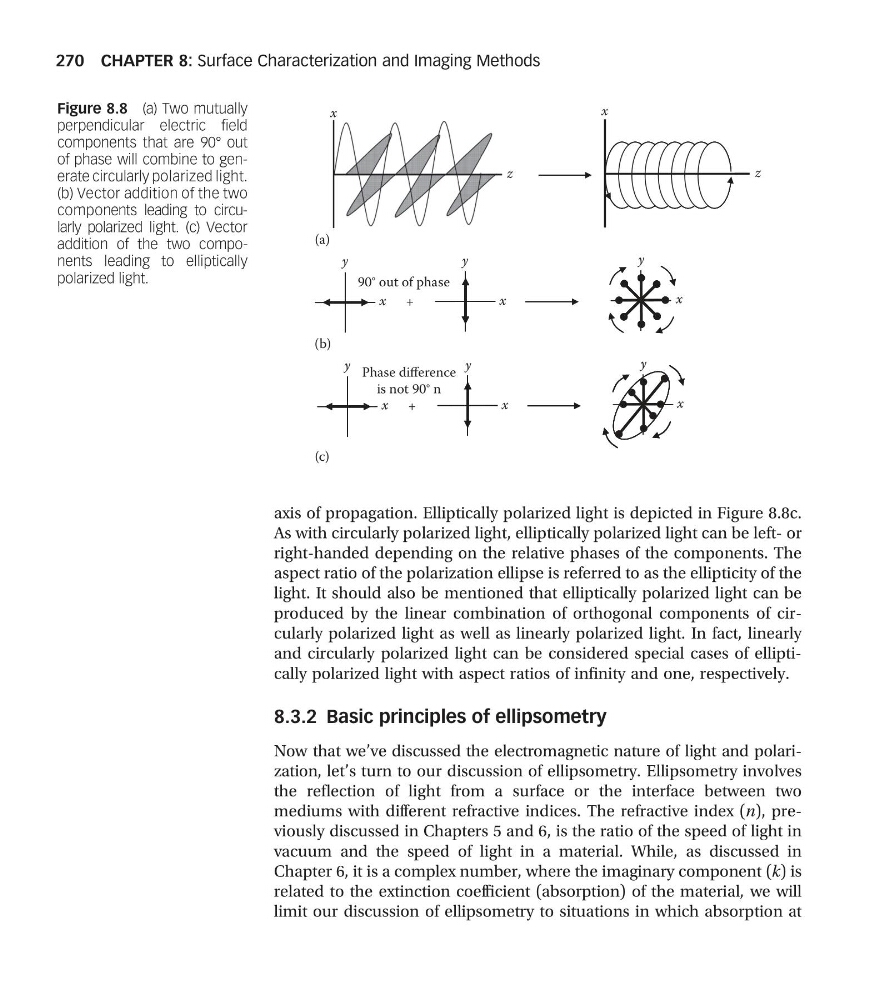
axis of propagation. Elliptically polarized light is depicted in Figure 8.8c.
As with circularly polarized light, elliptically polarized light can be left- or
right-handed depending on the relative phases of the components. The
aspect ratio of the polarization ellipse is referred to as the ellipticity of the
light. It should also be mentioned that elliptically polarized light can be
produced by the linear combination of orthogonal components of circularly polarized light as well as linearly polarized light. In fact, linearly
and circularly polarized light can be considered special cases of elliptically polarized light with aspect ratios of infinity and one, respectively.
8.3.2 Basic principles of ellipsometry
Now that we’ve discussed the electromagnetic nature of light and polarization, let’s turn to our discussion of ellipsometry. Ellipsometry involves
the reflection of light from a surface or the interface between two
mediums with different refractive indices. The refractive index (n), previously discussed in Chapters 5 and 6, is the ratio of the speed of light in
vacuum and the speed of light in a material. While, as discussed in
Chapter 6, it is a complex number, where the imaginary component (k) is
related to the extinction coefficient (absorption) of the material, we will
limit our discussion of ellipsometry to situations in which absorption at
x
x
(a)
z
z
y
x +
y
x
90° out of phase
x
(b)
y
y
y
Phase difference
is not 90° n
y
(c)
x +
x
x
Figure 8.8 (a) Two mutually
perpendicular electric field
components that are 90° out
of phase will combine to generate circularly polarized light.
(b) Vector addition of the two
components leading to circularly polarized light. (c) Vector
addition of the two components leading to elliptically
polarized light.
CHAPTER 8: Surface Characterization and Imaging Methods
270
As with circularly polarized light, elliptically polarized light can be left- or
right-handed depending on the relative phases of the components. The
aspect ratio of the polarization ellipse is referred to as the ellipticity of the
light. It should also be mentioned that elliptically polarized light can be
produced by the linear combination of orthogonal components of circularly polarized light as well as linearly polarized light. In fact, linearly
and circularly polarized light can be considered special cases of elliptically polarized light with aspect ratios of infinity and one, respectively.
8.3.2 Basic principles of ellipsometry
Now that we’ve discussed the electromagnetic nature of light and polarization, let’s turn to our discussion of ellipsometry. Ellipsometry involves
the reflection of light from a surface or the interface between two
mediums with different refractive indices. The refractive index (n), previously discussed in Chapters 5 and 6, is the ratio of the speed of light in
vacuum and the speed of light in a material. While, as discussed in
Chapter 6, it is a complex number, where the imaginary component (k) is
related to the extinction coefficient (absorption) of the material, we will
limit our discussion of ellipsometry to situations in which absorption at
x
x
(a)
z
z
y
x +
y
x
90° out of phase
x
(b)
y
y
y
Phase difference
is not 90° n
y
(c)
x +
x
x
Figure 8.8 (a) Two mutually
perpendicular electric field
components that are 90° out
of phase will combine to generate circularly polarized light.
(b) Vector addition of the two
components leading to circularly polarized light. (c) Vector
addition of the two components leading to elliptically
polarized light.
CHAPTER 8: Surface Characterization and Imaging Methods
270