

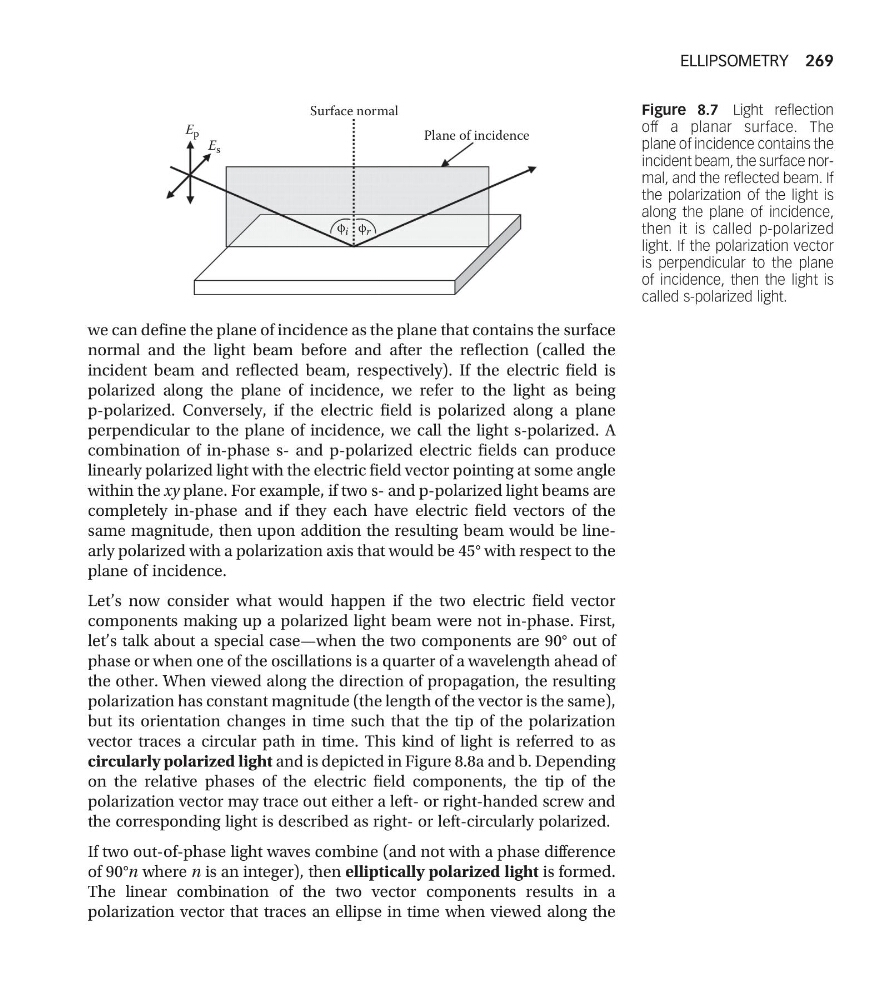
we can define the plane of incidence as the plane that contains the surface
normal and the light beam before and after the reflection (called the
incident beam and reflected beam, respectively). If the electric field is
polarized along the plane of incidence, we refer to the light as being
p-polarized. Conversely, if the electric field is polarized along a plane
perpendicular to the plane of incidence, we call the light s-polarized. A
combination of in-phase s- and p-polarized electric fields can produce
linearly polarized light with the electric field vector pointing at some angle
within the xy plane. For example, if two s- and p-polarized light beams are
completely in-phase and if they each have electric field vectors of the
same magnitude, then upon addition the resulting beam would be linearly polarized with a polarization axis that would be 45° with respect to the
plane of incidence.
Let’s now consider what would happen if the two electric field vector
components making up a polarized light beam were not in-phase. First,
let’s talk about a special case—when the two components are 90° out of
phase or when one of the oscillations is a quarter of a wavelength ahead of
the other. When viewed along the direction of propagation, the resulting
polarization has constant magnitude (the length of the vector is the same),
but its orientation changes in time such that the tip of the polarization
vector traces a circular path in time. This kind of light is referred to as
circularly polarized light and is depicted in Figure 8.8a and b. Depending
on the relative phases of the electric field components, the tip of the
polarization vector may trace out either a left- or right-handed screw and
the corresponding light is described as right- or left-circularly polarized.
If two out-of-phase light waves combine (and not with a phase difference
of 90°n where n is an integer), then elliptically polarized light is formed.
The linear combination of the two vector components results in a
polarization vector that traces an ellipse in time when viewed along the
Surface normal
Plane of incidence
E p
E s
φ i φ r
Figure 8.7 Light reflection
off a planar surface. The
plane of incidence contains the
incident beam, the surface normal, and the reflected beam. If
the polarization of the light is
along the plane of incidence,
then it is called p-polarized
light. If the polarization vector
is perpendicular to the plane
of incidence, then the light is
called s-polarized light.
ELLIPSOMETRY 269
normal and the light beam before and after the reflection (called the
incident beam and reflected beam, respectively). If the electric field is
polarized along the plane of incidence, we refer to the light as being
p-polarized. Conversely, if the electric field is polarized along a plane
perpendicular to the plane of incidence, we call the light s-polarized. A
combination of in-phase s- and p-polarized electric fields can produce
linearly polarized light with the electric field vector pointing at some angle
within the xy plane. For example, if two s- and p-polarized light beams are
completely in-phase and if they each have electric field vectors of the
same magnitude, then upon addition the resulting beam would be linearly polarized with a polarization axis that would be 45° with respect to the
plane of incidence.
Let’s now consider what would happen if the two electric field vector
components making up a polarized light beam were not in-phase. First,
let’s talk about a special case—when the two components are 90° out of
phase or when one of the oscillations is a quarter of a wavelength ahead of
the other. When viewed along the direction of propagation, the resulting
polarization has constant magnitude (the length of the vector is the same),
but its orientation changes in time such that the tip of the polarization
vector traces a circular path in time. This kind of light is referred to as
circularly polarized light and is depicted in Figure 8.8a and b. Depending
on the relative phases of the electric field components, the tip of the
polarization vector may trace out either a left- or right-handed screw and
the corresponding light is described as right- or left-circularly polarized.
If two out-of-phase light waves combine (and not with a phase difference
of 90°n where n is an integer), then elliptically polarized light is formed.
The linear combination of the two vector components results in a
polarization vector that traces an ellipse in time when viewed along the
Surface normal
Plane of incidence
E p
E s
φ i φ r
Figure 8.7 Light reflection
off a planar surface. The
plane of incidence contains the
incident beam, the surface normal, and the reflected beam. If
the polarization of the light is
along the plane of incidence,
then it is called p-polarized
light. If the polarization vector
is perpendicular to the plane
of incidence, then the light is
called s-polarized light.
ELLIPSOMETRY 269