

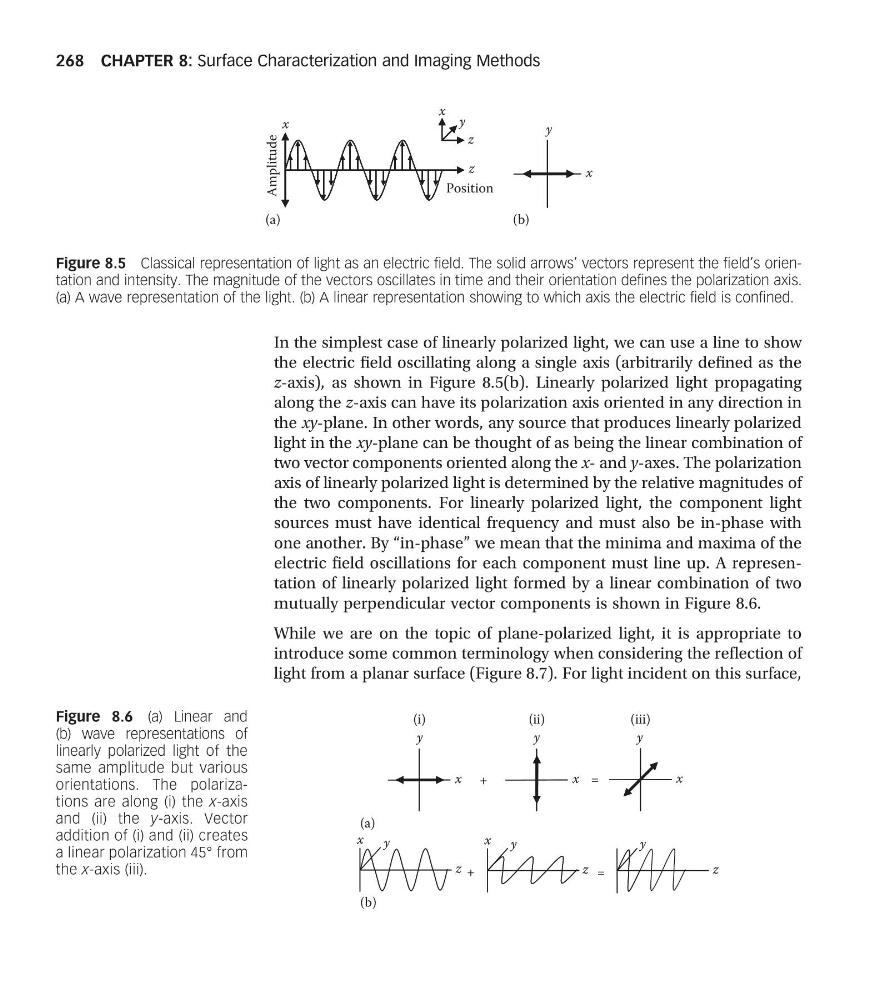
In the simplest case of linearly polarized light, we can use a line to show
the electric field oscillating along a single axis (arbitrarily defined as the
z-axis), as shown in Figure 8.5(b). Linearly polarized light propagating
along the z-axis can have its polarization axis oriented in any direction in
the xy-plane. In other words, any source that produces linearly polarized
light in the xy-plane can be thought of as being the linear combination of
two vector components oriented along the x- and y-axes. The polarization
axis of linearly polarized light is determined by the relative magnitudes of
the two components. For linearly polarized light, the component light
sources must have identical frequency and must also be in-phase with
one another. By “in-phase” we mean that the minima and maxima of the
electric field oscillations for each component must line up. A representation of linearly polarized light formed by a linear combination of two
mutually perpendicular vector components is shown in Figure 8.6.
While we are on the topic of plane-polarized light, it is appropriate to
introduce some common terminology when considering the reflection of
light from a planar surface (Figure 8.7). For light incident on this surface,
x
x
y
z
y
(a)
(b)
z
Amplitude
Position
x
Figure 8.5 Classical representation of light as an electric field. The solid arrows’ vectors represent the field’s orientation and intensity. The magnitude of the vectors oscillates in time and their orientation defines the polarization axis.
(a) A wave representation of the light. (b) A linear representation showing to which axis the electric field is confined.
y
y
y
(a)
(i)
(ii)
(iii)
x +
x =
x
x
x
(b)
z +
z
y
=
z
y
y
Figure 8.6 (a) Linear and
(b) wave representations of
linearly polarized light of the
same amplitude but various
orientations. The polarizations are along (i) the x-axis
and (ii) the y-axis. Vector
addition of (i) and (ii) creates
a linear polarization 45° from
the x-axis (iii).
CHAPTER 8: Surface Characterization and Imaging Methods
268
the electric field oscillating along a single axis (arbitrarily defined as the
z-axis), as shown in Figure 8.5(b). Linearly polarized light propagating
along the z-axis can have its polarization axis oriented in any direction in
the xy-plane. In other words, any source that produces linearly polarized
light in the xy-plane can be thought of as being the linear combination of
two vector components oriented along the x- and y-axes. The polarization
axis of linearly polarized light is determined by the relative magnitudes of
the two components. For linearly polarized light, the component light
sources must have identical frequency and must also be in-phase with
one another. By “in-phase” we mean that the minima and maxima of the
electric field oscillations for each component must line up. A representation of linearly polarized light formed by a linear combination of two
mutually perpendicular vector components is shown in Figure 8.6.
While we are on the topic of plane-polarized light, it is appropriate to
introduce some common terminology when considering the reflection of
light from a planar surface (Figure 8.7). For light incident on this surface,
x
x
y
z
y
(a)
(b)
z
Amplitude
Position
x
Figure 8.5 Classical representation of light as an electric field. The solid arrows’ vectors represent the field’s orientation and intensity. The magnitude of the vectors oscillates in time and their orientation defines the polarization axis.
(a) A wave representation of the light. (b) A linear representation showing to which axis the electric field is confined.
y
y
y
(a)
(i)
(ii)
(iii)
x +
x =
x
x
x
(b)
z +
z
y
=
z
y
y
Figure 8.6 (a) Linear and
(b) wave representations of
linearly polarized light of the
same amplitude but various
orientations. The polarizations are along (i) the x-axis
and (ii) the y-axis. Vector
addition of (i) and (ii) creates
a linear polarization 45° from
the x-axis (iii).
CHAPTER 8: Surface Characterization and Imaging Methods
268