

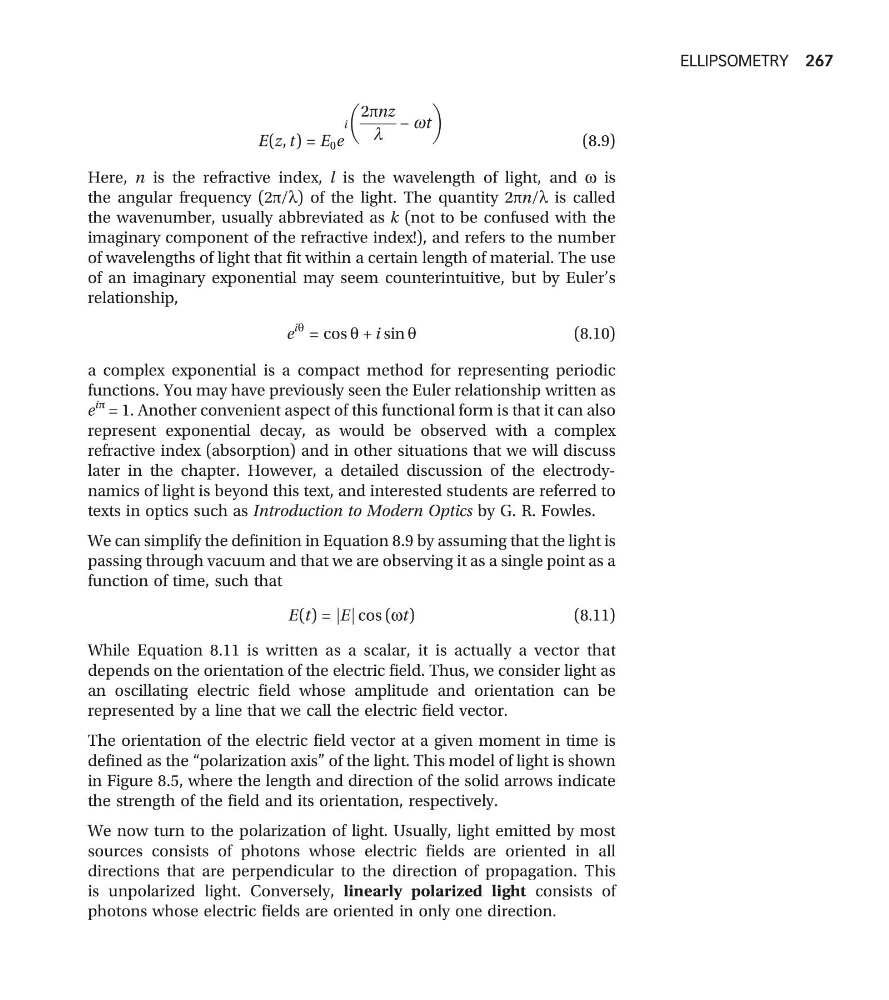
E(z, t) = E 0 e
i
2πnz
l
− wt
(8.9)
Here, n is the refractive index, l is the wavelength of light, and w is
the angular frequency (2π/l) of the light. The quantity 2πn/l is called
the wavenumber, usually abbreviated as k (not to be confused with the
imaginary component of the refractive index!), and refers to the number
of wavelengths of light that fit within a certain length of material. The use
of an imaginary exponential may seem counterintuitive, but by Euler’s
relationship,
e
iq = cos q + i sin q
(8.10)
a complex exponential is a compact method for representing periodic
functions. You may have previously seen the Euler relationship written as
e
iπ = 1. Another convenient aspect of this functional form is that it can also
represent exponential decay, as would be observed with a complex
refractive index (absorption) and in other situations that we will discuss
later in the chapter. However, a detailed discussion of the electrodynamics of light is beyond this text, and interested students are referred to
texts in optics such as Introduction to Modern Optics by G. R. Fowles.
We can simplify the definition in Equation 8.9 by assuming that the light is
passing through vacuum and that we are observing it as a single point as a
function of time, such that
E(t) = E
j j cos (wt)
(8.11)
While Equation 8.11 is written as a scalar, it is actually a vector that
depends on the orientation of the electric field. Thus, we consider light as
an oscillating electric field whose amplitude and orientation can be
represented by a line that we call the electric field vector.
The orientation of the electric field vector at a given moment in time is
defined as the “polarization axis” of the light. This model of light is shown
in Figure 8.5, where the length and direction of the solid arrows indicate
the strength of the field and its orientation, respectively.
We now turn to the polarization of light. Usually, light emitted by most
sources consists of photons whose electric fields are oriented in all
directions that are perpendicular to the direction of propagation. This
is unpolarized light. Conversely, linearly polarized light consists of
photons whose electric fields are oriented in only one direction.
ELLIPSOMETRY 267
i
2πnz
l
− wt
(8.9)
Here, n is the refractive index, l is the wavelength of light, and w is
the angular frequency (2π/l) of the light. The quantity 2πn/l is called
the wavenumber, usually abbreviated as k (not to be confused with the
imaginary component of the refractive index!), and refers to the number
of wavelengths of light that fit within a certain length of material. The use
of an imaginary exponential may seem counterintuitive, but by Euler’s
relationship,
e
iq = cos q + i sin q
(8.10)
a complex exponential is a compact method for representing periodic
functions. You may have previously seen the Euler relationship written as
e
iπ = 1. Another convenient aspect of this functional form is that it can also
represent exponential decay, as would be observed with a complex
refractive index (absorption) and in other situations that we will discuss
later in the chapter. However, a detailed discussion of the electrodynamics of light is beyond this text, and interested students are referred to
texts in optics such as Introduction to Modern Optics by G. R. Fowles.
We can simplify the definition in Equation 8.9 by assuming that the light is
passing through vacuum and that we are observing it as a single point as a
function of time, such that
E(t) = E
j j cos (wt)
(8.11)
While Equation 8.11 is written as a scalar, it is actually a vector that
depends on the orientation of the electric field. Thus, we consider light as
an oscillating electric field whose amplitude and orientation can be
represented by a line that we call the electric field vector.
The orientation of the electric field vector at a given moment in time is
defined as the “polarization axis” of the light. This model of light is shown
in Figure 8.5, where the length and direction of the solid arrows indicate
the strength of the field and its orientation, respectively.
We now turn to the polarization of light. Usually, light emitted by most
sources consists of photons whose electric fields are oriented in all
directions that are perpendicular to the direction of propagation. This
is unpolarized light. Conversely, linearly polarized light consists of
photons whose electric fields are oriented in only one direction.
ELLIPSOMETRY 267