

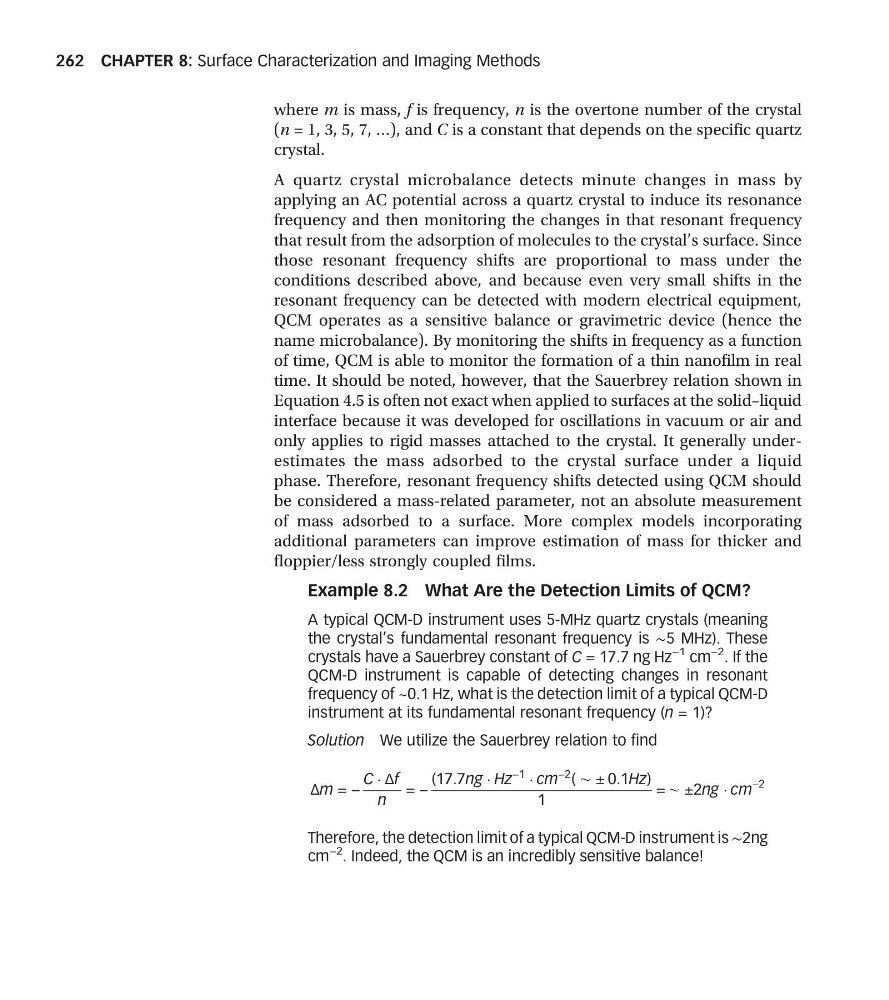
where m is mass, f is frequency, n is the overtone number of the crystal
(n = 1, 3, 5, 7, …), and C is a constant that depends on the specific quartz
crystal.
A quartz crystal microbalance detects minute changes in mass by
applying an AC potential across a quartz crystal to induce its resonance
frequency and then monitoring the changes in that resonant frequency
that result from the adsorption of molecules to the crystal’s surface. Since
those resonant frequency shifts are proportional to mass under the
conditions described above, and because even very small shifts in the
resonant frequency can be detected with modern electrical equipment,
QCM operates as a sensitive balance or gravimetric device (hence the
name microbalance). By monitoring the shifts in frequency as a function
of time, QCM is able to monitor the formation of a thin nanofilm in real
time. It should be noted, however, that the Sauerbrey relation shown in
Equation 4.5 is often not exact when applied to surfaces at the solid–liquid
interface because it was developed for oscillations in vacuum or air and
only applies to rigid masses attached to the crystal. It generally underestimates the mass adsorbed to the crystal surface under a liquid
phase. Therefore, resonant frequency shifts detected using QCM should
be considered a mass-related parameter, not an absolute measurement
of mass adsorbed to a surface. More complex models incorporating
additional parameters can improve estimation of mass for thicker and
floppier/less strongly coupled films.
Example 8.2 What Are the Detection Limits of QCM?
A typical QCM-D instrument uses 5-MHz quartz crystals (meaning
the crystal’s fundamental resonant frequency is ∼5 MHz). These
crystals have a Sauerbrey constant of C = 17.7 ng Hz
−1 cm
−2 . If the
QCM-D instrument is capable of detecting changes in resonant
frequency of ~0.1 Hz, what is the detection limit of a typical QCM-D
instrument at its fundamental resonant frequency (n = 1)?
Solution We utilize the Sauerbrey relation to find
Δm = −
C Á Δf
n
= −
(17:7ng Á Hz
−1
Á cm
−2 ( ∼ ± 0:1Hz)
1
= ∼ ±2ng Á cm
−2
Therefore, the detection limit of a typical QCM-D instrument is ∼2ng
cm
−2
. Indeed, the QCM is an incredibly sensitive balance!
CHAPTER 8: Surface Characterization and Imaging Methods
262
(n = 1, 3, 5, 7, …), and C is a constant that depends on the specific quartz
crystal.
A quartz crystal microbalance detects minute changes in mass by
applying an AC potential across a quartz crystal to induce its resonance
frequency and then monitoring the changes in that resonant frequency
that result from the adsorption of molecules to the crystal’s surface. Since
those resonant frequency shifts are proportional to mass under the
conditions described above, and because even very small shifts in the
resonant frequency can be detected with modern electrical equipment,
QCM operates as a sensitive balance or gravimetric device (hence the
name microbalance). By monitoring the shifts in frequency as a function
of time, QCM is able to monitor the formation of a thin nanofilm in real
time. It should be noted, however, that the Sauerbrey relation shown in
Equation 4.5 is often not exact when applied to surfaces at the solid–liquid
interface because it was developed for oscillations in vacuum or air and
only applies to rigid masses attached to the crystal. It generally underestimates the mass adsorbed to the crystal surface under a liquid
phase. Therefore, resonant frequency shifts detected using QCM should
be considered a mass-related parameter, not an absolute measurement
of mass adsorbed to a surface. More complex models incorporating
additional parameters can improve estimation of mass for thicker and
floppier/less strongly coupled films.
Example 8.2 What Are the Detection Limits of QCM?
A typical QCM-D instrument uses 5-MHz quartz crystals (meaning
the crystal’s fundamental resonant frequency is ∼5 MHz). These
crystals have a Sauerbrey constant of C = 17.7 ng Hz
−1 cm
−2 . If the
QCM-D instrument is capable of detecting changes in resonant
frequency of ~0.1 Hz, what is the detection limit of a typical QCM-D
instrument at its fundamental resonant frequency (n = 1)?
Solution We utilize the Sauerbrey relation to find
Δm = −
C Á Δf
n
= −
(17:7ng Á Hz
−1
Á cm
−2 ( ∼ ± 0:1Hz)
1
= ∼ ±2ng Á cm
−2
Therefore, the detection limit of a typical QCM-D instrument is ∼2ng
cm
−2
. Indeed, the QCM is an incredibly sensitive balance!
CHAPTER 8: Surface Characterization and Imaging Methods
262