

8.2.3 QCM and dissipation (D)
The quartz crystal microbalance with dissipation monitoring (QCM-D),
as compared with traditional QCM, offers additional information called
dissipation about the materials adsorbed to the QCM crystal surface.
Dissipation is a measure of the ability of the adsorbed material to release
or dissipate the energy of the oscillating QCM-D crystal. As such, it provides insight into characteristics of the adsorbed film such as its density,
thickness, and viscosity. Collectively, these properties are sometimes
referred to as viscoelastic properties. Dissipation is classically defined as
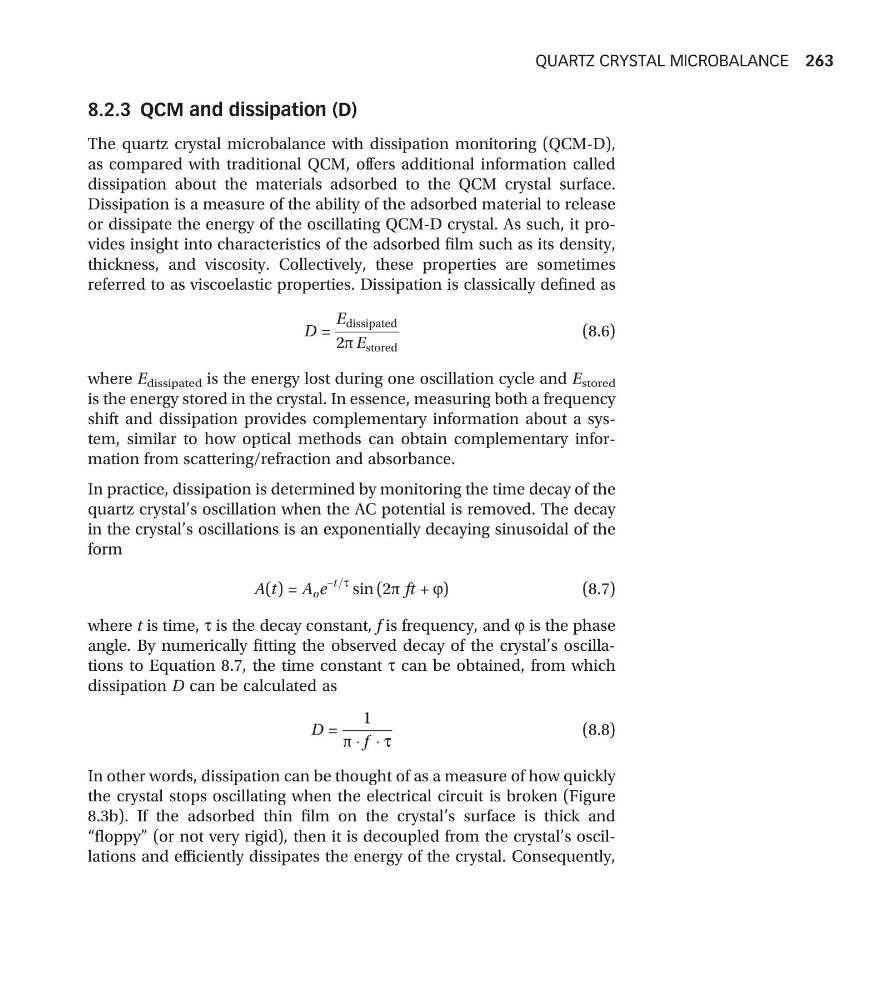
D =
E dissipated
2π E stored
(8.6)
where E dissipated is the energy lost during one oscillation cycle and E stored
is the energy stored in the crystal. In essence, measuring both a frequency
shift and dissipation provides complementary information about a system, similar to how optical methods can obtain complementary information from scattering/refraction and absorbance.
In practice, dissipation is determined by monitoring the time decay of the
quartz crystal’s oscillation when the AC potential is removed. The decay
in the crystal’s oscillations is an exponentially decaying sinusoidal of the
form
A(t) = A o e
−t=t sin (2π ft + j)
(8.7)
where t is time, t is the decay constant, f is frequency, and j is the phase
angle. By numerically fitting the observed decay of the crystal’s oscillations to Equation 8.7, the time constant t can be obtained, from which
dissipation D can be calculated as
D =
1
π Á f Á t
(8.8)
In other words, dissipation can be thought of as a measure of how quickly
the crystal stops oscillating when the electrical circuit is broken (Figure
8.3b). If the adsorbed thin film on the crystal’s surface is thick and
“floppy” (or not very rigid), then it is decoupled from the crystal’s oscillations and efficiently dissipates the energy of the crystal. Consequently,
QUARTZ CRYSTAL MICROBALANCE 263
The quartz crystal microbalance with dissipation monitoring (QCM-D),
as compared with traditional QCM, offers additional information called
dissipation about the materials adsorbed to the QCM crystal surface.
Dissipation is a measure of the ability of the adsorbed material to release
or dissipate the energy of the oscillating QCM-D crystal. As such, it provides insight into characteristics of the adsorbed film such as its density,
thickness, and viscosity. Collectively, these properties are sometimes
referred to as viscoelastic properties. Dissipation is classically defined as
D =
E dissipated
2π E stored
(8.6)
where E dissipated is the energy lost during one oscillation cycle and E stored
is the energy stored in the crystal. In essence, measuring both a frequency
shift and dissipation provides complementary information about a system, similar to how optical methods can obtain complementary information from scattering/refraction and absorbance.
In practice, dissipation is determined by monitoring the time decay of the
quartz crystal’s oscillation when the AC potential is removed. The decay
in the crystal’s oscillations is an exponentially decaying sinusoidal of the
form
A(t) = A o e
−t=t sin (2π ft + j)
(8.7)
where t is time, t is the decay constant, f is frequency, and j is the phase
angle. By numerically fitting the observed decay of the crystal’s oscillations to Equation 8.7, the time constant t can be obtained, from which
dissipation D can be calculated as
D =
1
π Á f Á t
(8.8)
In other words, dissipation can be thought of as a measure of how quickly
the crystal stops oscillating when the electrical circuit is broken (Figure
8.3b). If the adsorbed thin film on the crystal’s surface is thick and
“floppy” (or not very rigid), then it is decoupled from the crystal’s oscillations and efficiently dissipates the energy of the crystal. Consequently,
QUARTZ CRYSTAL MICROBALANCE 263