

F = (r P lwt)g − (r L hwt)g + 2(w + t)g cos f
(8.2)
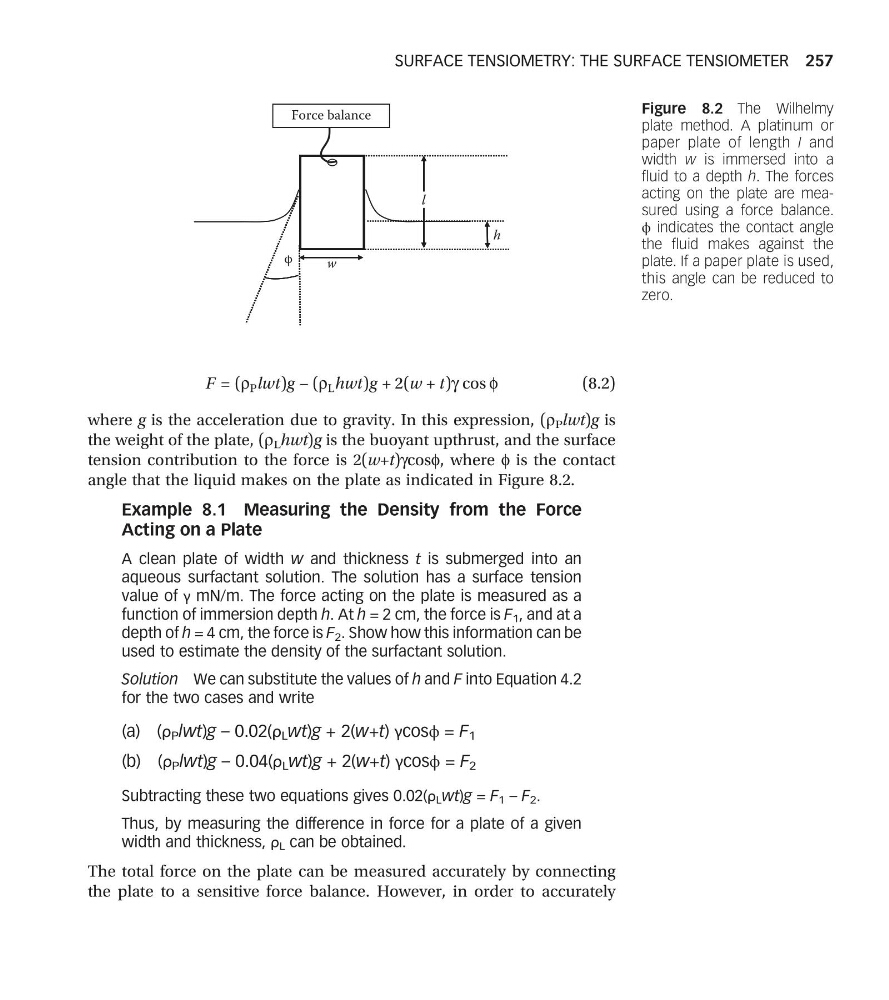
where g is the acceleration due to gravity. In this expression, (r P lwt)g is
the weight of the plate, (r L hwt)g is the buoyant upthrust, and the surface
tension contribution to the force is 2(w+t)gcosf, where f is the contact
angle that the liquid makes on the plate as indicated in Figure 8.2.
Example 8.1 Measuring the Density from the Force
Acting on a Plate
A clean plate of width w and thickness t is submerged into an
aqueous surfactant solution. The solution has a surface tension
value of γ mN/m. The force acting on the plate is measured as a
function of immersion depth h. At h = 2 cm, the force is F 1 , and at a
depth of h = 4 cm, the force is F 2 . Show how this information can be
used to estimate the density of the surfactant solution.
Solution We can substitute the values of h and F into Equation 4.2
for the two cases and write
(a) (ρ P lwt)g – 0.02(ρ L wt)g + 2(w+t) γcosϕ = F 1
(b) (ρ P lwt)g – 0.04(ρ L wt)g + 2(w+t) γcosϕ = F 2
Subtracting these two equations gives 0.02(ρ L wt)g = F 1 – F 2 .
Thus, by measuring the difference in force for a plate of a given
width and thickness, ρ L can be obtained.
The total force on the plate can be measured accurately by connecting
the plate to a sensitive force balance. However, in order to accurately
h
Force balance
l
φ
w
Figure 8.2 The Wilhelmy
plate method. A platinum or
paper plate of length I and
width w is immersed into a
fluid to a depth h. The forces
acting on the plate are measured using a force balance.
ϕ indicates the contact angle
the fluid makes against the
plate. If a paper plate is used,
this angle can be reduced to
zero.
SURFACE TENSIOMETRY: THE SURFACE TENSIOMETER 257
(8.2)
where g is the acceleration due to gravity. In this expression, (r P lwt)g is
the weight of the plate, (r L hwt)g is the buoyant upthrust, and the surface
tension contribution to the force is 2(w+t)gcosf, where f is the contact
angle that the liquid makes on the plate as indicated in Figure 8.2.
Example 8.1 Measuring the Density from the Force
Acting on a Plate
A clean plate of width w and thickness t is submerged into an
aqueous surfactant solution. The solution has a surface tension
value of γ mN/m. The force acting on the plate is measured as a
function of immersion depth h. At h = 2 cm, the force is F 1 , and at a
depth of h = 4 cm, the force is F 2 . Show how this information can be
used to estimate the density of the surfactant solution.
Solution We can substitute the values of h and F into Equation 4.2
for the two cases and write
(a) (ρ P lwt)g – 0.02(ρ L wt)g + 2(w+t) γcosϕ = F 1
(b) (ρ P lwt)g – 0.04(ρ L wt)g + 2(w+t) γcosϕ = F 2
Subtracting these two equations gives 0.02(ρ L wt)g = F 1 – F 2 .
Thus, by measuring the difference in force for a plate of a given
width and thickness, ρ L can be obtained.
The total force on the plate can be measured accurately by connecting
the plate to a sensitive force balance. However, in order to accurately
h
Force balance
l
φ
w
Figure 8.2 The Wilhelmy
plate method. A platinum or
paper plate of length I and
width w is immersed into a
fluid to a depth h. The forces
acting on the plate are measured using a force balance.
ϕ indicates the contact angle
the fluid makes against the
plate. If a paper plate is used,
this angle can be reduced to
zero.
SURFACE TENSIOMETRY: THE SURFACE TENSIOMETER 257