

calculate the surface tension from the total force using Equation 8.2, we
would need to know (also very accurately) the dimensions of the plate as
well as the densities of both the plate and the liquid. Fortunately, the
expression of the measured total force in Equation 8.2 can be simplified
through careful manipulation of the procedure used to measure the total
force on the plate, as follows.
First, before making any measurements and prior to submerging the plate
into the liquid, the force balance is zeroed. Zeroing the balance eliminates
the weight term from Equation 8.2. The plate is then submerged into the
fluid and slowly raised until its lower edge is level with the liquid surface,
thus eliminating the upthrust term because h = 0. In this position,
Equation 8.2 is reduced to
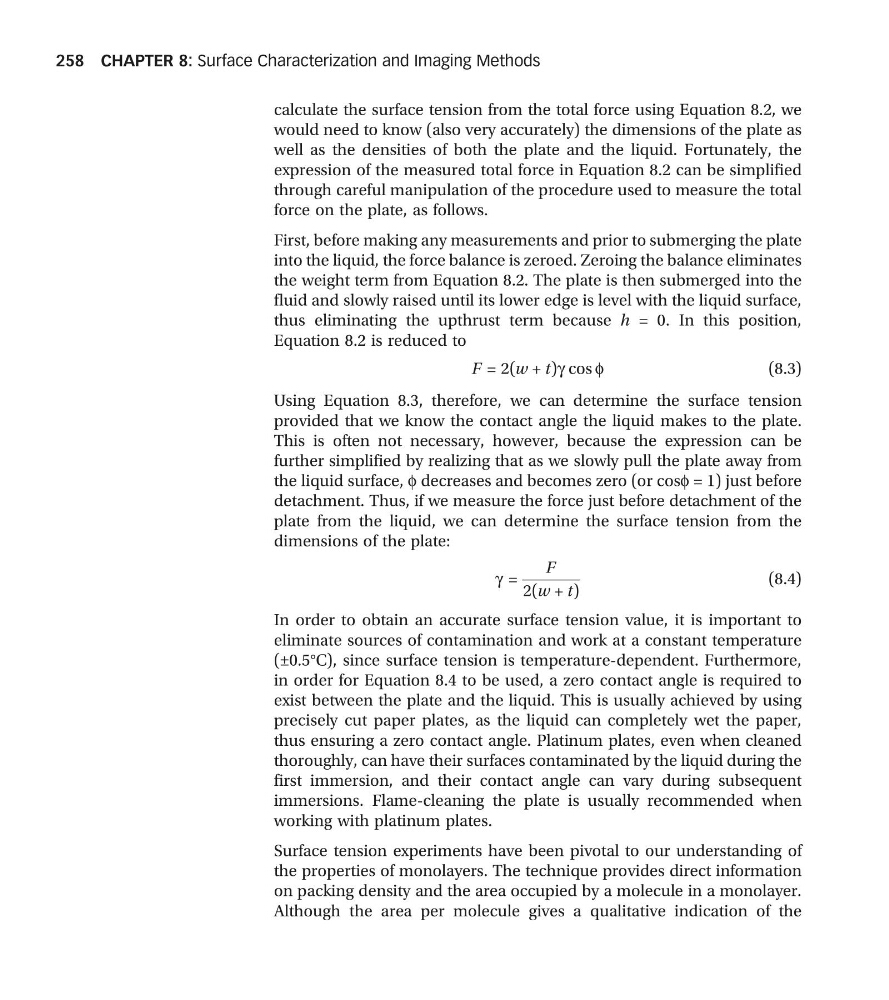
F = 2(w + t)g cos f
(8.3)
Using Equation 8.3, therefore, we can determine the surface tension
provided that we know the contact angle the liquid makes to the plate.
This is often not necessary, however, because the expression can be
further simplified by realizing that as we slowly pull the plate away from
the liquid surface, f decreases and becomes zero (or cosf = 1) just before
detachment. Thus, if we measure the force just before detachment of the
plate from the liquid, we can determine the surface tension from the
dimensions of the plate:
g =
F
2(w + t)
(8.4)
In order to obtain an accurate surface tension value, it is important to
eliminate sources of contamination and work at a constant temperature
(±0.5°C), since surface tension is temperature-dependent. Furthermore,
in order for Equation 8.4 to be used, a zero contact angle is required to
exist between the plate and the liquid. This is usually achieved by using
precisely cut paper plates, as the liquid can completely wet the paper,
thus ensuring a zero contact angle. Platinum plates, even when cleaned
thoroughly, can have their surfaces contaminated by the liquid during the
first immersion, and their contact angle can vary during subsequent
immersions. Flame-cleaning the plate is usually recommended when
working with platinum plates.
Surface tension experiments have been pivotal to our understanding of
the properties of monolayers. The technique provides direct information
on packing density and the area occupied by a molecule in a monolayer.
Although the area per molecule gives a qualitative indication of the
CHAPTER 8: Surface Characterization and Imaging Methods
258
would need to know (also very accurately) the dimensions of the plate as
well as the densities of both the plate and the liquid. Fortunately, the
expression of the measured total force in Equation 8.2 can be simplified
through careful manipulation of the procedure used to measure the total
force on the plate, as follows.
First, before making any measurements and prior to submerging the plate
into the liquid, the force balance is zeroed. Zeroing the balance eliminates
the weight term from Equation 8.2. The plate is then submerged into the
fluid and slowly raised until its lower edge is level with the liquid surface,
thus eliminating the upthrust term because h = 0. In this position,
Equation 8.2 is reduced to
F = 2(w + t)g cos f
(8.3)
Using Equation 8.3, therefore, we can determine the surface tension
provided that we know the contact angle the liquid makes to the plate.
This is often not necessary, however, because the expression can be
further simplified by realizing that as we slowly pull the plate away from
the liquid surface, f decreases and becomes zero (or cosf = 1) just before
detachment. Thus, if we measure the force just before detachment of the
plate from the liquid, we can determine the surface tension from the
dimensions of the plate:
g =
F
2(w + t)
(8.4)
In order to obtain an accurate surface tension value, it is important to
eliminate sources of contamination and work at a constant temperature
(±0.5°C), since surface tension is temperature-dependent. Furthermore,
in order for Equation 8.4 to be used, a zero contact angle is required to
exist between the plate and the liquid. This is usually achieved by using
precisely cut paper plates, as the liquid can completely wet the paper,
thus ensuring a zero contact angle. Platinum plates, even when cleaned
thoroughly, can have their surfaces contaminated by the liquid during the
first immersion, and their contact angle can vary during subsequent
immersions. Flame-cleaning the plate is usually recommended when
working with platinum plates.
Surface tension experiments have been pivotal to our understanding of
the properties of monolayers. The technique provides direct information
on packing density and the area occupied by a molecule in a monolayer.
Although the area per molecule gives a qualitative indication of the
CHAPTER 8: Surface Characterization and Imaging Methods
258