

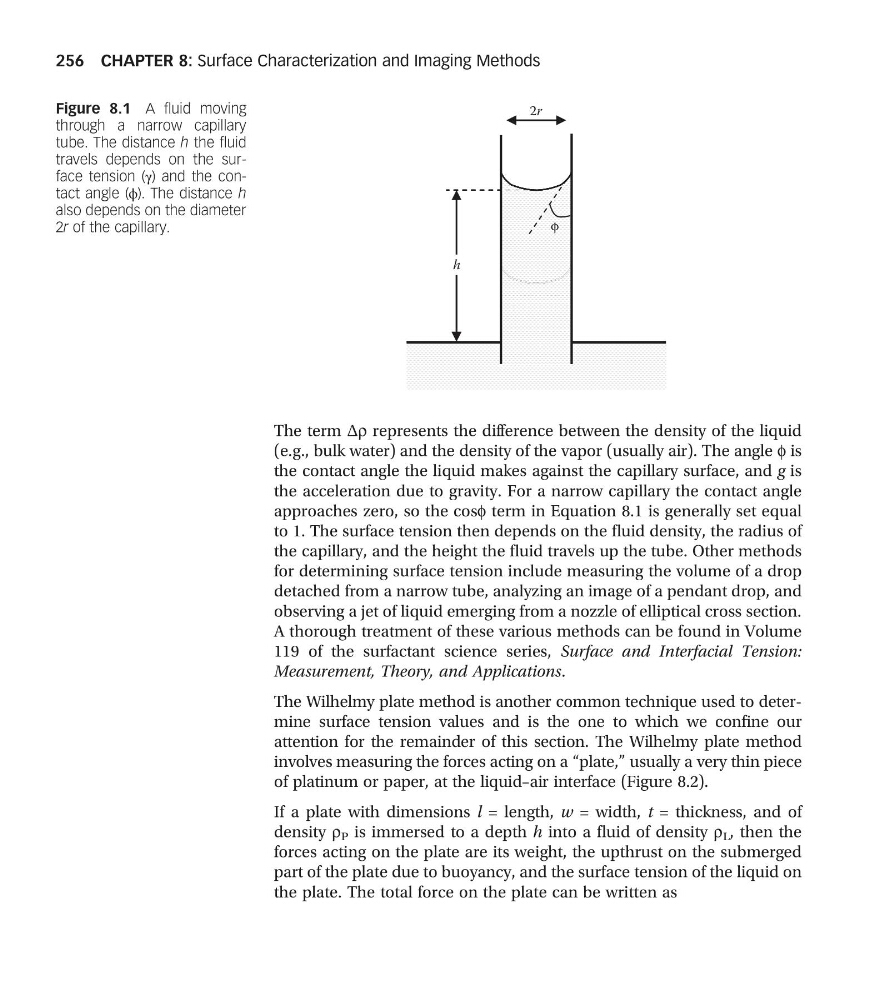
The term Δr represents the difference between the density of the liquid
(e.g., bulk water) and the density of the vapor (usually air). The angle f is
the contact angle the liquid makes against the capillary surface, and g is
the acceleration due to gravity. For a narrow capillary the contact angle
approaches zero, so the cosf term in Equation 8.1 is generally set equal
to 1. The surface tension then depends on the fluid density, the radius of
the capillary, and the height the fluid travels up the tube. Other methods
for determining surface tension include measuring the volume of a drop
detached from a narrow tube, analyzing an image of a pendant drop, and
observing a jet of liquid emerging from a nozzle of elliptical cross section.
A thorough treatment of these various methods can be found in Volume
119 of the surfactant science series, Surface and Interfacial Tension:
Measurement, Theory, and Applications.
The Wilhelmy plate method is another common technique used to determine surface tension values and is the one to which we confine our
attention for the remainder of this section. The Wilhelmy plate method
involves measuring the forces acting on a “plate,” usually a very thin piece
of platinum or paper, at the liquid–air interface (Figure 8.2).
If a plate with dimensions l = length, w = width, t = thickness, and of
density r P is immersed to a depth h into a fluid of density r L , then the
forces acting on the plate are its weight, the upthrust on the submerged
part of the plate due to buoyancy, and the surface tension of the liquid on
the plate. The total force on the plate can be written as
2r
φ
h
Figure 8.1 A fluid moving
through a narrow capillary
tube. The distance h the fluid
travels depends on the surface tension (γ) and the contact angle (ϕ). The distance h
also depends on the diameter
2r of the capillary.
CHAPTER 8: Surface Characterization and Imaging Methods
256
(e.g., bulk water) and the density of the vapor (usually air). The angle f is
the contact angle the liquid makes against the capillary surface, and g is
the acceleration due to gravity. For a narrow capillary the contact angle
approaches zero, so the cosf term in Equation 8.1 is generally set equal
to 1. The surface tension then depends on the fluid density, the radius of
the capillary, and the height the fluid travels up the tube. Other methods
for determining surface tension include measuring the volume of a drop
detached from a narrow tube, analyzing an image of a pendant drop, and
observing a jet of liquid emerging from a nozzle of elliptical cross section.
A thorough treatment of these various methods can be found in Volume
119 of the surfactant science series, Surface and Interfacial Tension:
Measurement, Theory, and Applications.
The Wilhelmy plate method is another common technique used to determine surface tension values and is the one to which we confine our
attention for the remainder of this section. The Wilhelmy plate method
involves measuring the forces acting on a “plate,” usually a very thin piece
of platinum or paper, at the liquid–air interface (Figure 8.2).
If a plate with dimensions l = length, w = width, t = thickness, and of
density r P is immersed to a depth h into a fluid of density r L , then the
forces acting on the plate are its weight, the upthrust on the submerged
part of the plate due to buoyancy, and the surface tension of the liquid on
the plate. The total force on the plate can be written as
2r
φ
h
Figure 8.1 A fluid moving
through a narrow capillary
tube. The distance h the fluid
travels depends on the surface tension (γ) and the contact angle (ϕ). The distance h
also depends on the diameter
2r of the capillary.
CHAPTER 8: Surface Characterization and Imaging Methods
256