

a. Calculate the surface excess concentrations and the average area occupied by
each adsorbed molecule for bulk concentrations of 0.01, 0.02, and 0.04 mol
dm
–3
.
b. Plot a surface pressure versus area per
molecule (Π–σ) curve for the adsorbed
n-pentanol monolayer and compare it
with the corresponding curve for an ideal
gaseous film. You should say something
about how the molecules are interacting.
Clue: The compressibility of the film is
Z =
Π σ
kT
This should be equal to 1 at all surface
pressures for an ideal gas.
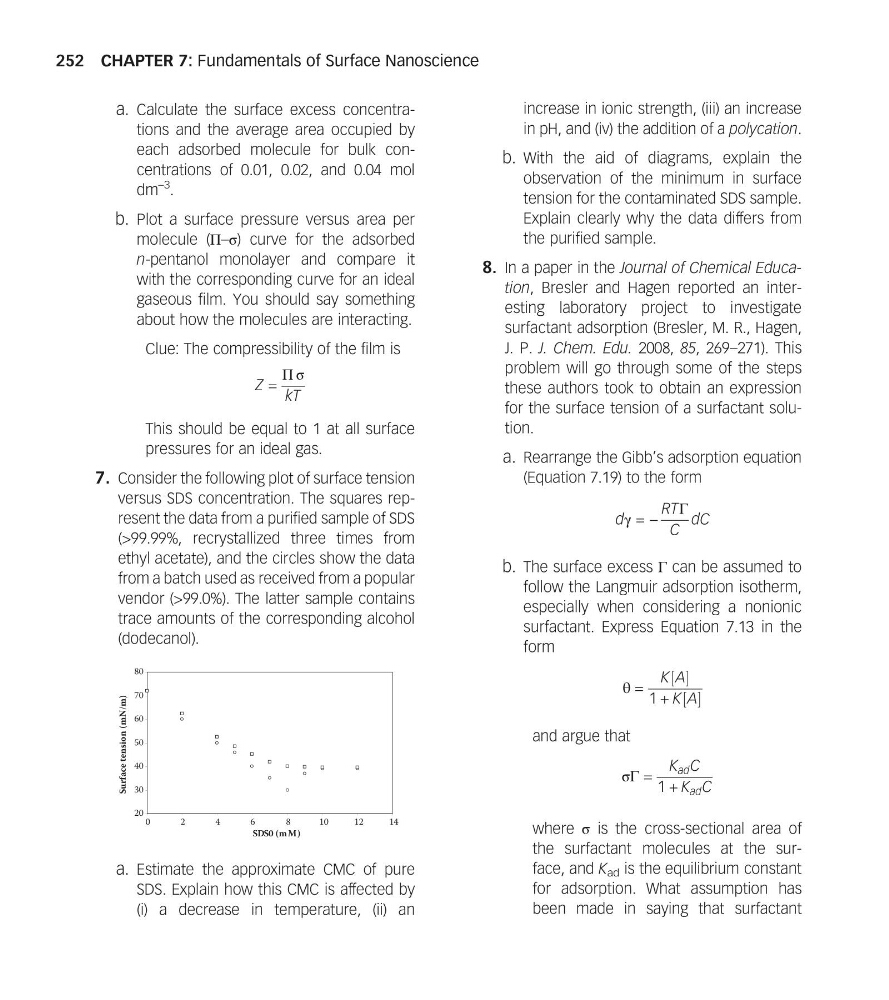
7. Consider the following plot of surface tension
versus SDS concentration. The squares represent the data from a purified sample of SDS
(>99.99%, recrystallized three times from
ethyl acetate), and the circles show the data
from a batch used as received from a popular
vendor (>99.0%). The latter sample contains
trace amounts of the corresponding alcohol
(dodecanol).
20
30
40
50
60
70
80
0
2
4
6
8
10
12
14
SDS0 (m M)
Surface tension (mN/m)
a. Estimate the approximate CMC of pure
SDS. Explain how this CMC is affected by
(i) a decrease in temperature, (ii) an
increase in ionic strength, (iii) an increase
in pH, and (iv) the addition of a polycation.
b. With the aid of diagrams, explain the
observation of the minimum in surface
tension for the contaminated SDS sample.
Explain clearly why the data differs from
the purified sample.
8. In a paper in the Journal of Chemical Education, Bresler and Hagen reported an interesting laboratory project to investigate
surfactant adsorption (Bresler, M. R., Hagen,
J. P. J. Chem. Edu. 2008, 85, 269–271). This
problem will go through some of the steps
these authors took to obtain an expression
for the surface tension of a surfactant solution.
a. Rearrange the Gibb’s adsorption equation
(Equation 7.19) to the form
dγ = −
RTΓ
C
dC
b. The surface excess Γ can be assumed to
follow the Langmuir adsorption isotherm,
especially when considering a nonionic
surfactant. Express Equation 7.13 in the
form
θ =
K A
½
1 + K A
½
and argue that
σΓ =
K ad C
1 + K ad C
where σ is the cross-sectional area of
the surfactant molecules at the surface, and K ad is the equilibrium constant
for adsorption. What assumption has
been made in saying that surfactant
CHAPTER 7: Fundamentals of Surface Nanoscience
252
each adsorbed molecule for bulk concentrations of 0.01, 0.02, and 0.04 mol
dm
–3
.
b. Plot a surface pressure versus area per
molecule (Π–σ) curve for the adsorbed
n-pentanol monolayer and compare it
with the corresponding curve for an ideal
gaseous film. You should say something
about how the molecules are interacting.
Clue: The compressibility of the film is
Z =
Π σ
kT
This should be equal to 1 at all surface
pressures for an ideal gas.
7. Consider the following plot of surface tension
versus SDS concentration. The squares represent the data from a purified sample of SDS
(>99.99%, recrystallized three times from
ethyl acetate), and the circles show the data
from a batch used as received from a popular
vendor (>99.0%). The latter sample contains
trace amounts of the corresponding alcohol
(dodecanol).
20
30
40
50
60
70
80
0
2
4
6
8
10
12
14
SDS0 (m M)
Surface tension (mN/m)
a. Estimate the approximate CMC of pure
SDS. Explain how this CMC is affected by
(i) a decrease in temperature, (ii) an
increase in ionic strength, (iii) an increase
in pH, and (iv) the addition of a polycation.
b. With the aid of diagrams, explain the
observation of the minimum in surface
tension for the contaminated SDS sample.
Explain clearly why the data differs from
the purified sample.
8. In a paper in the Journal of Chemical Education, Bresler and Hagen reported an interesting laboratory project to investigate
surfactant adsorption (Bresler, M. R., Hagen,
J. P. J. Chem. Edu. 2008, 85, 269–271). This
problem will go through some of the steps
these authors took to obtain an expression
for the surface tension of a surfactant solution.
a. Rearrange the Gibb’s adsorption equation
(Equation 7.19) to the form
dγ = −
RTΓ
C
dC
b. The surface excess Γ can be assumed to
follow the Langmuir adsorption isotherm,
especially when considering a nonionic
surfactant. Express Equation 7.13 in the
form
θ =
K A
½
1 + K A
½
and argue that
σΓ =
K ad C
1 + K ad C
where σ is the cross-sectional area of
the surfactant molecules at the surface, and K ad is the equilibrium constant
for adsorption. What assumption has
been made in saying that surfactant
CHAPTER 7: Fundamentals of Surface Nanoscience
252