

adsorption follows the Langmuir
adsorption isotherm?
c. Solve
σΓ =
K ad C
1 + K ad C
for the surface excess, and then substitute the result into
dγ = −
RTΓ
C
dC
Integrate the resulting expression to
obtain the Szyszkowski equation,
γ = γ 0 −
RT
σ
ln 1 + K ad C
ð
Þ
where γ 0 is the surface tension of pure
water.
9. The Szyszkowski equation in Question 8 can
be used to obtain the standard Gibb’s energy
of adsorption (ΔG
o
ad ). By plotting surface
tension versus bulk concentration below
the CMC and then curve fitting the data, one
can obtain K ad . This value is related to the
standard Gibb’s energy of adsorption by
the equation ΔG
o
ad = −RT ln K ad . The following
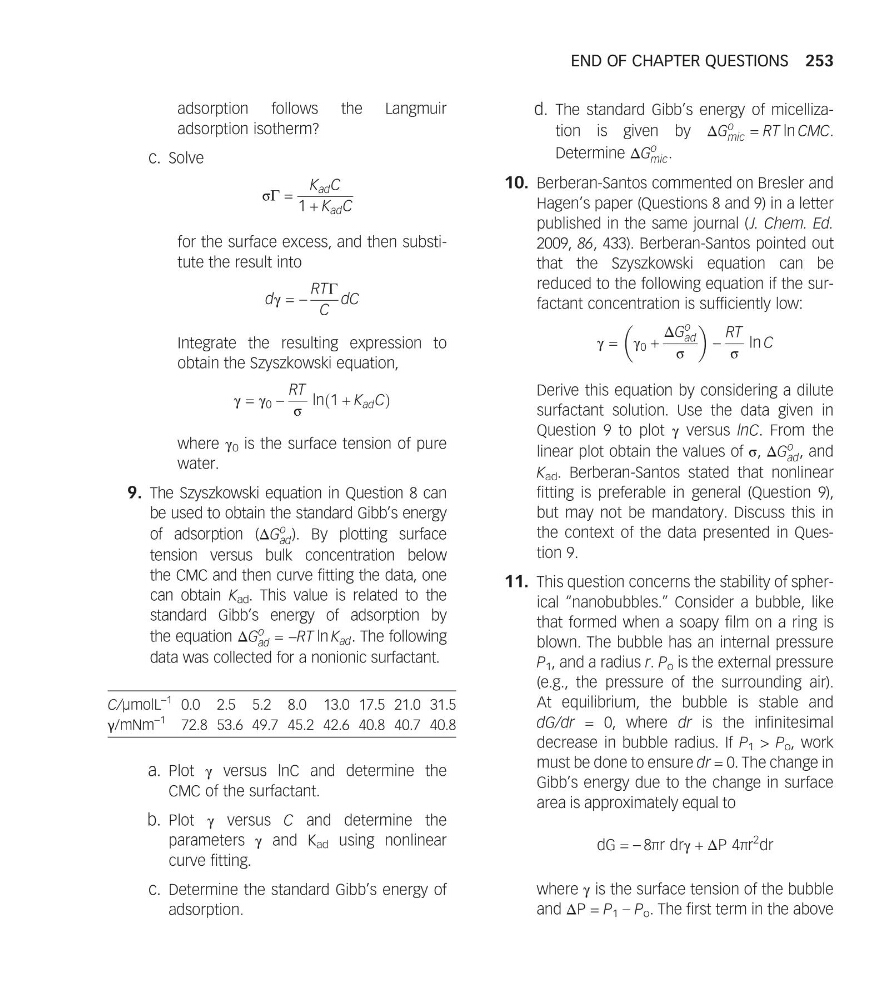
data was collected for a nonionic surfactant.
C/µmolL
–1 0.0 2.5 5.2 8.0 13.0 17.5 21.0 31.5
γ/mNm
–1
72.8 53.6 49.7 45.2 42.6 40.8 40.7 40.8
a. Plot γ versus lnC and determine the
CMC of the surfactant.
b. Plot γ versus C and determine the
parameters γ and K ad using nonlinear
curve fitting.
c. Determine the standard Gibb’s energy of
adsorption.
d. The standard Gibb’s energy of micellization is given by ΔG
o
mic = RT ln CMC.
Determine ΔG
o
mic .
10. Berberan-Santos commented on Bresler and
Hagen’s paper (Questions 8 and 9) in a letter
published in the same journal ( J. Chem. Ed.
2009, 86, 433). Berberan-Santos pointed out
that the Szyszkowski equation can be
reduced to the following equation if the surfactant concentration is sufficiently low:
γ = γ 0 +
ΔG
o
ad
σ
−
RT
σ
ln C
Derive this equation by considering a dilute
surfactant solution. Use the data given in
Question 9 to plot γ versus lnC. From the
linear plot obtain the values of σ, ΔG
o
ad , and
K ad . Berberan-Santos stated that nonlinear
fitting is preferable in general (Question 9),
but may not be mandatory. Discuss this in
the context of the data presented in Question 9.
11. This question concerns the stability of spherical “nanobubbles.” Consider a bubble, like
that formed when a soapy film on a ring is
blown. The bubble has an internal pressure
P 1 , and a radius r. P o is the external pressure
(e.g., the pressure of the surrounding air).
At equilibrium, the bubble is stable and
dG/dr = 0, where dr is the infinitesimal
decrease in bubble radius. If P 1 > P o , work
must be done to ensure dr = 0. The change in
Gibb’s energy due to the change in surface
area is approximately equal to
dG = – 8πr drγ + ΔP 4πr
2 dr
where γ is the surface tension of the bubble
and ΔP = P 1 – P o . The first term in the above
END OF CHAPTER QUESTIONS 253
adsorption isotherm?
c. Solve
σΓ =
K ad C
1 + K ad C
for the surface excess, and then substitute the result into
dγ = −
RTΓ
C
dC
Integrate the resulting expression to
obtain the Szyszkowski equation,
γ = γ 0 −
RT
σ
ln 1 + K ad C
ð
Þ
where γ 0 is the surface tension of pure
water.
9. The Szyszkowski equation in Question 8 can
be used to obtain the standard Gibb’s energy
of adsorption (ΔG
o
ad ). By plotting surface
tension versus bulk concentration below
the CMC and then curve fitting the data, one
can obtain K ad . This value is related to the
standard Gibb’s energy of adsorption by
the equation ΔG
o
ad = −RT ln K ad . The following
data was collected for a nonionic surfactant.
C/µmolL
–1 0.0 2.5 5.2 8.0 13.0 17.5 21.0 31.5
γ/mNm
–1
72.8 53.6 49.7 45.2 42.6 40.8 40.7 40.8
a. Plot γ versus lnC and determine the
CMC of the surfactant.
b. Plot γ versus C and determine the
parameters γ and K ad using nonlinear
curve fitting.
c. Determine the standard Gibb’s energy of
adsorption.
d. The standard Gibb’s energy of micellization is given by ΔG
o
mic = RT ln CMC.
Determine ΔG
o
mic .
10. Berberan-Santos commented on Bresler and
Hagen’s paper (Questions 8 and 9) in a letter
published in the same journal ( J. Chem. Ed.
2009, 86, 433). Berberan-Santos pointed out
that the Szyszkowski equation can be
reduced to the following equation if the surfactant concentration is sufficiently low:
γ = γ 0 +
ΔG
o
ad
σ
−
RT
σ
ln C
Derive this equation by considering a dilute
surfactant solution. Use the data given in
Question 9 to plot γ versus lnC. From the
linear plot obtain the values of σ, ΔG
o
ad , and
K ad . Berberan-Santos stated that nonlinear
fitting is preferable in general (Question 9),
but may not be mandatory. Discuss this in
the context of the data presented in Question 9.
11. This question concerns the stability of spherical “nanobubbles.” Consider a bubble, like
that formed when a soapy film on a ring is
blown. The bubble has an internal pressure
P 1 , and a radius r. P o is the external pressure
(e.g., the pressure of the surrounding air).
At equilibrium, the bubble is stable and
dG/dr = 0, where dr is the infinitesimal
decrease in bubble radius. If P 1 > P o , work
must be done to ensure dr = 0. The change in
Gibb’s energy due to the change in surface
area is approximately equal to
dG = – 8πr drγ + ΔP 4πr
2 dr
where γ is the surface tension of the bubble
and ΔP = P 1 – P o . The first term in the above
END OF CHAPTER QUESTIONS 253