

Derive an expression describing the reversible isothermal work due to the expansion of a
lipid monolayer obeying this equation of
state.
4. Charcoal is an excellent adsorbate for
organic molecules. The amount of dodecanol
adsorbed on this material from a toluene
solution was measured at room temperature. The following data gives the equilibrium amount adsorbed on charcoal and the
corresponding equilibrium concentration of
dodecanol in the bulk phase.
Bulk concentration
(mol dm
–3
)
0.010 0.035 0.061 0.104 0.149
Amount adsorbed
(µmol g
−1
)
24.0 50.3 70.0 81.2 90.8
a. By means of a graph, show that the data fit
the Langmuir adsorption model. Calculate
the area occupied by each adsorbed
dodecanol molecule at saturation coverage. Take the adsorption area of the
charcoal to be 100 m
2 g
−1 .
b. How would the adsorption isotherm
change if the dodecanol was adsorbed
from a slightly more polar solution compared to toluene?
5. This question concerns the application of
Young’s equation, which considers the
equilibrium state of a drop of liquid on a solid
surface in terms of the various surface tensions. Consider a drop of oil (an n-alkane) on
the surface of solid polytetrafluotoethylene
(PTFE). As expected, the oil spreads to some
degree and forms a drop on the surface. The
following oils were placed on the solid
surface and the corresponding contact
angles measured. The surface tension of
each oil is also given.
Oil (n-alkane), n
cosθ
γ(mN/m)
6
0.95
18
8
0.87
22
12
0.78
25
16
0.72
27
Estimate the critical surface tension (γ c ) corresponding to complete wetting. Show that
its value is simply γ SV . Do you think it is true
that all liquids with a surface tension less
than γ c will spread on PTFE? If so, explain.
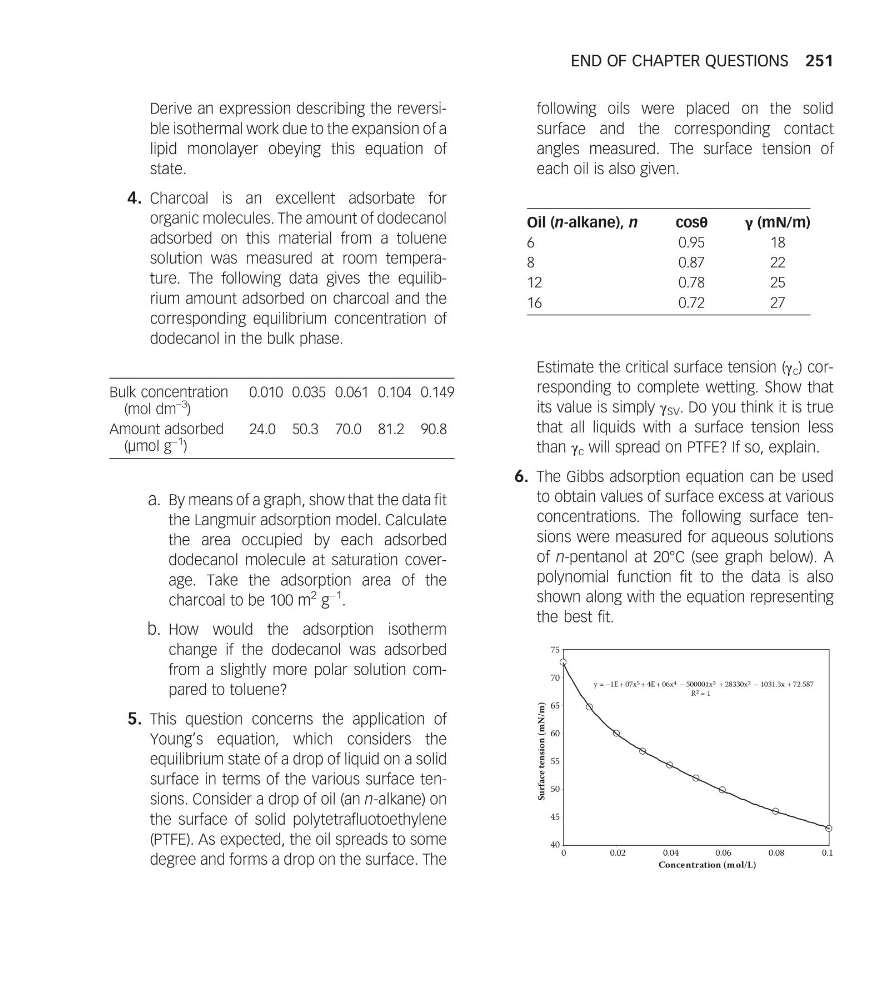
6. The Gibbs adsorption equation can be used
to obtain values of surface excess at various
concentrations. The following surface tensions were measured for aqueous solutions
of n-pentanol at 20°C (see graph below). A
polynomial function fit to the data is also
shown along with the equation representing
the best fit.
y = –1E + 07x 5 + 4E + 06x 4 – 500001x 3 + 28330x 2 – 1031.3x + 72.587
R 2 = 1
40
45
50
55
60
65
70
75
0
0.02
0.04
0.06
0.08
0.1
Concentration (m ol/L)
Surface tension (mN/m)
END OF CHAPTER QUESTIONS 251
lipid monolayer obeying this equation of
state.
4. Charcoal is an excellent adsorbate for
organic molecules. The amount of dodecanol
adsorbed on this material from a toluene
solution was measured at room temperature. The following data gives the equilibrium amount adsorbed on charcoal and the
corresponding equilibrium concentration of
dodecanol in the bulk phase.
Bulk concentration
(mol dm
–3
)
0.010 0.035 0.061 0.104 0.149
Amount adsorbed
(µmol g
−1
)
24.0 50.3 70.0 81.2 90.8
a. By means of a graph, show that the data fit
the Langmuir adsorption model. Calculate
the area occupied by each adsorbed
dodecanol molecule at saturation coverage. Take the adsorption area of the
charcoal to be 100 m
2 g
−1 .
b. How would the adsorption isotherm
change if the dodecanol was adsorbed
from a slightly more polar solution compared to toluene?
5. This question concerns the application of
Young’s equation, which considers the
equilibrium state of a drop of liquid on a solid
surface in terms of the various surface tensions. Consider a drop of oil (an n-alkane) on
the surface of solid polytetrafluotoethylene
(PTFE). As expected, the oil spreads to some
degree and forms a drop on the surface. The
following oils were placed on the solid
surface and the corresponding contact
angles measured. The surface tension of
each oil is also given.
Oil (n-alkane), n
cosθ
γ(mN/m)
6
0.95
18
8
0.87
22
12
0.78
25
16
0.72
27
Estimate the critical surface tension (γ c ) corresponding to complete wetting. Show that
its value is simply γ SV . Do you think it is true
that all liquids with a surface tension less
than γ c will spread on PTFE? If so, explain.
6. The Gibbs adsorption equation can be used
to obtain values of surface excess at various
concentrations. The following surface tensions were measured for aqueous solutions
of n-pentanol at 20°C (see graph below). A
polynomial function fit to the data is also
shown along with the equation representing
the best fit.
y = –1E + 07x 5 + 4E + 06x 4 – 500001x 3 + 28330x 2 – 1031.3x + 72.587
R 2 = 1
40
45
50
55
60
65
70
75
0
0.02
0.04
0.06
0.08
0.1
Concentration (m ol/L)
Surface tension (mN/m)
END OF CHAPTER QUESTIONS 251