

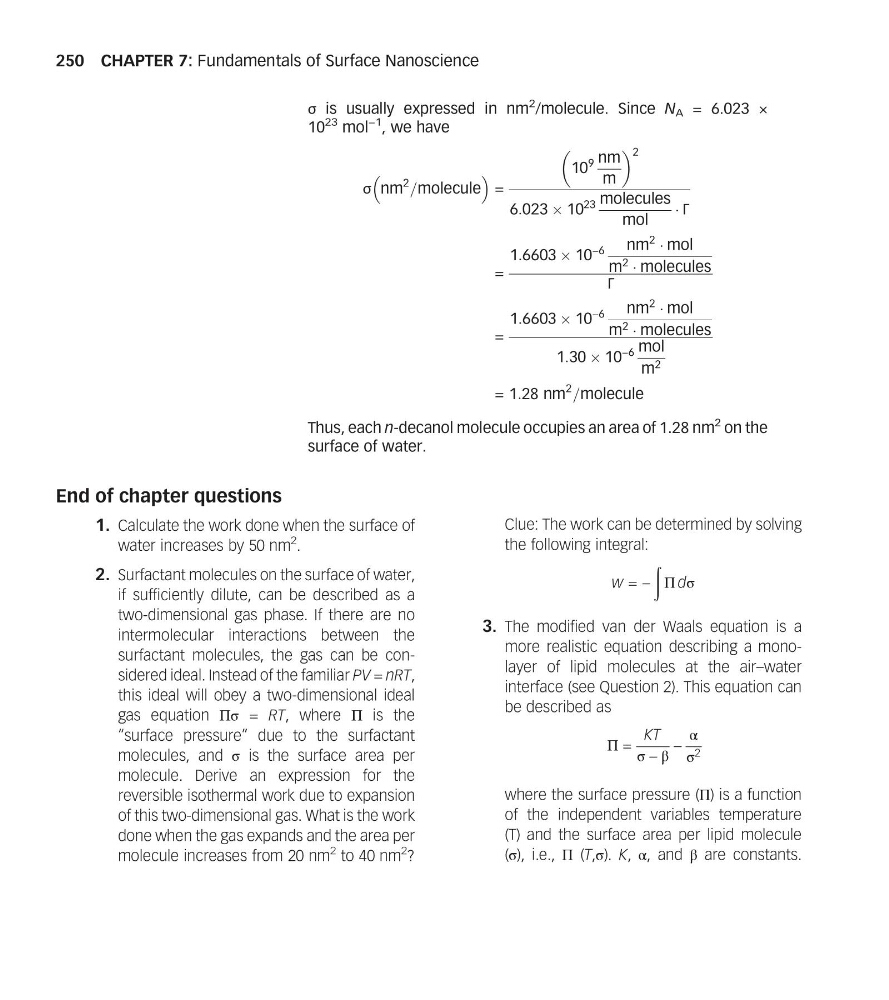
σ is usually expressed in nm
2
/molecule. Since N A = 6.023 ×
10
23 mol
−1
, we have
σ nm
2 =molecule
=
10
9 nm
m
2
6:023 Â 10
23 molecules
mol
Á Γ
=
1:6603 Â 10
−6
nm
2
Á mol
m
2
Á molecules
Γ
=
1:6603 Â 10
−6
nm
2
Á mol
m 2 Á molecules
1:30 Â 10
−6 mol
m 2
= 1:28 nm
2
=molecule
Thus, each n-decanol molecule occupies an area of 1.28 nm
2 on the
surface of water.
End of chapter questions
1. Calculate the work done when the surface of
water increases by 50 nm
2 .
2. Surfactant molecules on the surface of water,
if sufficiently dilute, can be described as a
two-dimensional gas phase. If there are no
intermolecular interactions between the
surfactant molecules, the gas can be considered ideal. Instead of the familiar PV = nRT,
this ideal will obey a two-dimensional ideal
gas equation Πσ = RT, where Π is the
“surface pressure” due to the surfactant
molecules, and σ is the surface area per
molecule. Derive an expression for the
reversible isothermal work due to expansion
of this two-dimensional gas. What is the work
done when the gas expands and the area per
molecule increases from 20 nm
2 to 40 nm
2 ?
Clue: The work can be determined by solving
the following integral:
w = −
ð
Π dσ
3. The modified van der Waals equation is a
more realistic equation describing a monolayer of lipid molecules at the air–water
interface (see Question 2). This equation can
be described as
Π =
KT
σ − β
−
α
σ 2
where the surface pressure (Π) is a function
of the independent variables temperature
(T) and the surface area per lipid molecule
(σ), i.e., Π (T,σ). K, α, and β are constants.
CHAPTER 7: Fundamentals of Surface Nanoscience
250
2
/molecule. Since N A = 6.023 ×
10
23 mol
−1
, we have
σ nm
2 =molecule
=
10
9 nm
m
2
6:023 Â 10
23 molecules
mol
Á Γ
=
1:6603 Â 10
−6
nm
2
Á mol
m
2
Á molecules
Γ
=
1:6603 Â 10
−6
nm
2
Á mol
m 2 Á molecules
1:30 Â 10
−6 mol
m 2
= 1:28 nm
2
=molecule
Thus, each n-decanol molecule occupies an area of 1.28 nm
2 on the
surface of water.
End of chapter questions
1. Calculate the work done when the surface of
water increases by 50 nm
2 .
2. Surfactant molecules on the surface of water,
if sufficiently dilute, can be described as a
two-dimensional gas phase. If there are no
intermolecular interactions between the
surfactant molecules, the gas can be considered ideal. Instead of the familiar PV = nRT,
this ideal will obey a two-dimensional ideal
gas equation Πσ = RT, where Π is the
“surface pressure” due to the surfactant
molecules, and σ is the surface area per
molecule. Derive an expression for the
reversible isothermal work due to expansion
of this two-dimensional gas. What is the work
done when the gas expands and the area per
molecule increases from 20 nm
2 to 40 nm
2 ?
Clue: The work can be determined by solving
the following integral:
w = −
ð
Π dσ
3. The modified van der Waals equation is a
more realistic equation describing a monolayer of lipid molecules at the air–water
interface (see Question 2). This equation can
be described as
Π =
KT
σ − β
−
α
σ 2
where the surface pressure (Π) is a function
of the independent variables temperature
(T) and the surface area per lipid molecule
(σ), i.e., Π (T,σ). K, α, and β are constants.
CHAPTER 7: Fundamentals of Surface Nanoscience
250