

concentrations like point (iii), the surface excess increases even more.
The largest slope occurs at the CMC and the maximum possible surface
excess is achieved, thus indicating the presence of a saturated monolayer
at the aqueous–air interface. Equations 7.19 and 7.20 cannot be applied
beyond the CMC.
Example 7.3 Calculating Surface Excess
Consider a concentrated aqueous solution of n-decanol. A plot of
the surface tension versus the logarithm of the concentration gives
a slope of –3.23 mN/m. Use dimensional analyses to determine the
units of surface excess and then calculate the surface excess.
Using this value, determine the cross-sectional area per molecule
of n-decanol at the air–water interface.
Solution Since the logarithm term in Equation 7.19 is unitless, the
derivative dγ/ ln C has the same units as surface tension. The units
of R are J K
−1 mol
−1 and we know that 1 N = 1 Jm
−1
. Thus, according
to Equation 3.19, the units of Γ are
1
JK
−1 mol
−1
Á K
Nm
−1 =
1
JK
−1 mol
−1
Á K
Jm
−1 m
−1 = mol m
−2
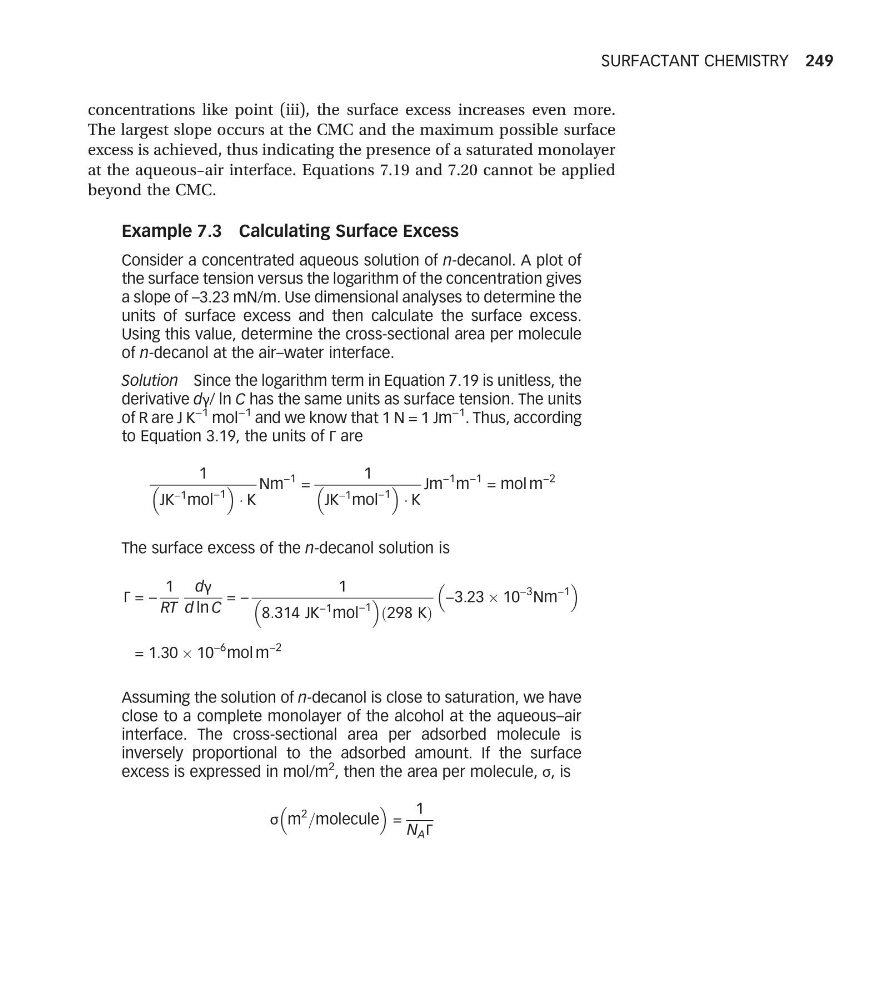
The surface excess of the n-decanol solution is
Γ = −
1
RT
dγ
d ln C
= −
1
8:314 JK
−1 mol
−1
298 K
ð
Þ
−3:23 Â 10
−3 Nm
−1
= 1:30 Â 10
−6 mol m
−2
Assuming the solution of n-decanol is close to saturation, we have
close to a complete monolayer of the alcohol at the aqueous–air
interface. The cross-sectional area per adsorbed molecule is
inversely proportional to the adsorbed amount. If the surface
excess is expressed in mol/m
2
, then the area per molecule, σ, is
σ m
2 =molecule
=
1
N A Γ
SURFACTANT CHEMISTRY 249
The largest slope occurs at the CMC and the maximum possible surface
excess is achieved, thus indicating the presence of a saturated monolayer
at the aqueous–air interface. Equations 7.19 and 7.20 cannot be applied
beyond the CMC.
Example 7.3 Calculating Surface Excess
Consider a concentrated aqueous solution of n-decanol. A plot of
the surface tension versus the logarithm of the concentration gives
a slope of –3.23 mN/m. Use dimensional analyses to determine the
units of surface excess and then calculate the surface excess.
Using this value, determine the cross-sectional area per molecule
of n-decanol at the air–water interface.
Solution Since the logarithm term in Equation 7.19 is unitless, the
derivative dγ/ ln C has the same units as surface tension. The units
of R are J K
−1 mol
−1 and we know that 1 N = 1 Jm
−1
. Thus, according
to Equation 3.19, the units of Γ are
1
JK
−1 mol
−1
Á K
Nm
−1 =
1
JK
−1 mol
−1
Á K
Jm
−1 m
−1 = mol m
−2
The surface excess of the n-decanol solution is
Γ = −
1
RT
dγ
d ln C
= −
1
8:314 JK
−1 mol
−1
298 K
ð
Þ
−3:23 Â 10
−3 Nm
−1
= 1:30 Â 10
−6 mol m
−2
Assuming the solution of n-decanol is close to saturation, we have
close to a complete monolayer of the alcohol at the aqueous–air
interface. The cross-sectional area per adsorbed molecule is
inversely proportional to the adsorbed amount. If the surface
excess is expressed in mol/m
2
, then the area per molecule, σ, is
σ m
2 =molecule
=
1
N A Γ
SURFACTANT CHEMISTRY 249