

method of fabricating these surfaces. All of these concepts are outlined in
the popular review article, “Progress in Superhydrophobic Surface
Development,” by Paul Roach, Neil Shirtcliffe, and Michael Newton, 2008.
First, a basic understanding of the mechanism behind superhydrophobicity is important in understanding its applications. Superhydrophobic
surfaces each have two distinct states of wetting, each governed by separate equations and having separate characteristics. These states are
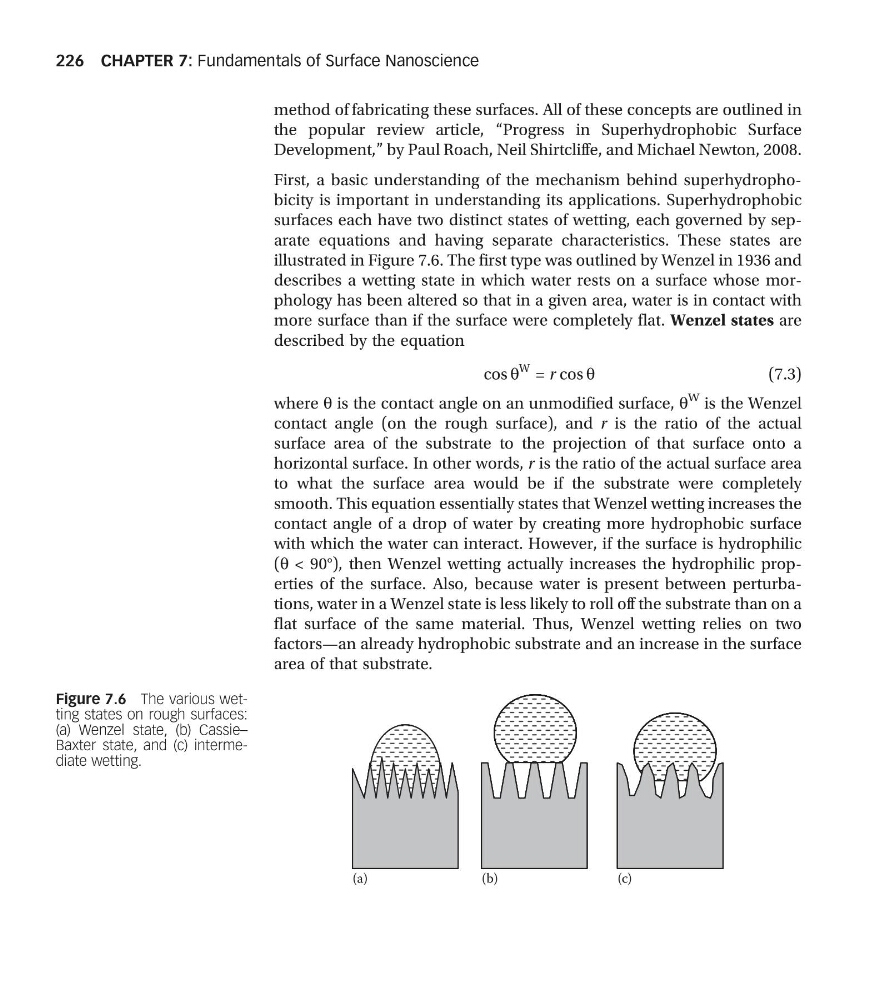
illustrated in Figure 7.6. The first type was outlined by Wenzel in 1936 and
describes a wetting state in which water rests on a surface whose morphology has been altered so that in a given area, water is in contact with
more surface than if the surface were completely flat. Wenzel states are
described by the equation
cos q
W = r cos q
(7.3)
where q is the contact angle on an unmodified surface, q
W is the Wenzel
contact angle (on the rough surface), and r is the ratio of the actual
surface area of the substrate to the projection of that surface onto a
horizontal surface. In other words, r is the ratio of the actual surface area
to what the surface area would be if the substrate were completely
smooth. This equation essentially states that Wenzel wetting increases the
contact angle of a drop of water by creating more hydrophobic surface
with which the water can interact. However, if the surface is hydrophilic
(q < 90°), then Wenzel wetting actually increases the hydrophilic properties of the surface. Also, because water is present between perturbations, water in a Wenzel state is less likely to roll off the substrate than on a
flat surface of the same material. Thus, Wenzel wetting relies on two
factors—an already hydrophobic substrate and an increase in the surface
area of that substrate.
(a)
(c)
(b)
Figure 7.6 The various wetting states on rough surfaces:
(a) Wenzel state, (b) Cassie–
Baxter state, and (c) intermediate wetting.
CHAPTER 7: Fundamentals of Surface Nanoscience
226
the popular review article, “Progress in Superhydrophobic Surface
Development,” by Paul Roach, Neil Shirtcliffe, and Michael Newton, 2008.
First, a basic understanding of the mechanism behind superhydrophobicity is important in understanding its applications. Superhydrophobic
surfaces each have two distinct states of wetting, each governed by separate equations and having separate characteristics. These states are
illustrated in Figure 7.6. The first type was outlined by Wenzel in 1936 and
describes a wetting state in which water rests on a surface whose morphology has been altered so that in a given area, water is in contact with
more surface than if the surface were completely flat. Wenzel states are
described by the equation
cos q
W = r cos q
(7.3)
where q is the contact angle on an unmodified surface, q
W is the Wenzel
contact angle (on the rough surface), and r is the ratio of the actual
surface area of the substrate to the projection of that surface onto a
horizontal surface. In other words, r is the ratio of the actual surface area
to what the surface area would be if the substrate were completely
smooth. This equation essentially states that Wenzel wetting increases the
contact angle of a drop of water by creating more hydrophobic surface
with which the water can interact. However, if the surface is hydrophilic
(q < 90°), then Wenzel wetting actually increases the hydrophilic properties of the surface. Also, because water is present between perturbations, water in a Wenzel state is less likely to roll off the substrate than on a
flat surface of the same material. Thus, Wenzel wetting relies on two
factors—an already hydrophobic substrate and an increase in the surface
area of that substrate.
(a)
(c)
(b)
Figure 7.6 The various wetting states on rough surfaces:
(a) Wenzel state, (b) Cassie–
Baxter state, and (c) intermediate wetting.
CHAPTER 7: Fundamentals of Surface Nanoscience
226