

The other major type of wetting was discovered by Cassie and Baxter in
1944 and describes a wetting state in which water rests on nano- or microsized “pins” with air spaces in between. Unlike Wenzel wetting, Cassie–
Baxter states have a smaller area of substrate in contact with the water
than a planar surface and rely on the air gaps in between regions on the
surface of the substrate to form a superhydrophobic surface. In fact,
Cassie–Baxter surfaces can be fabricated with hydrophilic substrates and
still display superhydrophobicity. Unlike Wenzel surfaces, water in
Cassie–Baxter states rolls off surfaces much more easily than on a flat
surface of the same material. These properties are reflected in the
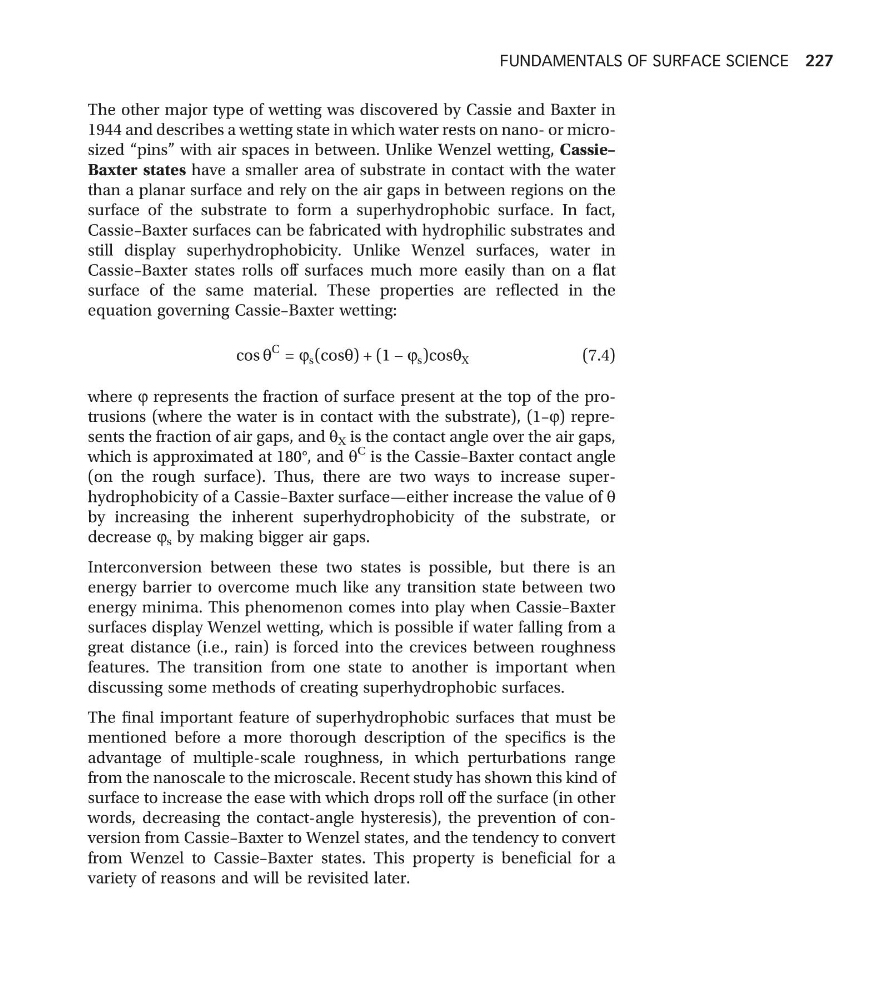
equation governing Cassie–Baxter wetting:
cos q
C = j s (cosq) + (1 − j s )cosq X
(7.4)
where j represents the fraction of surface present at the top of the protrusions (where the water is in contact with the substrate), (1–j) represents the fraction of air gaps, and q X is the contact angle over the air gaps,
which is approximated at 180°, and q
C is the Cassie–Baxter contact angle
(on the rough surface). Thus, there are two ways to increase superhydrophobicity of a Cassie–Baxter surface—either increase the value of q
by increasing the inherent superhydrophobicity of the substrate, or
decrease j s by making bigger air gaps.
Interconversion between these two states is possible, but there is an
energy barrier to overcome much like any transition state between two
energy minima. This phenomenon comes into play when Cassie–Baxter
surfaces display Wenzel wetting, which is possible if water falling from a
great distance (i.e., rain) is forced into the crevices between roughness
features. The transition from one state to another is important when
discussing some methods of creating superhydrophobic surfaces.
The final important feature of superhydrophobic surfaces that must be
mentioned before a more thorough description of the specifics is the
advantage of multiple-scale roughness, in which perturbations range
from the nanoscale to the microscale. Recent study has shown this kind of
surface to increase the ease with which drops roll off the surface (in other
words, decreasing the contact-angle hysteresis), the prevention of conversion from Cassie–Baxter to Wenzel states, and the tendency to convert
from Wenzel to Cassie–Baxter states. This property is beneficial for a
variety of reasons and will be revisited later.
FUNDAMENTALS OF SURFACE SCIENCE 227
1944 and describes a wetting state in which water rests on nano- or microsized “pins” with air spaces in between. Unlike Wenzel wetting, Cassie–
Baxter states have a smaller area of substrate in contact with the water
than a planar surface and rely on the air gaps in between regions on the
surface of the substrate to form a superhydrophobic surface. In fact,
Cassie–Baxter surfaces can be fabricated with hydrophilic substrates and
still display superhydrophobicity. Unlike Wenzel surfaces, water in
Cassie–Baxter states rolls off surfaces much more easily than on a flat
surface of the same material. These properties are reflected in the
equation governing Cassie–Baxter wetting:
cos q
C = j s (cosq) + (1 − j s )cosq X
(7.4)
where j represents the fraction of surface present at the top of the protrusions (where the water is in contact with the substrate), (1–j) represents the fraction of air gaps, and q X is the contact angle over the air gaps,
which is approximated at 180°, and q
C is the Cassie–Baxter contact angle
(on the rough surface). Thus, there are two ways to increase superhydrophobicity of a Cassie–Baxter surface—either increase the value of q
by increasing the inherent superhydrophobicity of the substrate, or
decrease j s by making bigger air gaps.
Interconversion between these two states is possible, but there is an
energy barrier to overcome much like any transition state between two
energy minima. This phenomenon comes into play when Cassie–Baxter
surfaces display Wenzel wetting, which is possible if water falling from a
great distance (i.e., rain) is forced into the crevices between roughness
features. The transition from one state to another is important when
discussing some methods of creating superhydrophobic surfaces.
The final important feature of superhydrophobic surfaces that must be
mentioned before a more thorough description of the specifics is the
advantage of multiple-scale roughness, in which perturbations range
from the nanoscale to the microscale. Recent study has shown this kind of
surface to increase the ease with which drops roll off the surface (in other
words, decreasing the contact-angle hysteresis), the prevention of conversion from Cassie–Baxter to Wenzel states, and the tendency to convert
from Wenzel to Cassie–Baxter states. This property is beneficial for a
variety of reasons and will be revisited later.
FUNDAMENTALS OF SURFACE SCIENCE 227