

a droplet with a relatively large contact angle. Conversely, water will
spread on a hydrophilic surface since it has a strong affinity for that
surface, forming a thin film with a very small contact angle.
7.1.4 Nanomaterials and superhydrophobic surfaces
If the contact angle of a sessile drop approaches 180°, the drop essentially
adopts its spherical geometry on the surface and moves around much like
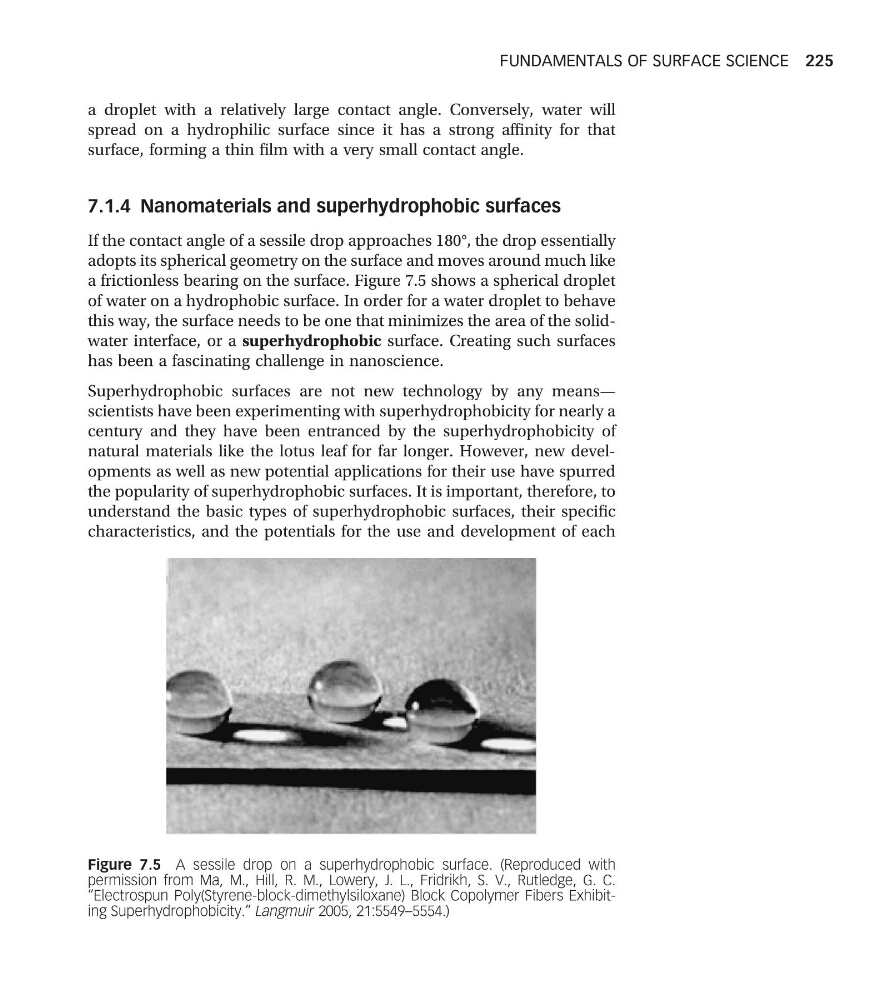
a frictionless bearing on the surface. Figure 7.5 shows a spherical droplet
of water on a hydrophobic surface. In order for a water droplet to behave
this way, the surface needs to be one that minimizes the area of the solidwater interface, or a superhydrophobic surface. Creating such surfaces
has been a fascinating challenge in nanoscience.
Superhydrophobic surfaces are not new technology by any means—
scientists have been experimenting with superhydrophobicity for nearly a
century and they have been entranced by the superhydrophobicity of
natural materials like the lotus leaf for far longer. However, new developments as well as new potential applications for their use have spurred
the popularity of superhydrophobic surfaces. It is important, therefore, to
understand the basic types of superhydrophobic surfaces, their specific
characteristics, and the potentials for the use and development of each
Figure 7.5 A sessile drop on a superhydrophobic surface. (Reproduced with
permission from Ma, M., Hill, R. M., Lowery, J. L., Fridrikh, S. V., Rutledge, G. C.
“Electrospun Poly(Styrene-block-dimethylsiloxane) Block Copolymer Fibers Exhibiting Superhydrophobicity.” Langmuir 2005, 21:5549–5554.)
FUNDAMENTALS OF SURFACE SCIENCE 225
spread on a hydrophilic surface since it has a strong affinity for that
surface, forming a thin film with a very small contact angle.
7.1.4 Nanomaterials and superhydrophobic surfaces
If the contact angle of a sessile drop approaches 180°, the drop essentially
adopts its spherical geometry on the surface and moves around much like
a frictionless bearing on the surface. Figure 7.5 shows a spherical droplet
of water on a hydrophobic surface. In order for a water droplet to behave
this way, the surface needs to be one that minimizes the area of the solidwater interface, or a superhydrophobic surface. Creating such surfaces
has been a fascinating challenge in nanoscience.
Superhydrophobic surfaces are not new technology by any means—
scientists have been experimenting with superhydrophobicity for nearly a
century and they have been entranced by the superhydrophobicity of
natural materials like the lotus leaf for far longer. However, new developments as well as new potential applications for their use have spurred
the popularity of superhydrophobic surfaces. It is important, therefore, to
understand the basic types of superhydrophobic surfaces, their specific
characteristics, and the potentials for the use and development of each
Figure 7.5 A sessile drop on a superhydrophobic surface. (Reproduced with
permission from Ma, M., Hill, R. M., Lowery, J. L., Fridrikh, S. V., Rutledge, G. C.
“Electrospun Poly(Styrene-block-dimethylsiloxane) Block Copolymer Fibers Exhibiting Superhydrophobicity.” Langmuir 2005, 21:5549–5554.)
FUNDAMENTALS OF SURFACE SCIENCE 225