

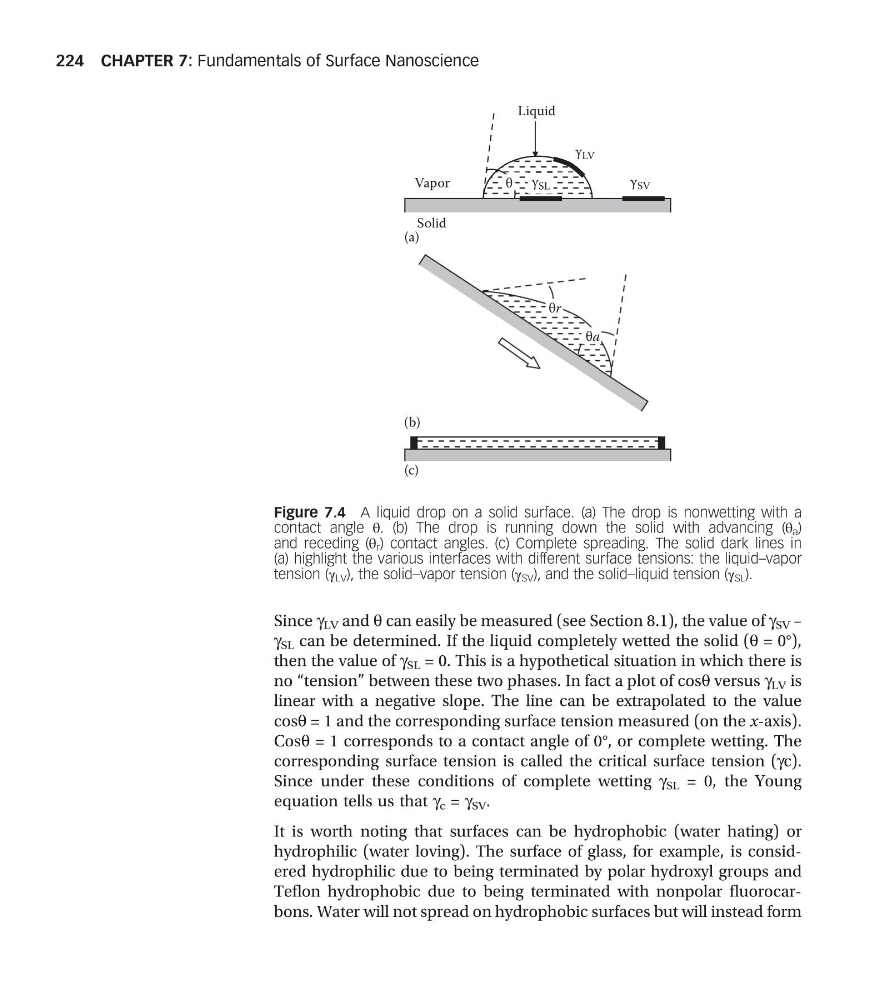
Since g LV and q can easily be measured (see Section 8.1), the value of g SV –
g SL can be determined. If the liquid completely wetted the solid (q = 0°),
then the value of g SL = 0. This is a hypothetical situation in which there is
no “tension” between these two phases. In fact a plot of cosq versus g LV is
linear with a negative slope. The line can be extrapolated to the value
cosq = 1 and the corresponding surface tension measured (on the x-axis).
Cosq = 1 corresponds to a contact angle of 0°, or complete wetting. The
corresponding surface tension is called the critical surface tension (gc).
Since under these conditions of complete wetting g SL = 0, the Young
equation tells us that g c = g SV .
It is worth noting that surfaces can be hydrophobic (water hating) or
hydrophilic (water loving). The surface of glass, for example, is considered hydrophilic due to being terminated by polar hydroxyl groups and
Teflon hydrophobic due to being terminated with nonpolar fluorocarbons. Water will not spread on hydrophobic surfaces but will instead form
γ LV
Liquid
γ SV
γ SL
Solid
Vapor
(b)
θa
θr
θ
(a)
(c)
Figure 7.4 A liquid drop on a solid surface. (a) The drop is nonwetting with a
contact angle θ. (b) The drop is running down the solid with advancing (θ a )
and receding (θ r ) contact angles. (c) Complete spreading. The solid dark lines in
(a) highlight the various interfaces with different surface tensions: the liquid–vapor
tension (γ LV ), the solid–vapor tension (γ SV ), and the solid–liquid tension (γ SL ).
CHAPTER 7: Fundamentals of Surface Nanoscience
224
g SL can be determined. If the liquid completely wetted the solid (q = 0°),
then the value of g SL = 0. This is a hypothetical situation in which there is
no “tension” between these two phases. In fact a plot of cosq versus g LV is
linear with a negative slope. The line can be extrapolated to the value
cosq = 1 and the corresponding surface tension measured (on the x-axis).
Cosq = 1 corresponds to a contact angle of 0°, or complete wetting. The
corresponding surface tension is called the critical surface tension (gc).
Since under these conditions of complete wetting g SL = 0, the Young
equation tells us that g c = g SV .
It is worth noting that surfaces can be hydrophobic (water hating) or
hydrophilic (water loving). The surface of glass, for example, is considered hydrophilic due to being terminated by polar hydroxyl groups and
Teflon hydrophobic due to being terminated with nonpolar fluorocarbons. Water will not spread on hydrophobic surfaces but will instead form
γ LV
Liquid
γ SV
γ SL
Solid
Vapor
(b)
θa
θr
θ
(a)
(c)
Figure 7.4 A liquid drop on a solid surface. (a) The drop is nonwetting with a
contact angle θ. (b) The drop is running down the solid with advancing (θ a )
and receding (θ r ) contact angles. (c) Complete spreading. The solid dark lines in
(a) highlight the various interfaces with different surface tensions: the liquid–vapor
tension (γ LV ), the solid–vapor tension (γ SV ), and the solid–liquid tension (γ SL ).
CHAPTER 7: Fundamentals of Surface Nanoscience
224