

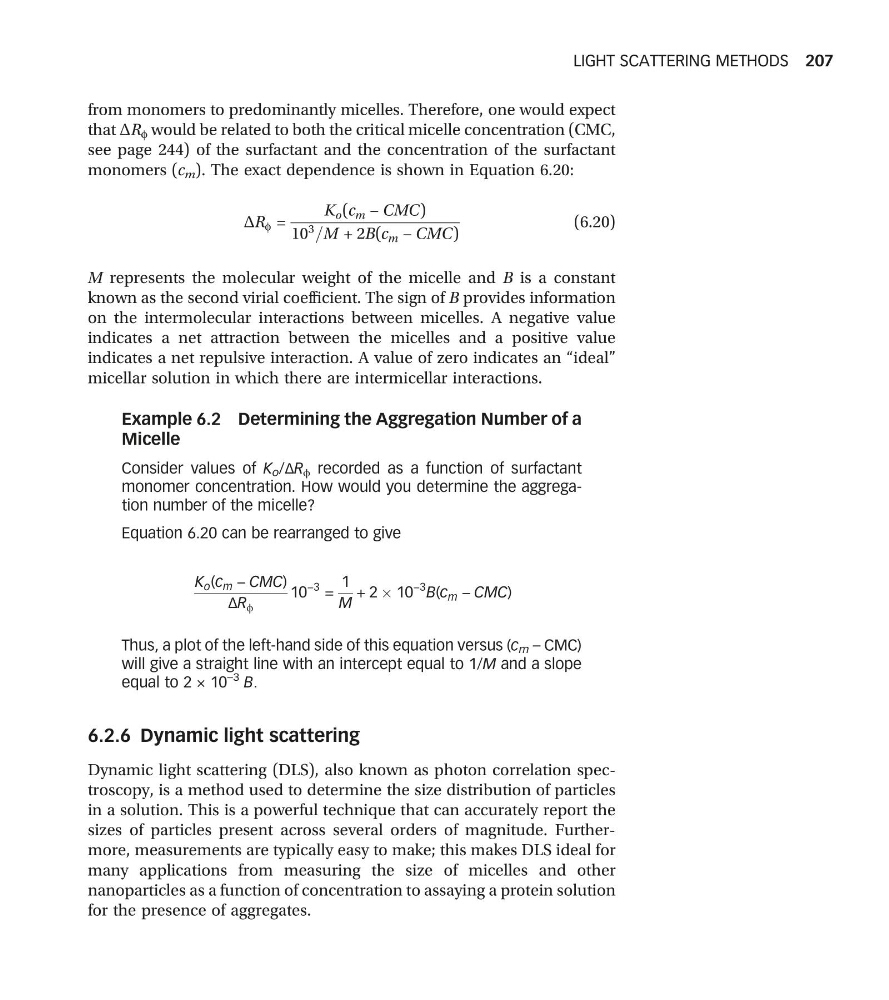
from monomers to predominantly micelles. Therefore, one would expect
that ΔR f would be related to both the critical micelle concentration (CMC,
see page 244) of the surfactant and the concentration of the surfactant
monomers (c m ). The exact dependence is shown in Equation 6.20:
ΔR f =
K o (c m − CMC)
10
3
=M + 2B(c m − CMC)
(6.20)
M represents the molecular weight of the micelle and B is a constant
known as the second virial coefficient. The sign of B provides information
on the intermolecular interactions between micelles. A negative value
indicates a net attraction between the micelles and a positive value
indicates a net repulsive interaction. A value of zero indicates an “ideal”
micellar solution in which there are intermicellar interactions.
Example 6.2 Determining the Aggregation Number of a
Micelle
Consider values of K o /ΔR ϕ recorded as a function of surfactant
monomer concentration. How would you determine the aggregation number of the micelle?
Equation 6.20 can be rearranged to give
K o (c m − CMC)
ΔR ϕ
10
−3 =
1
M
+ 2 Â 10
−3 B(c m − CMC)
Thus, a plot of the left-hand side of this equation versus (c m – CMC)
will give a straight line with an intercept equal to 1/M and a slope
equal to 2 × 10
–3 B.
6.2.6 Dynamic light scattering
Dynamic light scattering (DLS), also known as photon correlation spectroscopy, is a method used to determine the size distribution of particles
in a solution. This is a powerful technique that can accurately report the
sizes of particles present across several orders of magnitude. Furthermore, measurements are typically easy to make; this makes DLS ideal for
many applications from measuring the size of micelles and other
nanoparticles as a function of concentration to assaying a protein solution
for the presence of aggregates.
LIGHT SCATTERING METHODS 207
that ΔR f would be related to both the critical micelle concentration (CMC,
see page 244) of the surfactant and the concentration of the surfactant
monomers (c m ). The exact dependence is shown in Equation 6.20:
ΔR f =
K o (c m − CMC)
10
3
=M + 2B(c m − CMC)
(6.20)
M represents the molecular weight of the micelle and B is a constant
known as the second virial coefficient. The sign of B provides information
on the intermolecular interactions between micelles. A negative value
indicates a net attraction between the micelles and a positive value
indicates a net repulsive interaction. A value of zero indicates an “ideal”
micellar solution in which there are intermicellar interactions.
Example 6.2 Determining the Aggregation Number of a
Micelle
Consider values of K o /ΔR ϕ recorded as a function of surfactant
monomer concentration. How would you determine the aggregation number of the micelle?
Equation 6.20 can be rearranged to give
K o (c m − CMC)
ΔR ϕ
10
−3 =
1
M
+ 2 Â 10
−3 B(c m − CMC)
Thus, a plot of the left-hand side of this equation versus (c m – CMC)
will give a straight line with an intercept equal to 1/M and a slope
equal to 2 × 10
–3 B.
6.2.6 Dynamic light scattering
Dynamic light scattering (DLS), also known as photon correlation spectroscopy, is a method used to determine the size distribution of particles
in a solution. This is a powerful technique that can accurately report the
sizes of particles present across several orders of magnitude. Furthermore, measurements are typically easy to make; this makes DLS ideal for
many applications from measuring the size of micelles and other
nanoparticles as a function of concentration to assaying a protein solution
for the presence of aggregates.
LIGHT SCATTERING METHODS 207