

DLS works by shining a laser at a sample solution and observing the
scattered light. If the particles in the solution are small compared to the
wavelength of the light (x < 10, from Equation 6.16), then this phenomenon will proceed primarily through Rayleigh scattering. In this process,
particles absorb a photon and then reemit a photon shortly thereafter.
However, the emitted photon is sent in a random direction. Thus, even if
the entire incident light comes from one direction, the emitted light is
radiated in all directions (scattered). This is an elastic process, meaning
that if light of a particular wavelength is absorbed, the scattered light will
have exactly the same wavelength. With this in mind, if one conducted an
experiment shining a 632-nm HeNe laser at a solution of interest, one
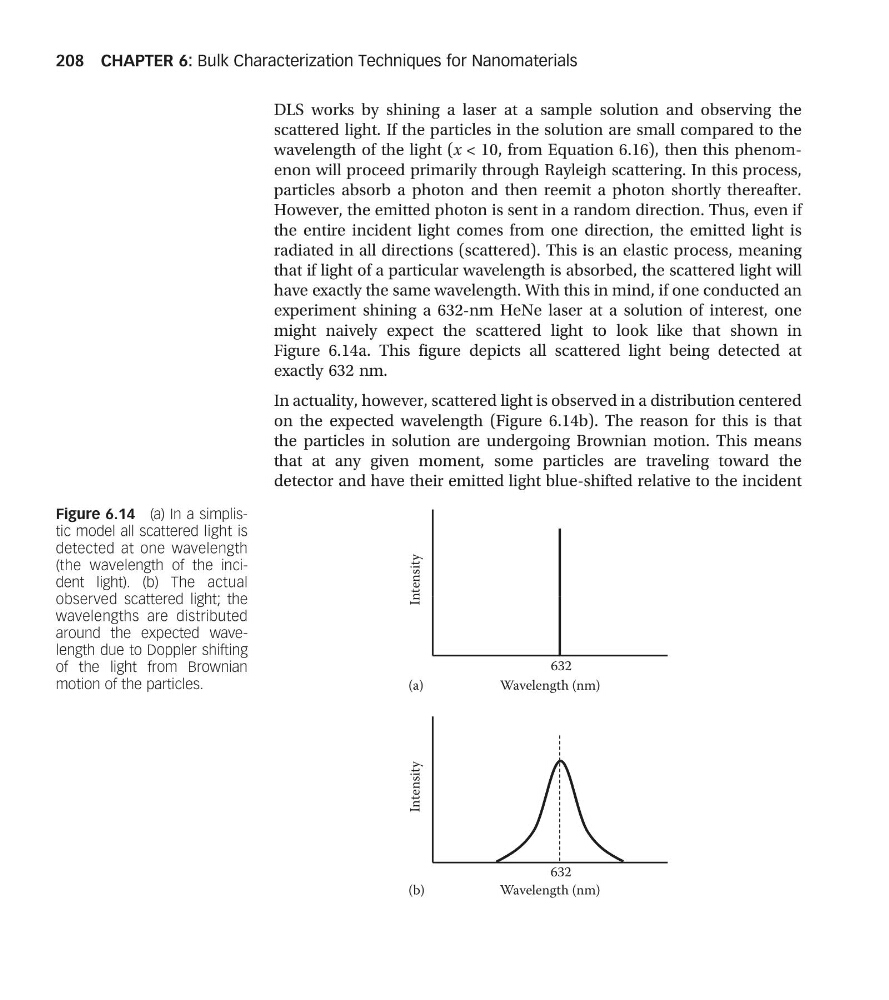
might naively expect the scattered light to look like that shown in
Figure 6.14a. This figure depicts all scattered light being detected at
exactly 632 nm.
In actuality, however, scattered light is observed in a distribution centered
on the expected wavelength (Figure 6.14b). The reason for this is that
the particles in solution are undergoing Brownian motion. This means
that at any given moment, some particles are traveling toward the
detector and have their emitted light blue-shifted relative to the incident
632
Intensity
Intensity
Wavelength (nm)
632
(a)
Wavelength (nm)
(b)
Figure 6.14 (a) In a simplistic model all scattered light is
detected at one wavelength
(the wavelength of the incident light). (b) The actual
observed scattered light; the
wavelengths are distributed
around the expected wavelength due to Doppler shifting
of the light from Brownian
motion of the particles.
CHAPTER 6: Bulk Characterization Techniques for Nanomaterials
208
scattered light. If the particles in the solution are small compared to the
wavelength of the light (x < 10, from Equation 6.16), then this phenomenon will proceed primarily through Rayleigh scattering. In this process,
particles absorb a photon and then reemit a photon shortly thereafter.
However, the emitted photon is sent in a random direction. Thus, even if
the entire incident light comes from one direction, the emitted light is
radiated in all directions (scattered). This is an elastic process, meaning
that if light of a particular wavelength is absorbed, the scattered light will
have exactly the same wavelength. With this in mind, if one conducted an
experiment shining a 632-nm HeNe laser at a solution of interest, one
might naively expect the scattered light to look like that shown in
Figure 6.14a. This figure depicts all scattered light being detected at
exactly 632 nm.
In actuality, however, scattered light is observed in a distribution centered
on the expected wavelength (Figure 6.14b). The reason for this is that
the particles in solution are undergoing Brownian motion. This means
that at any given moment, some particles are traveling toward the
detector and have their emitted light blue-shifted relative to the incident
632
Intensity
Intensity
Wavelength (nm)
632
(a)
Wavelength (nm)
(b)
Figure 6.14 (a) In a simplistic model all scattered light is
detected at one wavelength
(the wavelength of the incident light). (b) The actual
observed scattered light; the
wavelengths are distributed
around the expected wavelength due to Doppler shifting
of the light from Brownian
motion of the particles.
CHAPTER 6: Bulk Characterization Techniques for Nanomaterials
208