

the average refractive index of the solution will therefore vary with the
local concentration of micelles. This variation will cause light to be
scattered. The intensity of the scattered light depends on the intensity and
wavelength of the incoming light, the solution refractive index increment
(i.e., how n varies with concentration, dn/dc), and the average number
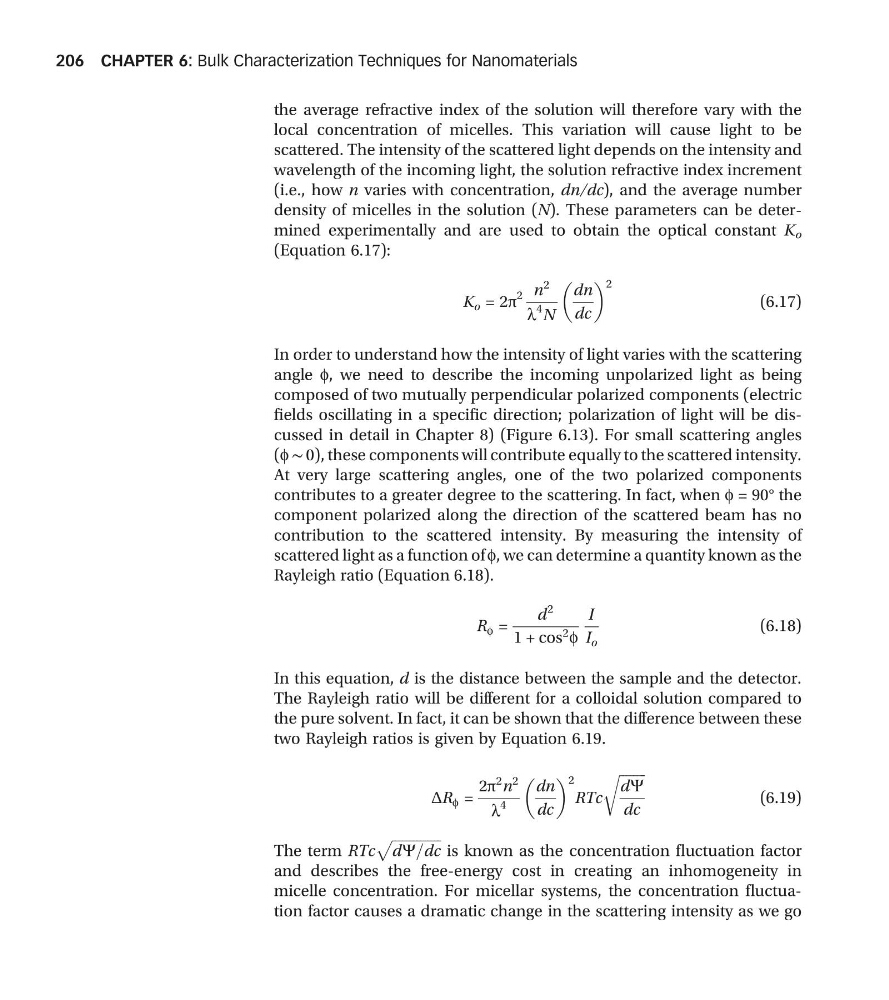
density of micelles in the solution (N). These parameters can be determined experimentally and are used to obtain the optical constant K o
(Equation 6.17):
K o = 2π
2 n
2
l
4 N
dn
dc
2
(6.17)
In order to understand how the intensity of light varies with the scattering
angle f, we need to describe the incoming unpolarized light as being
composed of two mutually perpendicular polarized components (electric
fields oscillating in a specific direction; polarization of light will be discussed in detail in Chapter 8) (Figure 6.13). For small scattering angles
(f ∼ 0), these components will contribute equally to the scattered intensity.
At very large scattering angles, one of the two polarized components
contributes to a greater degree to the scattering. In fact, when f = 90° the
component polarized along the direction of the scattered beam has no
contribution to the scattered intensity. By measuring the intensity of
scattered light as a function of f, we can determine a quantity known as the
Rayleigh ratio (Equation 6.18).
R f =
d
2
1 + cos
2 f
I
I o
(6.18)
In this equation, d is the distance between the sample and the detector.
The Rayleigh ratio will be different for a colloidal solution compared to
the pure solvent. In fact, it can be shown that the difference between these
two Rayleigh ratios is given by Equation 6.19.
ΔR f =
2π
2 n
2
l
4
dn
dc
2
RTc
ffiffiffiffiffiffiffi ffi
dY
dc
r
(6.19)
The term RTc
ffiffiffiffiffiffiffiffiffiffiffiffiffiffi
dY=dc
p
is known as the concentration fluctuation factor
and describes the free-energy cost in creating an inhomogeneity in
micelle concentration. For micellar systems, the concentration fluctuation factor causes a dramatic change in the scattering intensity as we go
CHAPTER 6: Bulk Characterization Techniques for Nanomaterials
206
local concentration of micelles. This variation will cause light to be
scattered. The intensity of the scattered light depends on the intensity and
wavelength of the incoming light, the solution refractive index increment
(i.e., how n varies with concentration, dn/dc), and the average number
density of micelles in the solution (N). These parameters can be determined experimentally and are used to obtain the optical constant K o
(Equation 6.17):
K o = 2π
2 n
2
l
4 N
dn
dc
2
(6.17)
In order to understand how the intensity of light varies with the scattering
angle f, we need to describe the incoming unpolarized light as being
composed of two mutually perpendicular polarized components (electric
fields oscillating in a specific direction; polarization of light will be discussed in detail in Chapter 8) (Figure 6.13). For small scattering angles
(f ∼ 0), these components will contribute equally to the scattered intensity.
At very large scattering angles, one of the two polarized components
contributes to a greater degree to the scattering. In fact, when f = 90° the
component polarized along the direction of the scattered beam has no
contribution to the scattered intensity. By measuring the intensity of
scattered light as a function of f, we can determine a quantity known as the
Rayleigh ratio (Equation 6.18).
R f =
d
2
1 + cos
2 f
I
I o
(6.18)
In this equation, d is the distance between the sample and the detector.
The Rayleigh ratio will be different for a colloidal solution compared to
the pure solvent. In fact, it can be shown that the difference between these
two Rayleigh ratios is given by Equation 6.19.
ΔR f =
2π
2 n
2
l
4
dn
dc
2
RTc
ffiffiffiffiffiffiffi ffi
dY
dc
r
(6.19)
The term RTc
ffiffiffiffiffiffiffiffiffiffiffiffiffiffi
dY=dc
p
is known as the concentration fluctuation factor
and describes the free-energy cost in creating an inhomogeneity in
micelle concentration. For micellar systems, the concentration fluctuation factor causes a dramatic change in the scattering intensity as we go
CHAPTER 6: Bulk Characterization Techniques for Nanomaterials
206