

provide useful structural information (particle shape and size) and interparticle interactions on colloidal systems. The measurements are generally
instantaneous, noninvasive, and allow representative sampling of polydisperse samples. However, the presence of small particle impurities,
particularly those that have a tendency to scatter the light, can impose
serious errors in the measurement.
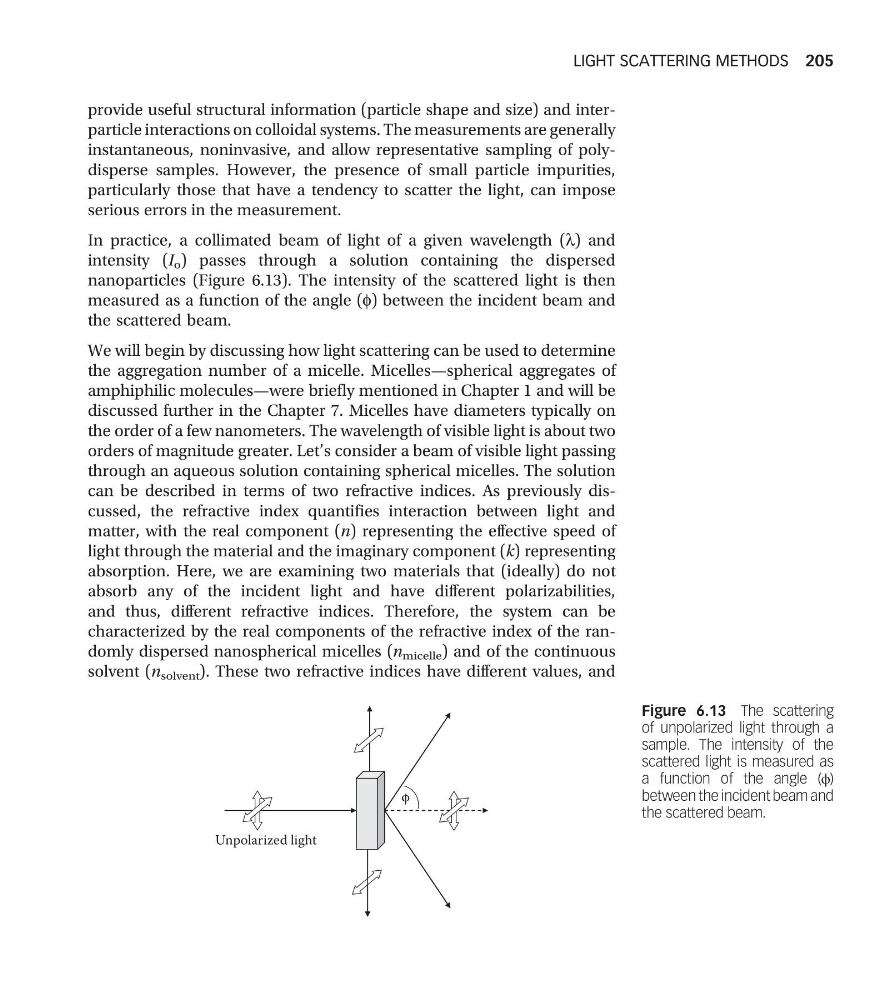
In practice, a collimated beam of light of a given wavelength (l) and
intensity (I o ) passes through a solution containing the dispersed
nanoparticles (Figure 6.13). The intensity of the scattered light is then
measured as a function of the angle (f) between the incident beam and
the scattered beam.
We will begin by discussing how light scattering can be used to determine
the aggregation number of a micelle. Micelles—spherical aggregates of
amphiphilic molecules—were briefly mentioned in Chapter 1 and will be
discussed further in the Chapter 7. Micelles have diameters typically on
the order of a few nanometers. The wavelength of visible light is about two
orders of magnitude greater. Let’s consider a beam of visible light passing
through an aqueous solution containing spherical micelles. The solution
can be described in terms of two refractive indices. As previously discussed, the refractive index quantifies interaction between light and
matter, with the real component (n) representing the effective speed of
light through the material and the imaginary component (k) representing
absorption. Here, we are examining two materials that (ideally) do not
absorb any of the incident light and have different polarizabilities,
and thus, different refractive indices. Therefore, the system can be
characterized by the real components of the refractive index of the randomly dispersed nanospherical micelles (n micelle ) and of the continuous
solvent (n solvent ). These two refractive indices have different values, and
φ
Unpolarized light
Figure 6.13 The scattering
of unpolarized light through a
sample. The intensity of the
scattered light is measured as
a function of the angle (ϕ)
between the incident beam and
the scattered beam.
LIGHT SCATTERING METHODS 205
instantaneous, noninvasive, and allow representative sampling of polydisperse samples. However, the presence of small particle impurities,
particularly those that have a tendency to scatter the light, can impose
serious errors in the measurement.
In practice, a collimated beam of light of a given wavelength (l) and
intensity (I o ) passes through a solution containing the dispersed
nanoparticles (Figure 6.13). The intensity of the scattered light is then
measured as a function of the angle (f) between the incident beam and
the scattered beam.
We will begin by discussing how light scattering can be used to determine
the aggregation number of a micelle. Micelles—spherical aggregates of
amphiphilic molecules—were briefly mentioned in Chapter 1 and will be
discussed further in the Chapter 7. Micelles have diameters typically on
the order of a few nanometers. The wavelength of visible light is about two
orders of magnitude greater. Let’s consider a beam of visible light passing
through an aqueous solution containing spherical micelles. The solution
can be described in terms of two refractive indices. As previously discussed, the refractive index quantifies interaction between light and
matter, with the real component (n) representing the effective speed of
light through the material and the imaginary component (k) representing
absorption. Here, we are examining two materials that (ideally) do not
absorb any of the incident light and have different polarizabilities,
and thus, different refractive indices. Therefore, the system can be
characterized by the real components of the refractive index of the randomly dispersed nanospherical micelles (n micelle ) and of the continuous
solvent (n solvent ). These two refractive indices have different values, and
φ
Unpolarized light
Figure 6.13 The scattering
of unpolarized light through a
sample. The intensity of the
scattered light is measured as
a function of the angle (ϕ)
between the incident beam and
the scattered beam.
LIGHT SCATTERING METHODS 205