

As a matter of naming convention, one should note that a frequency shift
of Raman scattered light to a lower energy (or lower frequency) is called a
Stokes shift. A frequency shift to a higher energy (or higher frequency) is
called an anti-Stokes shift. Typically, Stokes shifts are more probable than
anti-Stokes shifts, so their signals are stronger. As might be expected,
Raman scattering is much less likely to occur than Rayleigh scattering for
a given molecule and a given wavelength of light. Therefore, a Raman
spectrum that maps intensity versus frequency of the scattered light has a
centralized and strong peak that represents the Rayleigh scattering of the
incident light. The Rayleigh peak is symmetrically surrounded by a distribution of much smaller peaks that represent the Stokes lines at the
lower frequencies and the anti-Stokes lines at the higher frequencies. This
peak is often blocked from the detector by a filter.
6.2.4 Light scattering by nanoparticles
As discussed in Chapter 5, intermolecular interactions can drive molecules to aggregate into colloidal particles such as micelles. Like molecules, these nanoparticles can scatter light, and the manner in which they
scatter light can provide information about the concentration and size of
particles in the system. In addition to Rayleigh (inelastic) and Raman
(elastic) scattering as discussed above, these particles can also undergo
two other types of inelastic scattering, known as Mie scattering and
geometric scattering. The type of scattering depends on the size of the
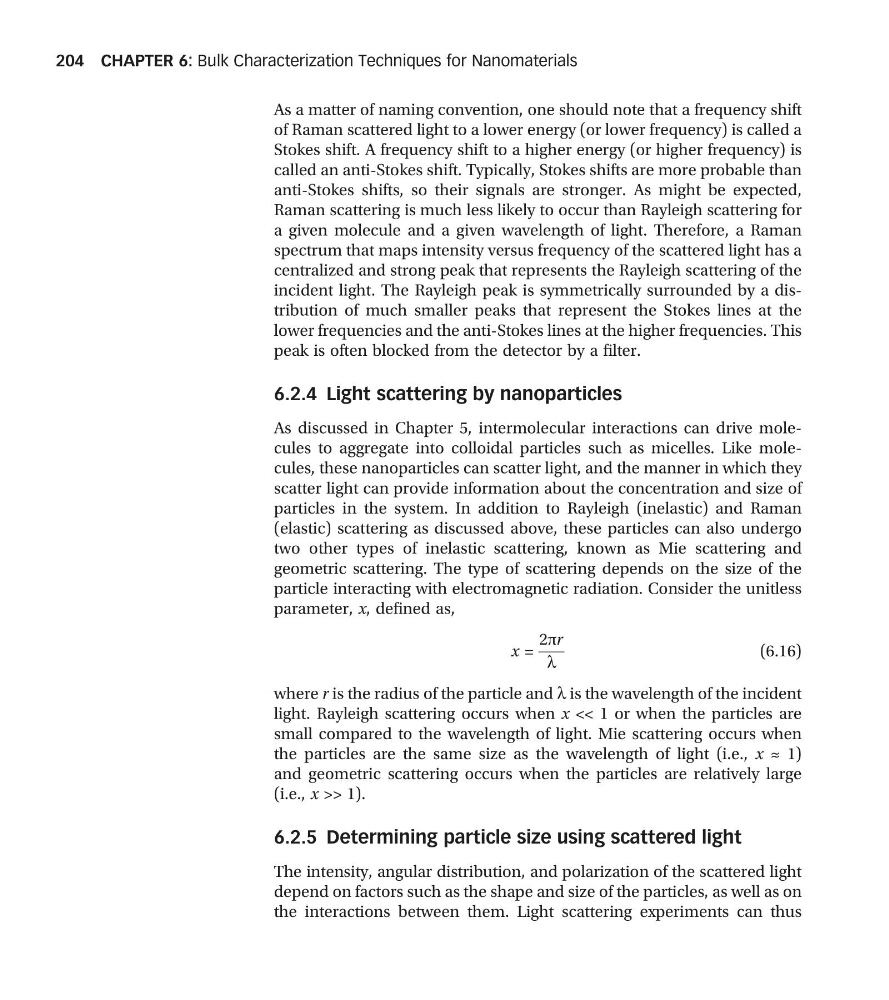
particle interacting with electromagnetic radiation. Consider the unitless
parameter, x, defined as,
x =
2πr
l
(6.16)
where r is the radius of the particle and l is the wavelength of the incident
light. Rayleigh scattering occurs when x << 1 or when the particles are
small compared to the wavelength of light. Mie scattering occurs when
the particles are the same size as the wavelength of light (i.e., x ≈ 1)
and geometric scattering occurs when the particles are relatively large
(i.e., x >> 1).
6.2.5 Determining particle size using scattered light
The intensity, angular distribution, and polarization of the scattered light
depend on factors such as the shape and size of the particles, as well as on
the interactions between them. Light scattering experiments can thus
CHAPTER 6: Bulk Characterization Techniques for Nanomaterials
204
of Raman scattered light to a lower energy (or lower frequency) is called a
Stokes shift. A frequency shift to a higher energy (or higher frequency) is
called an anti-Stokes shift. Typically, Stokes shifts are more probable than
anti-Stokes shifts, so their signals are stronger. As might be expected,
Raman scattering is much less likely to occur than Rayleigh scattering for
a given molecule and a given wavelength of light. Therefore, a Raman
spectrum that maps intensity versus frequency of the scattered light has a
centralized and strong peak that represents the Rayleigh scattering of the
incident light. The Rayleigh peak is symmetrically surrounded by a distribution of much smaller peaks that represent the Stokes lines at the
lower frequencies and the anti-Stokes lines at the higher frequencies. This
peak is often blocked from the detector by a filter.
6.2.4 Light scattering by nanoparticles
As discussed in Chapter 5, intermolecular interactions can drive molecules to aggregate into colloidal particles such as micelles. Like molecules, these nanoparticles can scatter light, and the manner in which they
scatter light can provide information about the concentration and size of
particles in the system. In addition to Rayleigh (inelastic) and Raman
(elastic) scattering as discussed above, these particles can also undergo
two other types of inelastic scattering, known as Mie scattering and
geometric scattering. The type of scattering depends on the size of the
particle interacting with electromagnetic radiation. Consider the unitless
parameter, x, defined as,
x =
2πr
l
(6.16)
where r is the radius of the particle and l is the wavelength of the incident
light. Rayleigh scattering occurs when x << 1 or when the particles are
small compared to the wavelength of light. Mie scattering occurs when
the particles are the same size as the wavelength of light (i.e., x ≈ 1)
and geometric scattering occurs when the particles are relatively large
(i.e., x >> 1).
6.2.5 Determining particle size using scattered light
The intensity, angular distribution, and polarization of the scattered light
depend on factors such as the shape and size of the particles, as well as on
the interactions between them. Light scattering experiments can thus
CHAPTER 6: Bulk Characterization Techniques for Nanomaterials
204