

When this molecule vibrates symmetrically, as shown in Figure 6.11, the net
dipole moment remains zero. Thus, the symmetric vibration of CO 2 does
not lead to the absorption of IR radiation. However, the asymmetric and
bending modes of CO 2 produce a net dipole moment, and therefore they
lead to the absorption of IR radiation. Therefore, it will have two absorption
frequencies, one corresponding to the asymmetric mode, and the other
corresponding to the doubly degenerate bending mode.
Organic molecules usually contain a variety of functional groups. Each
functional group absorbs a specific IR frequency that is characteristic of
that group. For example, the carbonyl group (C = O) absorbs around
1700 cm
–1 . The exact value depends on the local environment of the
functional group, such as the identity of other atoms that are attached to
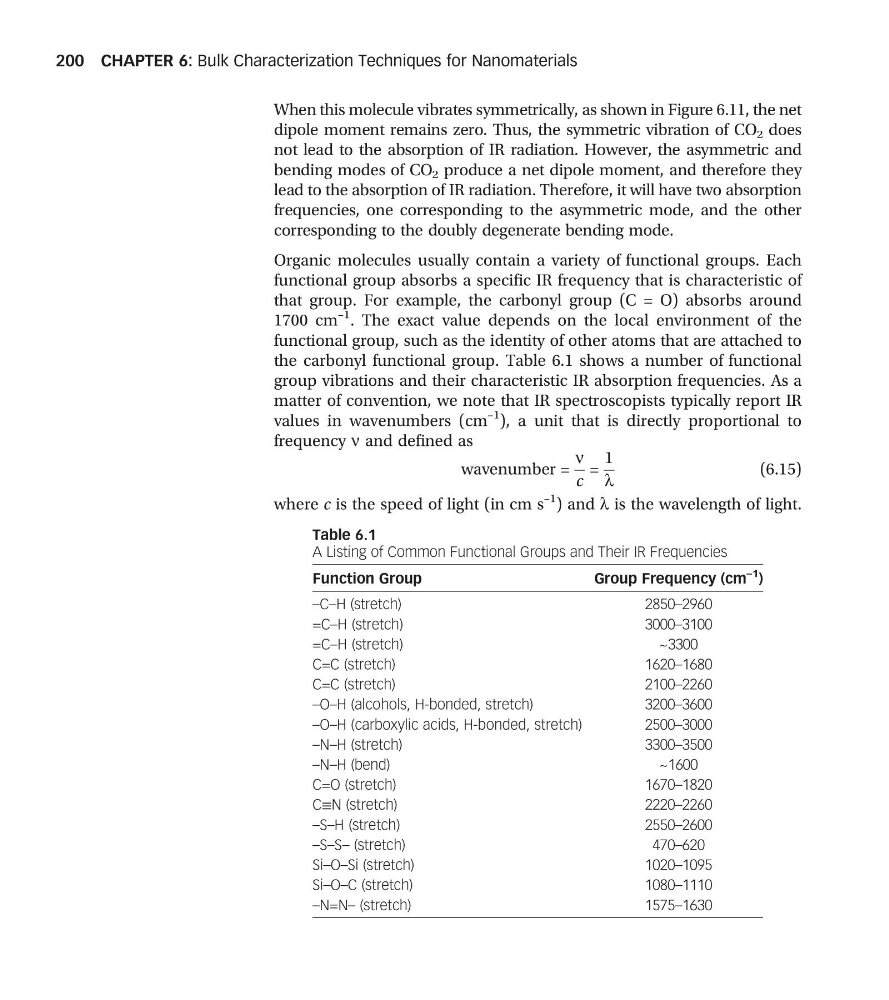
the carbonyl functional group. Table 6.1 shows a number of functional
group vibrations and their characteristic IR absorption frequencies. As a
matter of convention, we note that IR spectroscopists typically report IR
values in wavenumbers (cm
–1 ), a unit that is directly proportional to
frequency n and defined as
wavenumber =
n
c
=
1
l
(6.15)
where c is the speed of light (in cm s
–1
) and l is the wavelength of light.
Table 6.1
A Listing of Common Functional Groups and Their IR Frequencies
Function Group
Group Frequency (cm
–1 )
–C–H (stretch)
2850–2960
=C–H (stretch)
3000–3100
=C–H (stretch)
~3300
C=C (stretch)
1620–1680
C=C (stretch)
2100–2260
–O–H (alcohols, H-bonded, stretch)
3200–3600
–O–H (carboxylic acids, H-bonded, stretch)
2500–3000
–N–H (stretch)
3300–3500
–N–H (bend)
~1600
C=O (stretch)
1670–1820
C≡N (stretch)
2220–2260
–S–H (stretch)
2550–2600
–S–S– (stretch)
470–620
Si–O–Si (stretch)
1020–1095
Si–O–C (stretch)
1080–1110
–N=N– (stretch)
1575–1630
CHAPTER 6: Bulk Characterization Techniques for Nanomaterials
200
dipole moment remains zero. Thus, the symmetric vibration of CO 2 does
not lead to the absorption of IR radiation. However, the asymmetric and
bending modes of CO 2 produce a net dipole moment, and therefore they
lead to the absorption of IR radiation. Therefore, it will have two absorption
frequencies, one corresponding to the asymmetric mode, and the other
corresponding to the doubly degenerate bending mode.
Organic molecules usually contain a variety of functional groups. Each
functional group absorbs a specific IR frequency that is characteristic of
that group. For example, the carbonyl group (C = O) absorbs around
1700 cm
–1 . The exact value depends on the local environment of the
functional group, such as the identity of other atoms that are attached to
the carbonyl functional group. Table 6.1 shows a number of functional
group vibrations and their characteristic IR absorption frequencies. As a
matter of convention, we note that IR spectroscopists typically report IR
values in wavenumbers (cm
–1 ), a unit that is directly proportional to
frequency n and defined as
wavenumber =
n
c
=
1
l
(6.15)
where c is the speed of light (in cm s
–1
) and l is the wavelength of light.
Table 6.1
A Listing of Common Functional Groups and Their IR Frequencies
Function Group
Group Frequency (cm
–1 )
–C–H (stretch)
2850–2960
=C–H (stretch)
3000–3100
=C–H (stretch)
~3300
C=C (stretch)
1620–1680
C=C (stretch)
2100–2260
–O–H (alcohols, H-bonded, stretch)
3200–3600
–O–H (carboxylic acids, H-bonded, stretch)
2500–3000
–N–H (stretch)
3300–3500
–N–H (bend)
~1600
C=O (stretch)
1670–1820
C≡N (stretch)
2220–2260
–S–H (stretch)
2550–2600
–S–S– (stretch)
470–620
Si–O–Si (stretch)
1020–1095
Si–O–C (stretch)
1080–1110
–N=N– (stretch)
1575–1630
CHAPTER 6: Bulk Characterization Techniques for Nanomaterials
200