

one fewer rotational degree of freedom due to their symmetry. As a simple
example, consider the structure of H 2 O. The central oxygen atom is sp
3
hybridized, meaning that the molecule is bent with single bonds between
the oxygen and hydrogen atoms. The molecule has a net dipole moment
and is thus able to absorb IR radiation. The molecule is non-linear and
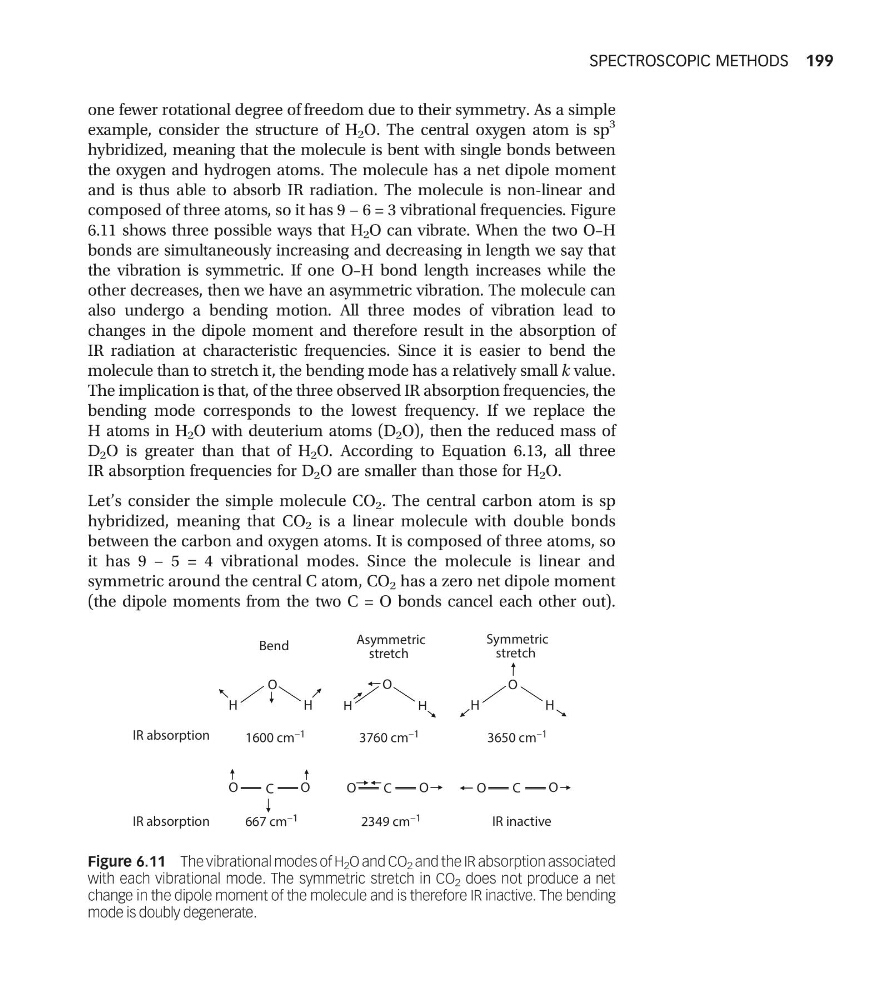
composed of three atoms, so it has 9 − 6 = 3 vibrational frequencies. Figure
6.11 shows three possible ways that H 2 O can vibrate. When the two O–H
bonds are simultaneously increasing and decreasing in length we say that
the vibration is symmetric. If one O–H bond length increases while the
other decreases, then we have an asymmetric vibration. The molecule can
also undergo a bending motion. All three modes of vibration lead to
changes in the dipole moment and therefore result in the absorption of
IR radiation at characteristic frequencies. Since it is easier to bend the
molecule than to stretch it, the bending mode has a relatively small k value.
The implication is that, of the three observed IR absorption frequencies, the
bending mode corresponds to the lowest frequency. If we replace the
H atoms in H 2 O with deuterium atoms (D 2 O), then the reduced mass of
D 2 O is greater than that of H 2 O. According to Equation 6.13, all three
IR absorption frequencies for D 2 O are smaller than those for H 2 O.
Let’s consider the simple molecule CO 2 . The central carbon atom is sp
hybridized, meaning that CO 2 is a linear molecule with double bonds
between the carbon and oxygen atoms. It is composed of three atoms, so
it has 9 − 5 = 4 vibrational modes. Since the molecule is linear and
symmetric around the central C atom, CO 2 has a zero net dipole moment
(the dipole moments from the two C = O bonds cancel each other out).
Asymmetric
Symmetric
O
O
O
stretch
stretch
Bend
H
H
H
H
H
H
IR absorption
1600 cm –1
3760 cm –1
3650 cm –1
O
O
C
O
O
C
O
O
C
IR absorption
2349 cm –1
IR inactive
667 cm –1
Figure 6.11 The vibrational modes of H 2 O and CO 2 and the IR absorption associated
with each vibrational mode. The symmetric stretch in CO 2 does not produce a net
change in the dipole moment of the molecule and is therefore IR inactive. The bending
mode is doubly degenerate.
SPECTROSCOPIC METHODS 199
example, consider the structure of H 2 O. The central oxygen atom is sp
3
hybridized, meaning that the molecule is bent with single bonds between
the oxygen and hydrogen atoms. The molecule has a net dipole moment
and is thus able to absorb IR radiation. The molecule is non-linear and
composed of three atoms, so it has 9 − 6 = 3 vibrational frequencies. Figure
6.11 shows three possible ways that H 2 O can vibrate. When the two O–H
bonds are simultaneously increasing and decreasing in length we say that
the vibration is symmetric. If one O–H bond length increases while the
other decreases, then we have an asymmetric vibration. The molecule can
also undergo a bending motion. All three modes of vibration lead to
changes in the dipole moment and therefore result in the absorption of
IR radiation at characteristic frequencies. Since it is easier to bend the
molecule than to stretch it, the bending mode has a relatively small k value.
The implication is that, of the three observed IR absorption frequencies, the
bending mode corresponds to the lowest frequency. If we replace the
H atoms in H 2 O with deuterium atoms (D 2 O), then the reduced mass of
D 2 O is greater than that of H 2 O. According to Equation 6.13, all three
IR absorption frequencies for D 2 O are smaller than those for H 2 O.
Let’s consider the simple molecule CO 2 . The central carbon atom is sp
hybridized, meaning that CO 2 is a linear molecule with double bonds
between the carbon and oxygen atoms. It is composed of three atoms, so
it has 9 − 5 = 4 vibrational modes. Since the molecule is linear and
symmetric around the central C atom, CO 2 has a zero net dipole moment
(the dipole moments from the two C = O bonds cancel each other out).
Asymmetric
Symmetric
O
O
O
stretch
stretch
Bend
H
H
H
H
H
H
IR absorption
1600 cm –1
3760 cm –1
3650 cm –1
O
O
C
O
O
C
O
O
C
IR absorption
2349 cm –1
IR inactive
667 cm –1
Figure 6.11 The vibrational modes of H 2 O and CO 2 and the IR absorption associated
with each vibrational mode. The symmetric stretch in CO 2 does not produce a net
change in the dipole moment of the molecule and is therefore IR inactive. The bending
mode is doubly degenerate.
SPECTROSCOPIC METHODS 199