

and the molecule can absorb only particular frequencies of IR radiation.
The absorption of IR radiation corresponds to a change in energy of
approximately 20 kJ/mol. This is the amount of energy required to cause
covalent bonds to stretch, bend, and twist, particular combinations of which
are called the vibrational modes of a molecule. Only those frequencies of IR
radiation that match the natural vibrational frequencies of the covalent
bonds of the molecule lead to IR absorption by the molecule. These frequencies are called vibrational modes. The energy absorbed leads to an
increase in the amplitude of the vibrational motions of the bonds in the
molecule. Furthermore, in order for a molecule to absorb IR radiation, it
must undergo a change in dipole moment during the course of the vibration. The change in dipole moment is due to the motion of atoms in
response to the oscillating electric field of the infrared light shining on the
sample. Just as how electronic transitions only occur with frequencies of
light with the same energy as the difference between electronic states,
energy transfer, and consequently, IR absorption, occurs when the frequency of the light is the same as a frequency of bond vibration. For
vibrational transitions, the transition dipole moment is the change in the
dipole moment as the atoms in the molecule vibrate. Therefore, symmetric
diatomic molecules that have no dipole moment, such as N 2 , H 2 , and O 2 , do
not absorb IR radiation, since their vibration cannot produce a nonzero
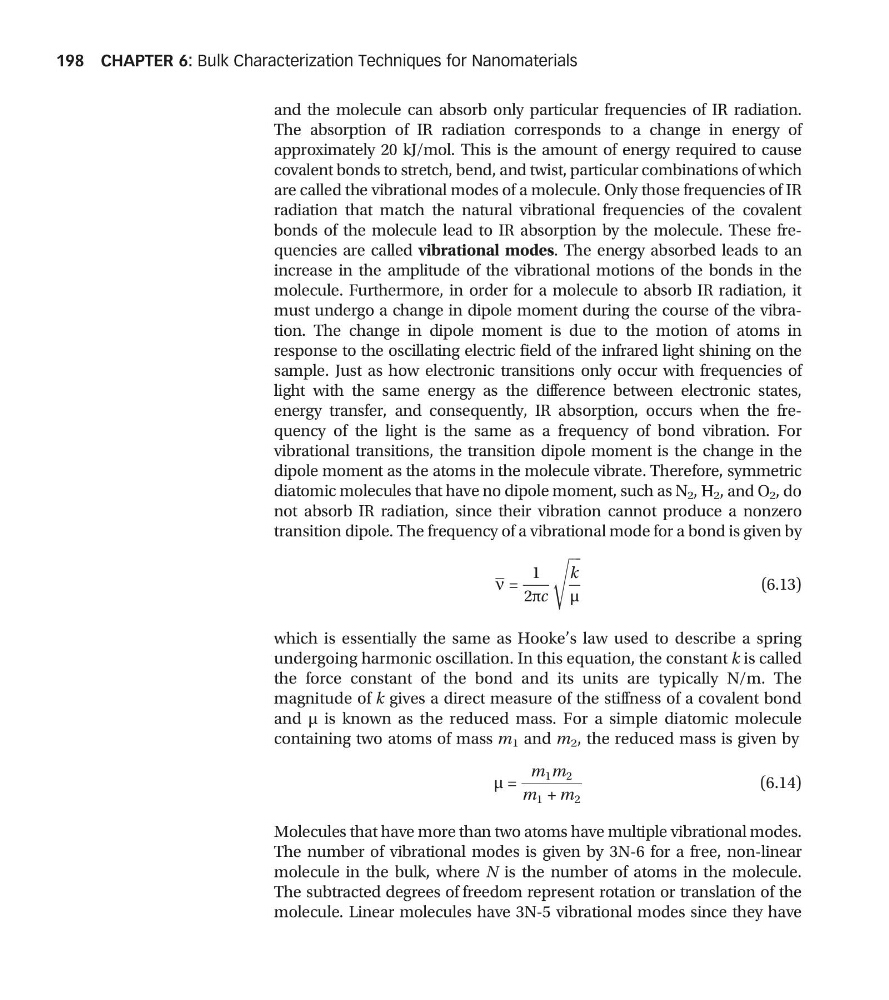
transition dipole. The frequency of a vibrational mode for a bond is given by
n =
1
2πc
ffiffiffi ffi
k
μ
s
(6.13)
which is essentially the same as Hooke’s law used to describe a spring
undergoing harmonic oscillation. In this equation, the constant k is called
the force constant of the bond and its units are typically N/m. The
magnitude of k gives a direct measure of the stiffness of a covalent bond
and µ is known as the reduced mass. For a simple diatomic molecule
containing two atoms of mass m 1 and m 2 , the reduced mass is given by
μ =
m 1 m 2
m 1 + m 2
(6.14)
Molecules that have more than two atoms have multiple vibrational modes.
The number of vibrational modes is given by 3N-6 for a free, non-linear
molecule in the bulk, where N is the number of atoms in the molecule.
The subtracted degrees of freedom represent rotation or translation of the
molecule. Linear molecules have 3N-5 vibrational modes since they have
CHAPTER 6: Bulk Characterization Techniques for Nanomaterials
198
The absorption of IR radiation corresponds to a change in energy of
approximately 20 kJ/mol. This is the amount of energy required to cause
covalent bonds to stretch, bend, and twist, particular combinations of which
are called the vibrational modes of a molecule. Only those frequencies of IR
radiation that match the natural vibrational frequencies of the covalent
bonds of the molecule lead to IR absorption by the molecule. These frequencies are called vibrational modes. The energy absorbed leads to an
increase in the amplitude of the vibrational motions of the bonds in the
molecule. Furthermore, in order for a molecule to absorb IR radiation, it
must undergo a change in dipole moment during the course of the vibration. The change in dipole moment is due to the motion of atoms in
response to the oscillating electric field of the infrared light shining on the
sample. Just as how electronic transitions only occur with frequencies of
light with the same energy as the difference between electronic states,
energy transfer, and consequently, IR absorption, occurs when the frequency of the light is the same as a frequency of bond vibration. For
vibrational transitions, the transition dipole moment is the change in the
dipole moment as the atoms in the molecule vibrate. Therefore, symmetric
diatomic molecules that have no dipole moment, such as N 2 , H 2 , and O 2 , do
not absorb IR radiation, since their vibration cannot produce a nonzero
transition dipole. The frequency of a vibrational mode for a bond is given by
n =
1
2πc
ffiffiffi ffi
k
μ
s
(6.13)
which is essentially the same as Hooke’s law used to describe a spring
undergoing harmonic oscillation. In this equation, the constant k is called
the force constant of the bond and its units are typically N/m. The
magnitude of k gives a direct measure of the stiffness of a covalent bond
and µ is known as the reduced mass. For a simple diatomic molecule
containing two atoms of mass m 1 and m 2 , the reduced mass is given by
μ =
m 1 m 2
m 1 + m 2
(6.14)
Molecules that have more than two atoms have multiple vibrational modes.
The number of vibrational modes is given by 3N-6 for a free, non-linear
molecule in the bulk, where N is the number of atoms in the molecule.
The subtracted degrees of freedom represent rotation or translation of the
molecule. Linear molecules have 3N-5 vibrational modes since they have
CHAPTER 6: Bulk Characterization Techniques for Nanomaterials
198