

In some circumstances the intensity of the emission is too low to be
recorded without amplification. In these situations it is best to use an
instrument that uses a photomultiplier tube for detecting light. It is worth
noting that photomultiplier tubes should be used only in cases of low-power
radiation; otherwise, they will be damaged. A photomultiplier tube contains
a photocathode surface that emits electrons when exposed to radiation. It
also has multiple other electrodes, called dynodes. Each photoelectron that
strikes a dynode causes many more electrons to be emitted. This creates an
avalanche effect that results in millions of electrons for each initial photoelectron to be collected at an anode. The resulting current is measured in
terms of voltage and is related to the wavelength being scanned.
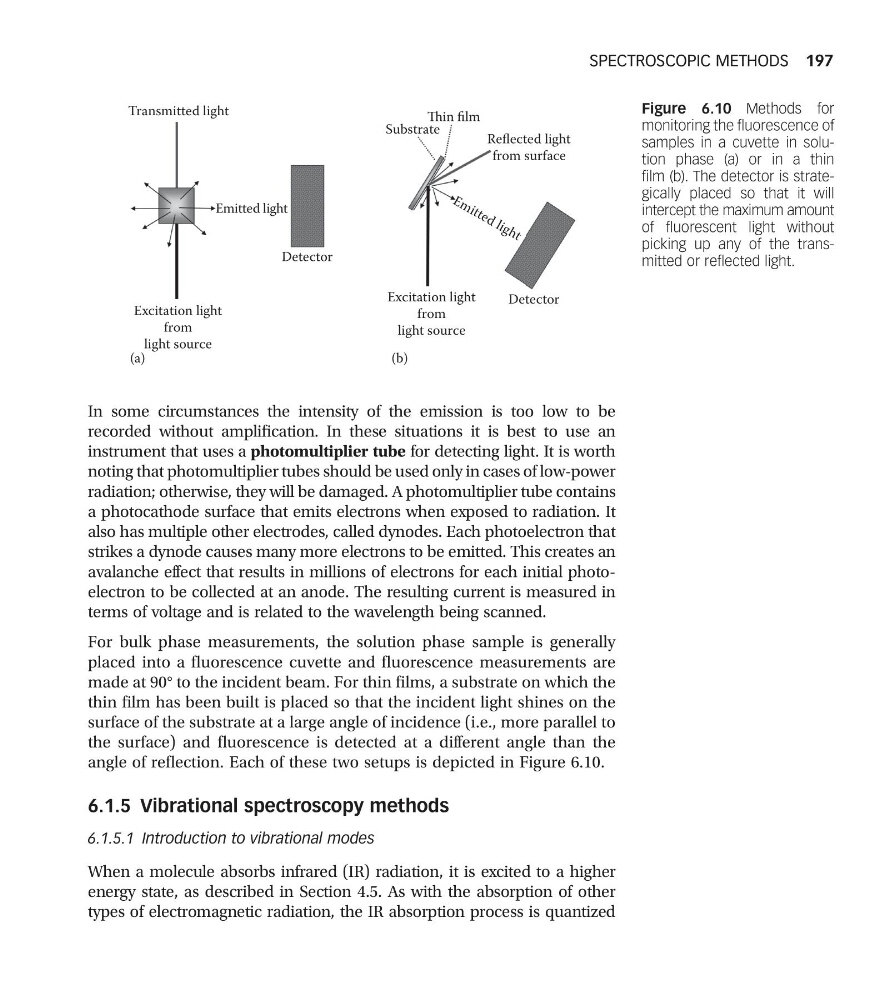
For bulk phase measurements, the solution phase sample is generally
placed into a fluorescence cuvette and fluorescence measurements are
made at 90° to the incident beam. For thin films, a substrate on which the
thin film has been built is placed so that the incident light shines on the
surface of the substrate at a large angle of incidence (i.e., more parallel to
the surface) and fluorescence is detected at a different angle than the
angle of reflection. Each of these two setups is depicted in Figure 6.10.
6.1.5 Vibrational spectroscopy methods
6.1.5.1 Introduction to vibrational modes
When a molecule absorbs infrared (IR) radiation, it is excited to a higher
energy state, as described in Section 4.5. As with the absorption of other
types of electromagnetic radiation, the IR absorption process is quantized
Transmitted light
Emitted light
E m i t t e d l i g h t
Detector
Detector
Substrate
Thin film
Reflected light
from surface
Excitation light
from
light source
(a)
(b)
Excitation light
from
light source
Figure 6.10 Methods for
monitoring the fluorescence of
samples in a cuvette in solution phase (a) or in a thin
film (b). The detector is strategically placed so that it will
intercept the maximum amount
of fluorescent light without
picking up any of the transmitted or reflected light.
SPECTROSCOPIC METHODS 197
recorded without amplification. In these situations it is best to use an
instrument that uses a photomultiplier tube for detecting light. It is worth
noting that photomultiplier tubes should be used only in cases of low-power
radiation; otherwise, they will be damaged. A photomultiplier tube contains
a photocathode surface that emits electrons when exposed to radiation. It
also has multiple other electrodes, called dynodes. Each photoelectron that
strikes a dynode causes many more electrons to be emitted. This creates an
avalanche effect that results in millions of electrons for each initial photoelectron to be collected at an anode. The resulting current is measured in
terms of voltage and is related to the wavelength being scanned.
For bulk phase measurements, the solution phase sample is generally
placed into a fluorescence cuvette and fluorescence measurements are
made at 90° to the incident beam. For thin films, a substrate on which the
thin film has been built is placed so that the incident light shines on the
surface of the substrate at a large angle of incidence (i.e., more parallel to
the surface) and fluorescence is detected at a different angle than the
angle of reflection. Each of these two setups is depicted in Figure 6.10.
6.1.5 Vibrational spectroscopy methods
6.1.5.1 Introduction to vibrational modes
When a molecule absorbs infrared (IR) radiation, it is excited to a higher
energy state, as described in Section 4.5. As with the absorption of other
types of electromagnetic radiation, the IR absorption process is quantized
Transmitted light
Emitted light
E m i t t e d l i g h t
Detector
Detector
Substrate
Thin film
Reflected light
from surface
Excitation light
from
light source
(a)
(b)
Excitation light
from
light source
Figure 6.10 Methods for
monitoring the fluorescence of
samples in a cuvette in solution phase (a) or in a thin
film (b). The detector is strategically placed so that it will
intercept the maximum amount
of fluorescent light without
picking up any of the transmitted or reflected light.
SPECTROSCOPIC METHODS 197