

By plotting absorption or transmission versus incident IR frequency, one
can map out the exact absorption frequencies for a sample containing the
molecule of interest. This infrared spectrum provides a fingerprint of the
molecular structure of the molecule. Several specialized applications of
infrared spectroscopy for characterizing molecules confined to surfaces
will be discussed in Chapter 8.
6.2 LIGHT SCATTERING METHODS
6.2.1 Scattering and absorption
In the opening discussion of the interactions between light and matter
(see Section 6.1.1), we focused on processes such as absorption, emission,
and fluorescence. However, another interaction called light scattering
occurs commonly when light encounters nanoscale matter. In order to
understand the scope and utility of Raman spectroscopy, a brief introduction to light scattering is provided.
When light passes through a solution or suspension, much of the light is
transmitted directly through the solution, but some of the light is scattered in different directions. To better understand this scattering process,
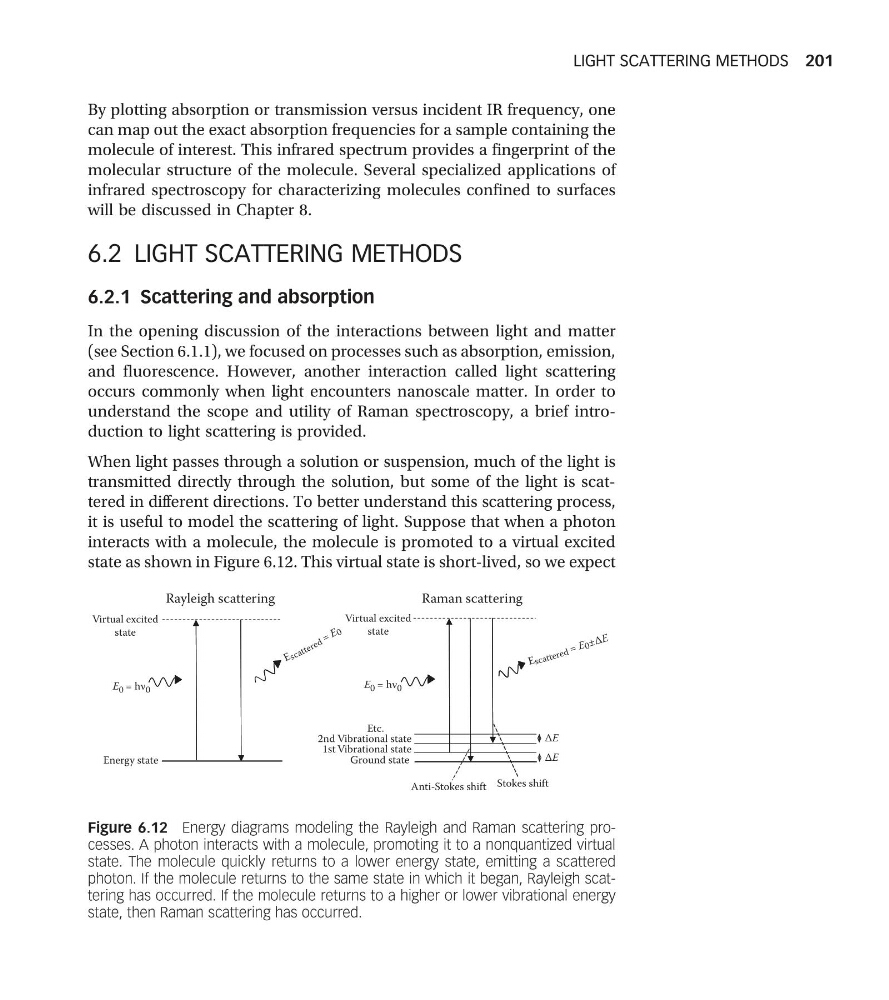
it is useful to model the scattering of light. Suppose that when a photon
interacts with a molecule, the molecule is promoted to a virtual excited
state as shown in Figure 6.12. This virtual state is short-lived, so we expect
Rayleigh scattering
Raman scattering
Virtual excited
state
Virtual excited
state
Esc at te re d = E0 ± Δ E
Es c a tt e r e d = E0
E 0 = hν 0
E 0 = hν 0
Etc.
ΔE
Energy state
ΔE
Ground state
1st Vibrational state
2nd Vibrational state
Anti-Stokes shift Stokes shift
Figure 6.12 Energy diagrams modeling the Rayleigh and Raman scattering processes. A photon interacts with a molecule, promoting it to a nonquantized virtual
state. The molecule quickly returns to a lower energy state, emitting a scattered
photon. If the molecule returns to the same state in which it began, Rayleigh scattering has occurred. If the molecule returns to a higher or lower vibrational energy
state, then Raman scattering has occurred.
LIGHT SCATTERING METHODS 201
can map out the exact absorption frequencies for a sample containing the
molecule of interest. This infrared spectrum provides a fingerprint of the
molecular structure of the molecule. Several specialized applications of
infrared spectroscopy for characterizing molecules confined to surfaces
will be discussed in Chapter 8.
6.2 LIGHT SCATTERING METHODS
6.2.1 Scattering and absorption
In the opening discussion of the interactions between light and matter
(see Section 6.1.1), we focused on processes such as absorption, emission,
and fluorescence. However, another interaction called light scattering
occurs commonly when light encounters nanoscale matter. In order to
understand the scope and utility of Raman spectroscopy, a brief introduction to light scattering is provided.
When light passes through a solution or suspension, much of the light is
transmitted directly through the solution, but some of the light is scattered in different directions. To better understand this scattering process,
it is useful to model the scattering of light. Suppose that when a photon
interacts with a molecule, the molecule is promoted to a virtual excited
state as shown in Figure 6.12. This virtual state is short-lived, so we expect
Rayleigh scattering
Raman scattering
Virtual excited
state
Virtual excited
state
Esc at te re d = E0 ± Δ E
Es c a tt e r e d = E0
E 0 = hν 0
E 0 = hν 0
Etc.
ΔE
Energy state
ΔE
Ground state
1st Vibrational state
2nd Vibrational state
Anti-Stokes shift Stokes shift
Figure 6.12 Energy diagrams modeling the Rayleigh and Raman scattering processes. A photon interacts with a molecule, promoting it to a nonquantized virtual
state. The molecule quickly returns to a lower energy state, emitting a scattered
photon. If the molecule returns to the same state in which it began, Rayleigh scattering has occurred. If the molecule returns to a higher or lower vibrational energy
state, then Raman scattering has occurred.
LIGHT SCATTERING METHODS 201