

the path length is simply the film thickness (d), and in this manner the
thickness of a nanofilm can be determined using UV–vis spectroscopy.
6.1.2.2 Setup of a UV–visible spectrophotometer
At a basic level, a UV–vis spectrophotometer consists of a light source, a
dispersive device for selecting wavelengths of light, a sample holder, and
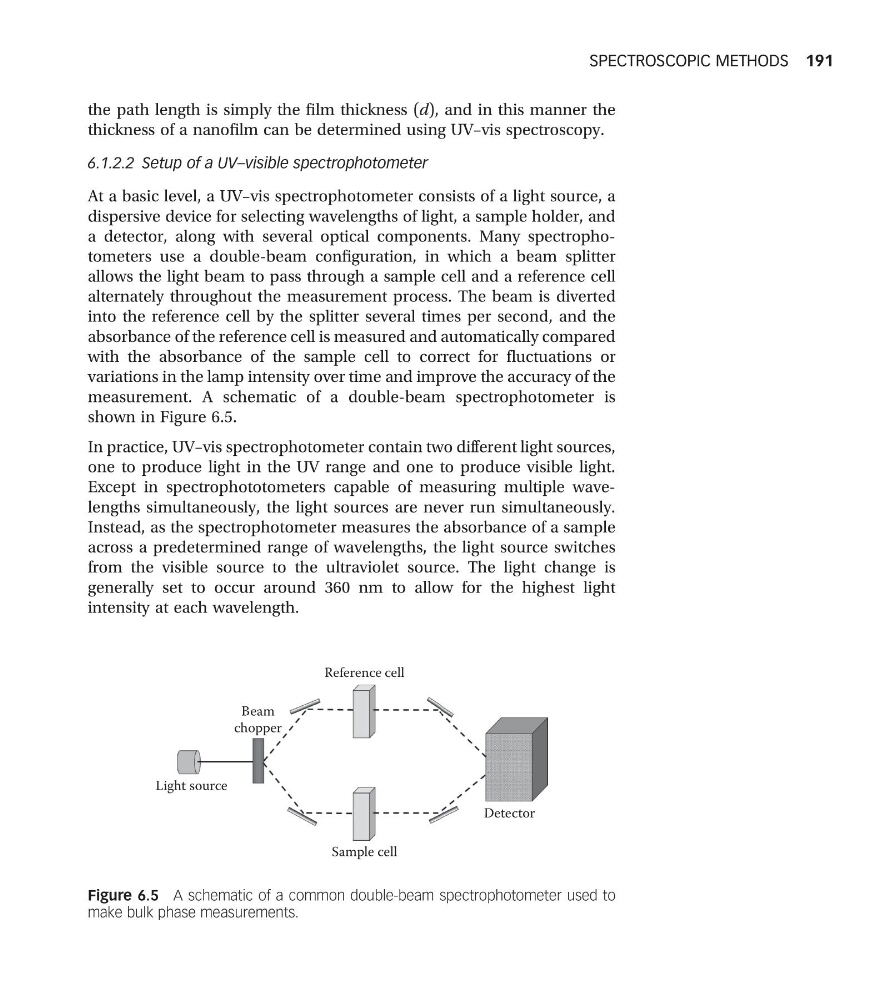
a detector, along with several optical components. Many spectrophotometers use a double-beam configuration, in which a beam splitter
allows the light beam to pass through a sample cell and a reference cell
alternately throughout the measurement process. The beam is diverted
into the reference cell by the splitter several times per second, and the
absorbance of the reference cell is measured and automatically compared
with the absorbance of the sample cell to correct for fluctuations or
variations in the lamp intensity over time and improve the accuracy of the
measurement. A schematic of a double-beam spectrophotometer is
shown in Figure 6.5.
In practice, UV–vis spectrophotometer contain two different light sources,
one to produce light in the UV range and one to produce visible light.
Except in spectrophototometers capable of measuring multiple wavelengths simultaneously, the light sources are never run simultaneously.
Instead, as the spectrophotometer measures the absorbance of a sample
across a predetermined range of wavelengths, the light source switches
from the visible source to the ultraviolet source. The light change is
generally set to occur around 360 nm to allow for the highest light
intensity at each wavelength.
Detector
Sample cell
Reference cell
Beam
chopper
Light source
Figure 6.5 A schematic of a common double-beam spectrophotometer used to
make bulk phase measurements.
SPECTROSCOPIC METHODS 191
thickness of a nanofilm can be determined using UV–vis spectroscopy.
6.1.2.2 Setup of a UV–visible spectrophotometer
At a basic level, a UV–vis spectrophotometer consists of a light source, a
dispersive device for selecting wavelengths of light, a sample holder, and
a detector, along with several optical components. Many spectrophotometers use a double-beam configuration, in which a beam splitter
allows the light beam to pass through a sample cell and a reference cell
alternately throughout the measurement process. The beam is diverted
into the reference cell by the splitter several times per second, and the
absorbance of the reference cell is measured and automatically compared
with the absorbance of the sample cell to correct for fluctuations or
variations in the lamp intensity over time and improve the accuracy of the
measurement. A schematic of a double-beam spectrophotometer is
shown in Figure 6.5.
In practice, UV–vis spectrophotometer contain two different light sources,
one to produce light in the UV range and one to produce visible light.
Except in spectrophototometers capable of measuring multiple wavelengths simultaneously, the light sources are never run simultaneously.
Instead, as the spectrophotometer measures the absorbance of a sample
across a predetermined range of wavelengths, the light source switches
from the visible source to the ultraviolet source. The light change is
generally set to occur around 360 nm to allow for the highest light
intensity at each wavelength.
Detector
Sample cell
Reference cell
Beam
chopper
Light source
Figure 6.5 A schematic of a common double-beam spectrophotometer used to
make bulk phase measurements.
SPECTROSCOPIC METHODS 191